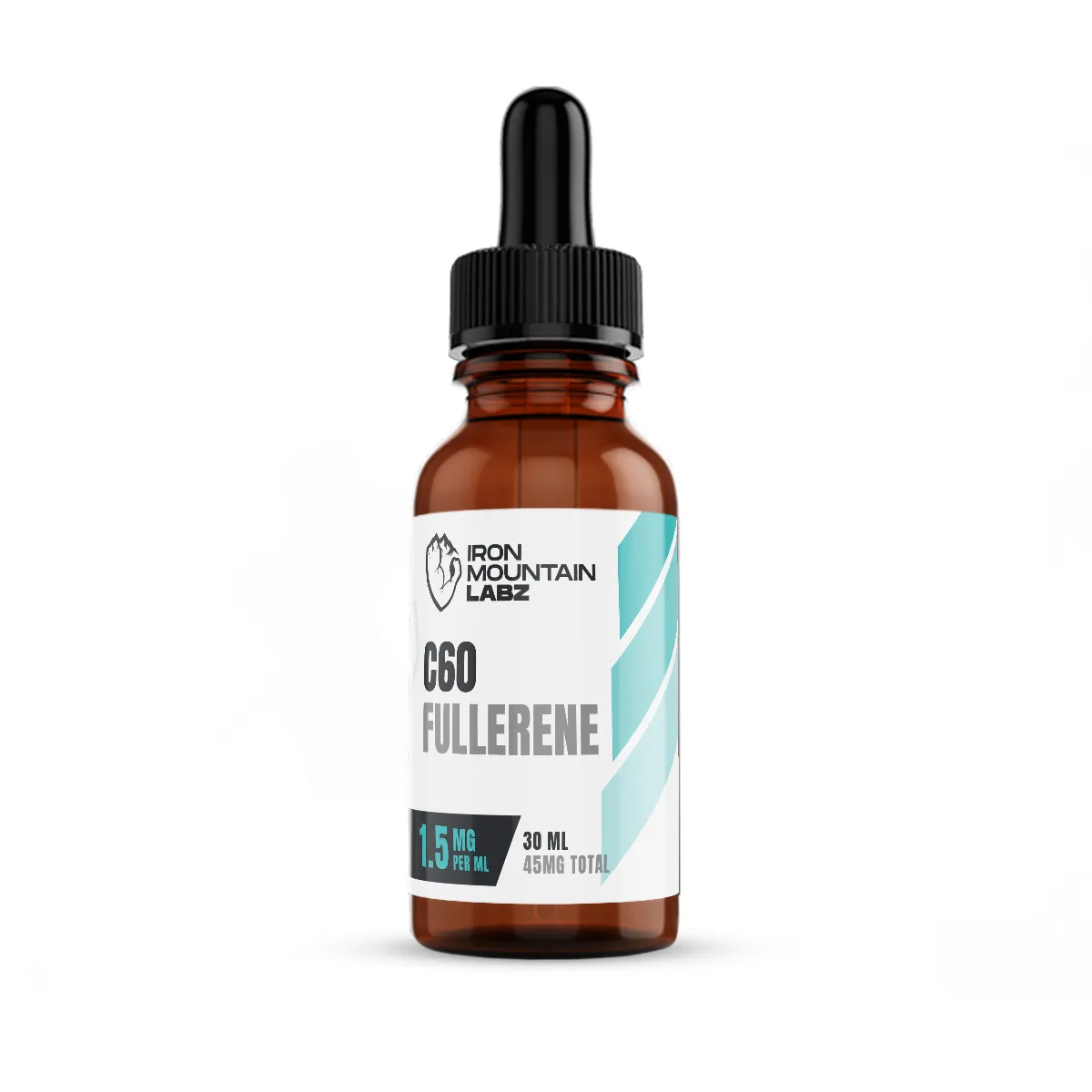


Description
C60 Fullerene Research Overview
Disclaimer: The compounds described on this page are intended for laboratory research use only and are not approved for human consumption.
Overview of C60 Fullerene
C60 Fullerene (CAS 99685-96-8; Buckminsterfullerene) is a carbon allotrope/nanomaterial – 60 carbon atoms covalently arranged in a truncated icosahedron (soccer-ball geometry) comprising 20 hexagonal and 12 pentagonal carbon faces, with an outer cage diameter of approximately 0.71 nm. Molecular formula: C60; MW: 720.66 g/mol; PubChem CID: 123591; IUPAC: (C60-Ih)[5,6]fullerene. It is classified under Other Research (Carbon Nanomaterial). C60 is not a SARM – it has no androgen receptor activity. It is definitely not a peptide – it is made entirely of carbon atoms arranged in a soccer-ball-shaped cage structure; it is not a molecule in the conventional pharmaceutical chemical sense – it is a carbon nanomaterial with no nitrogen, no amino acids, and no peptide bonds.
Discovered in 1985 by Kroto, Curl, and Smalley (1996 Nobel Prize in Chemistry), C60 fullerene is a third allotrope of carbon alongside graphite and diamond. Its unique electronic structure – 30 delocalized π-electron bonds distributed across the cage surface in three low-lying LUMOs – confers powerful electron-accepting capacity, enabling C60 to function as a “free radical sponge” by reacting with multiple superoxide and other radical species per molecule in research systems.
This product is not approved by the FDA for any therapeutic indication. Intended for laboratory and research purposes only; not a dietary supplement or consumer product. Restricted to qualified researchers and licensed laboratory institutions. IRB guidance is required for clinical research; IACUC compliance is required for preclinical animal research. Handle as a carbon nanomaterial with full nanomaterial precautions – N95 or P100 respirator and certified fume hood mandatory for ALL dry powder operations.
Chemical Properties
| Section | Details |
| CAS Number | 99685-96-8 |
| Chemical Class | Carbon Allotrope / Nanomaterial |
| Classification – NOT a SARM | No androgen receptor activity |
| Classification – NOT a Peptide | Made entirely of carbon atoms in a soccer-ball-shaped cage; not a conventional molecule – a carbon nanomaterial; no nitrogen, no amino acids, no peptide bonds |
| Regulatory Status | Research Compound – Not FDA-Approved |
| Molar Mass | 720.66 g/mol |
| Chemical Formula | C60 |
| IUPAC Name | (C60-Ih)[5,6]fullerene |
| Synonyms | C60 fullerene; Buckminsterfullerene; buckyball; [60]fullerene; carbon-60 |
| PubChem CID | 123591 |
| Physical Form | Black to dark brown powder or crystalline solid |
| Purity | ≥99.5% by HPLC-UV (326 nm); ¹³C-NMR: single peak at ~143 ppm per lot |
| C70 Impurity | ≤0.5% (HPLC-verified per lot) |
| Solubility | Toluene: ~1–3 mg/mL; xylene: ~4 mg/mL; CS₂: ~7.9 mg/mL; 1-methylnaphthalene: ~33 mg/mL; water: essentially insoluble (nC60 colloidal suspensions can be prepared) |
| Storage | Ambient or 2–8°C; sealed in a dry, dark container; stable for years under dry, dark ambient conditions |
| Shelf Life | ≥36 months sealed dark ambient |
| Classification | Research Use Only (RUO) – Nanomaterial |
C60 Fullerene’s Mechanism of Action in Research Models
Within carbon nanomaterial and free radical biology research, C60 fullerene exhibits a dual ROS profile that is critically dependent on its physicochemical state and preparation method. In its ground state (dark conditions, without photosensitization), C60 functions as a multi-radical quencher – its three low-lying LUMOs enable consecutive electron additions from radical species, theoretically quenching multiple radical species per molecule via its three low-lying LUMOs enabling up to 6 reversible one-electron reductions with some literature citing up to ~34 radical quenching events for water-soluble C60 derivatives (fullerenols), though this figure applies to hydroxylated forms rather than pristine C60, generating stable polyhydroxylated adducts rather than propagating radical chain reactions. The quinoid-type electronic structure of C60’s surface (alternating single and double bonds) provides a complementary radical-trapping mechanism analogous to hindered phenol antioxidants but with multi-valent capacity.
Conversely, under visible or UV irradiation, C60 undergoes efficient intersystem crossing to a long-lived triplet excited state (τT ~40 µs) that sensitizes molecular oxygen to generate singlet oxygen (¹O₂) and, via electron transfer, superoxide (O₂•⁻) – making photoexcited C60 a potent ROS generator exploited in photodynamic therapy research models.
Markovic and Trajkovic (2008) comprehensively reviewed the dual ROS-generating and ROS-quenching properties of C60 in Biomaterials, analyzing the molecular mechanisms of radical quenching vs. photosensitized ROS generation and characterizing how different solubilization procedures (colloidal nC60, polyhydroxylated derivatives, organic solvent solutions) fundamentally alter the biological ROS behavior of C60 by modifying its photophysical properties and surface chemistry (DOI). Kraevaya and Troshin (2026) reviewed current methods for the regioselective synthesis of isomerically pure water-soluble C60 derivatives – including fullerenols, amino-acid adducts, and cationic derivatives – and discussed their antioxidant, antiviral, antitumor, antibacterial, and myogenic biological activities in cellular and preclinical research models, emphasizing how molecular structure precision determines biological activity (DOI). Data remain limited, and findings are not consistent across all experimental model systems.
Risk & Handling
Risk Tier: MODERATE-HIGH – NANOMATERIAL PRECAUTIONS REQUIRED
C60 fullerene is an engineered carbon nanomaterial with incompletely characterized inhalation toxicology. Apply the precautionary principle throughout all handling:
- Respiratory protection MANDATORY: N95 or P100 respirator for ALL dry powder handling – no exceptions; fine carbonaceous nanoparticle inhalation risk; do not handle open-bench under any circumstances
- Engineering controls: ALL dry powder operations in a certified chemical fume hood or BSC with HEPA filtration – mandatory
- Skin and eye protection: Nitrile gloves, lab coat, and safety eyewear – change gloves after C60 powder contact to prevent secondary surface contamination
- nC60 colloidal suspensions: Characterized by DLS (hydrodynamic diameter) and ζ-potential before biological assays – aggregation state critically determines biological activity and safety profile
- Organic solvents: Toluene, xylene, CS₂ are toxic and flammable – all dissolution in a certified fume hood; eliminate ignition sources
- Dual ROS property: Protect all stock solutions and suspensions from light exposure – UV/visible irradiation converts C60 from radical quencher to singlet oxygen generator
- Waste disposal: Dispose as nanomaterial waste per institutional and EPA guidelines – do not dispose in standard waste streams
- No established human inhalation toxicity data for this nanomaterial – apply maximum precaution. Contact help@ironmountainlabz.com for the Safety Data Sheet before any handling.
Why Consider C60 Fullerene for Research?
- Purity: ≥99.5% by HPLC-UV (326 nm) per lot
- C70 content: ≤0.5% by HPLC per lot – key impurity controlled
- Identity: ¹³C-NMR single peak at ~143 ppm (icosahedral symmetry confirmed) per lot
- UV-Vis: characteristic absorption at 259 nm (allowed band) and 329 nm (forbidden band) confirmed per lot
- Certificate of Analysis with purity, C70 content, and NMR identity data available on request per lot
- For queries, complaints, or support, please contact help@ironmountainlabz.com
FAQs
Q1: What is C60 Fullerene chemically, and why is it definitively not a SARM or peptide?
C60 fullerene is a carbon allotrope nanomaterial – 60 carbon atoms arranged in a truncated icosahedron cage with no heteroatoms whatsoever. It contains no nitrogen, no oxygen beyond surface adducts, no amino acids, and no peptide bonds – definitively not a peptide in any sense. It has no androgen receptor binding activity – definitively not a SARM. It is not a conventional pharmaceutical molecule; it is a carbon nanomaterial with unique electronic properties arising from its cage geometry.
Q2: What is the dual ROS profile of C60, and why does it matter for research design?
Under dark conditions, C60 quenches multiple radical species per cage (up to ~34 superoxide radicals theoretically) via its multi-LUMO electron-accepting capacity. Under UV/visible irradiation, photoexcited C60 generates singlet oxygen and superoxide via triplet-state photosensitization. This duality means experimental conditions – particularly light exposure – fundamentally determine whether C60 functions as a radical scavenger or ROS generator in any given assay. All C60 research must include light-control conditions and specify the solubilization method used.
Q3: What research applications has C60 been investigated in?
In preclinical laboratory settings: free radical scavenging assays (ESR spectroscopy, DPPH/ABTS), antioxidant cellular protection models, photodynamic therapy cell-kill research, neuroprotection against oxidative stress in cell culture, antibacterial and antiviral biological activity studies using functionalized C60 derivatives, and nanotoxicology characterization research. All in laboratory and preclinical contexts only.
Q4: How is C60 prepared for aqueous biological research assays?
Three approaches: (1) Colloidal nC60: extended stirring of C60 in water (days to weeks) generates aggregated colloidal suspensions – characterize by DLS (typically 100–200 nm) and ζ-potential before use; (2) solvent exchange: dissolve in toluene/THF, evaporate, resuspend in water with sonication; (3) surface functionalization (fullerenols, amino acid adducts) for true water solubility. Each method yields different aggregation states and biological activity profiles – the preparation method must be specified in publications.
Q5: What mandatory safety precautions are required for C60 research?
N95 or P100 respirator MANDATORY for all dry powder operations – no exceptions. Certified fume hood or HEPA-filtered BSC required. Nitrile gloves, lab coat, safety eyewear. Protect all solutions from light. Dispose as nanomaterial waste per EPA/institutional guidelines. Characterize nC60 suspensions by DLS before biological assays. Contact help@ironmountainlabz.com for the Safety Data Sheet BEFORE initiating any handling.
References
- Markovic Z, Trajkovic V. Biomedical potential of the reactive oxygen species generation and quenching by fullerenes (C60). Biomaterials. 2008;29(26):3561–3573. PMID: 18534675.
https://pubmed.ncbi.nlm.nih.gov/18534675/ - Kraevaya OA, Troshin PA. Transforming the buckyball: regioselective synthesis of water-soluble [60]fullerene derivatives for biomedical applications. Molecules. 2026;31(12):2005. PMID: 42357403.
https://doi.org/10.3390/molecules31122005 - Gharbi N, Pressac M, Hadchouel M, Szwarc H, Wilson SR, Moussa F. Fullerene is an in vivo powerful antioxidant with no acute or subacute toxicity. Nano Letters. 2005;5(12):2578–2585. PMID: 16351219 https://pubmed.ncbi.nlm.nih.gov/16351219/
IML Affiliate Disclosure
Some links on IML may connect readers with third-party suppliers through affiliate arrangements. IML may receive compensation from qualifying transactions at no additional cost to the reader, but the third-party supplier remains responsible for the actual sale, fulfillment, and product documentation.