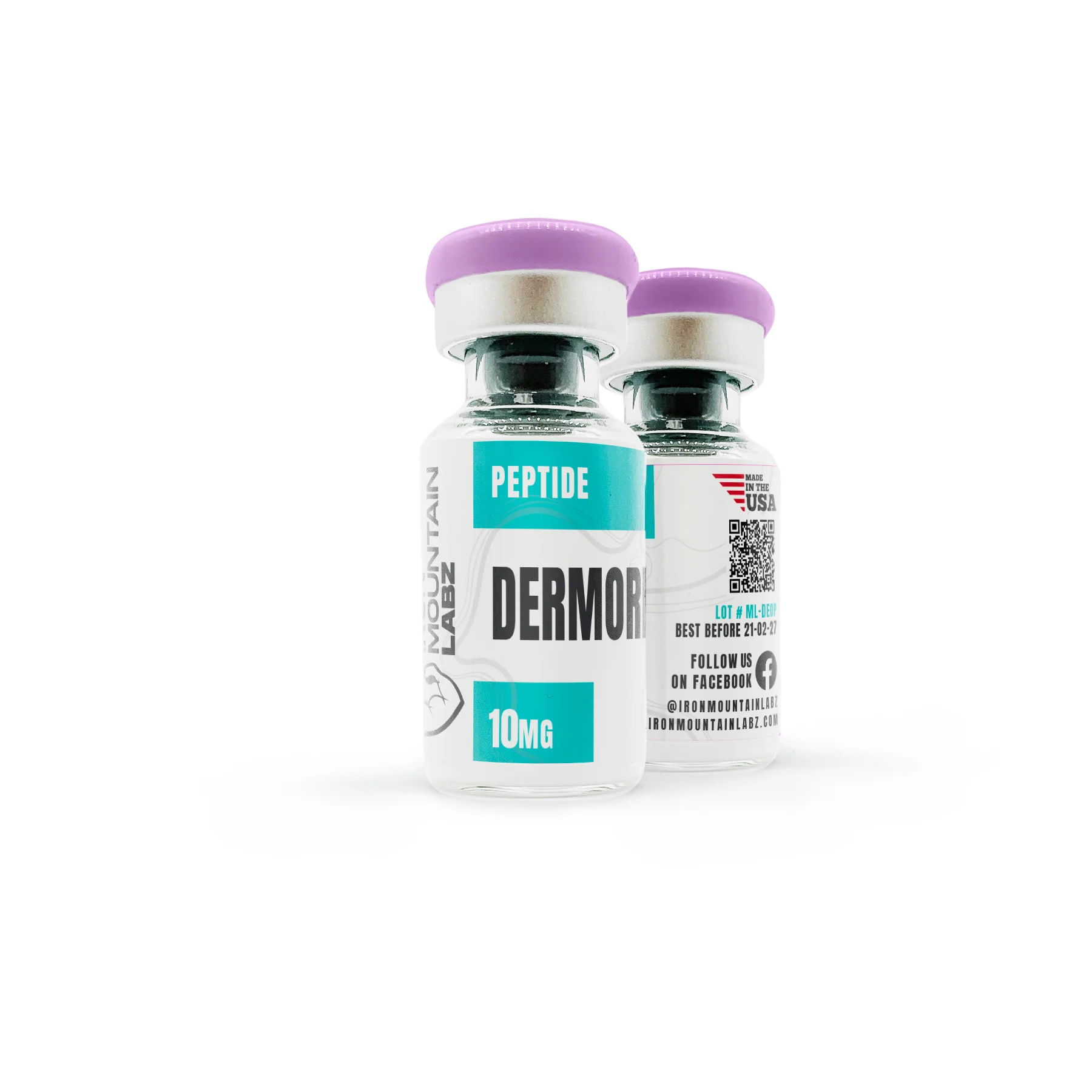
Description
Dermorphin
Disclaimer: The compounds described on this page are intended for laboratory research use only and are not approved for human consumption.
Overview of Dermorphin
Dermorphin is a research peptide that is derived from the skin of a frog species in South America. It is a natural opioid. Dermorphin has a potentially strong selectivity for mu opioid receptors in the brain of clinical models.
| Section | Details |
| CAS Number | 77614-16-5 (r) |
| Molar Mass | 802.9 g/mol |
| Chemical Formula | C40H50N8O10 |
| IUPAC Name | (2S)-N-[(2S)-1-amino-3-hydroxy-1-oxopropan-2-yl]-1-[(2S)-2-[[2-[[(2S)-2-[[(2R)-2-[[(2S)-2-amino-3-(4-hydroxyphenyl)propanoyl]amino]propanoyl]amino]-3-phenylpropanoyl]amino]acetyl]amino]-3-(4-hydroxyphenyl)propanoyl]pyrrolidine-2-carboxamide |
| Synonyms | H-Tyr-D-ala-phe-gly-tyr-pro-ser-NH2 |
| Ingredients / Composition | Lyophilized powder (off-white) in a sterile vial or ampoule. |
| Shelf Life | After reconstitution, Dermorphin remains stable for up to 30 days when refrigerated properly. |
| Storage Instructions | Once reconstituted, store in the refrigerator (2–8°C or 36–46°F). |
| Disclaimer | This product is intended for research use only and is not approved for human or veterinary consumption. |
Why Consider Dermorphin Peptide for Research?
- Potential for potent opioid interaction: Dermorphin studies show a potentially higher affinity for mu-opioid receptors compared to morphine.
- Selectivity in receptor targeting: It has a unique specificity for mu opioid receptors. Research shows it may reduce interaction with other opioid receptor subtypes.
- Future potential applications: Dermorphin in clinical settings explores pain modulation and opioid signalling pathways.
- It is subject to stringent testing and is verified for 99% purity with third-party lab testing.
Researchers may consider Dermorphin Peptide based on its intended research application, available specifications, and supporting documentation.
Frequently Asked Questions (FAQs)
How does Dermorphin work?
Research shows that Dermorphin works by potentially binding to μ-opioid receptors. This interaction takes place in the nervous system of clinical models. It potentially activates signalling pathways. This is linked to pain perception, response to stress, and mood influences.
What are the potential benefits of research on Dermorphin?
Researchers investigate Dermorphin for potential benefits:
- It helps researchers understand the function of certain opioid receptors.
- It has potential as a future treatment to help manage pain in clinical settings.
- It is of interest in the field of neuro- and behavioral science.
- It may help our understanding of the influence of peptides on the nervous system of clinical models.
Is Dermophin addictive in clinical research?
Researchers have studied Dermorphin for its selectivity and potency. This is due to its strong potential opioid activity. Research suggests it may potentially cause tolerance, withdrawal symptoms, and addictive qualities.
Is Dermorphin legal?
Dermorphin peptide is legal for research purposes only. It is not recommended or intended for human consumption.
What is the half-life of Dermorphin?
The half-life of Dermorphin depends on the subject of administration in the research study. Studies on horses have found some interesting results. Intravenous administration exhibits a distribution half-life of approximately 5.4 minutes. Additionally, an elimination half-life of 46 minutes.
In rodent models, data seem to indicate a plasma half-life of between 8-12 minutes.
IML Affiliate Disclosure
Some links on IML may connect readers with third-party suppliers through affiliate arrangements. IML may receive compensation from qualifying transactions at no additional cost to the reader, but the third-party supplier remains responsible for the actual sale, fulfillment, and product documentation.