

Description
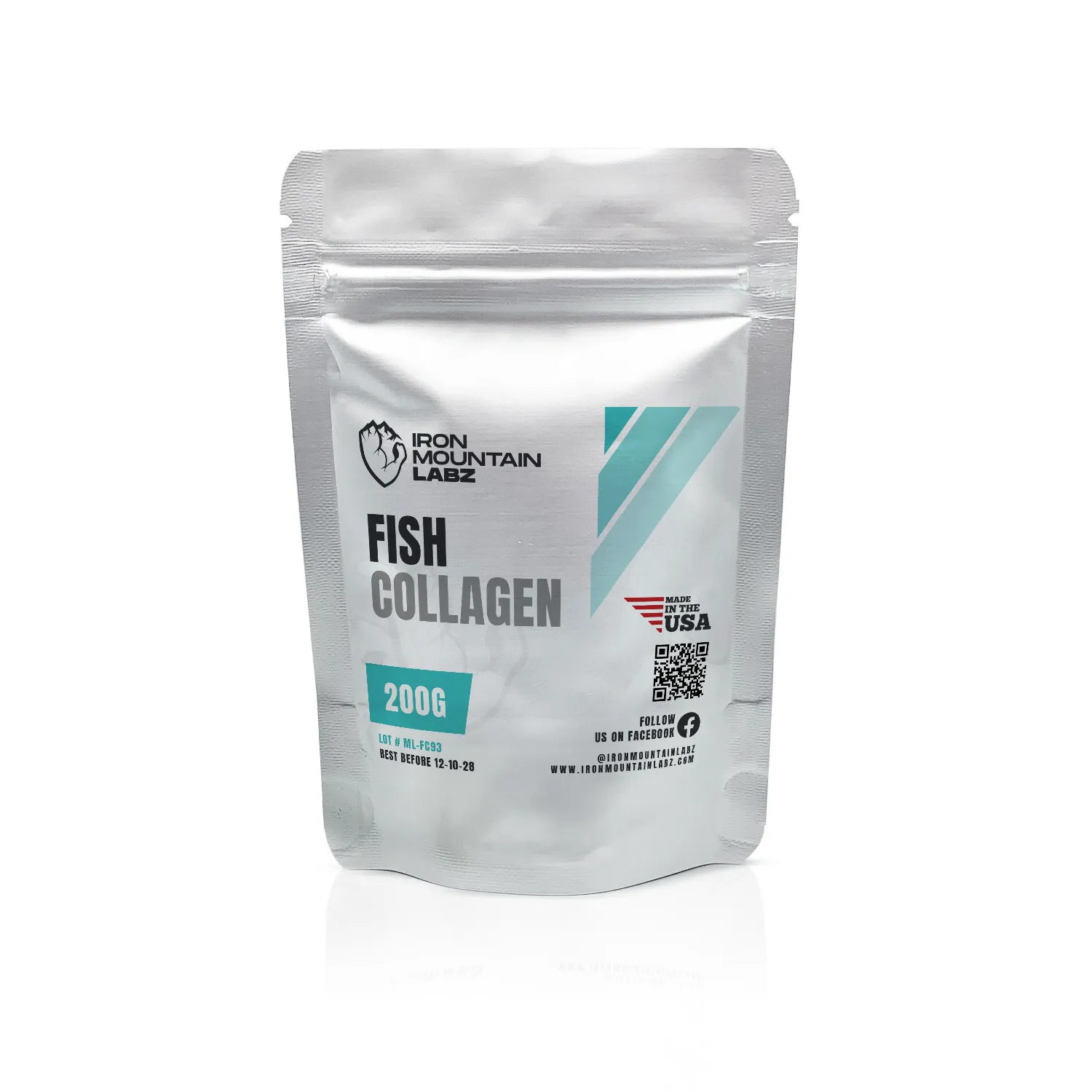
Fish Collagen Powder Research Overview
Disclaimer: The compounds described on this page are intended for laboratory research use only and are not approved for human consumption.
Overview of Fish Collagen Powder
Fish Collagen Powder (CAS 9064-67-9) is a hydrolysed protein – specifically, enzymatically processed type I collagen polypeptides derived from marine fish species including tilapia, cod, and salmon. Understanding what this compound is – and is not – matters for researchers sourcing it correctly: it is a hydrolysed dietary protein powder belonging to the same chemical class as food-grade collagen supplements. It is not a SARM – it has no androgen receptor binding activity whatsoever. It is not a research peptide in the pharmacological sense – it contains naturally occurring collagen peptide fragments (predominantly Gly-X-Y tripeptide sequences) from fish protein. Still, it is classified and sold as a food/supplement protein powder, not as a bioactive research peptide drug.
The hydrolysate yields low-molecular-weight collagen peptide fractions in the 1,000–5,000 Da range, characterized by approximately 33 mol% glycine, 12% proline, and 10% hydroxyproline – the defining amino acid composition of the repeating Gly-X-Y triplet that assembles into the right-handed triple helix of native type I collagen. Fish-derived type I collagen is distinguishable from mammalian sources by its lower thermal denaturation temperature (Td ~25–28°C versus ~37°C for bovine or porcine type I), an adaptation arising from reduced hydroxyproline content in certain fish species.
This product is not approved by the FDA for any therapeutic indication, including ingestion, injection, or any form of administration for human use. It is intended for laboratory and research purposes only. It is not a dietary supplement or consumer product in this formulation. Restricted to qualified researchers and licensed laboratory institutions. IRB guidance is required for any clinical research protocol; IACUC compliance is required for preclinical animal research. Handle as a fine protein powder with appropriate respiratory precautions – an N95 mask is recommended during weighing. Store at 2–8°C in a sealed, moisture-proof container away from UV light.
Chemical Properties
| Section | Details |
| CAS Number | 9064-67-9 |
| Chemical Class | Hydrolysed Protein (Type I Collagen Hydrolysate) |
| Classification – NOT a SARM | No androgen receptor activity; hydrolysed dietary protein powder |
| Classification – NOT a Peptide Drug | Contains collagen peptide fragments from fish protein; sold as food/supplement protein, not as a research peptide |
| Regulatory Status | Dietary Supplement (DSHEA) in consumer context; sold here as research-grade material only |
| Molar Mass | 1,000–5,000 Da (polydisperse hydrolysate; major fractions by SEC-HPLC) |
| Chemical Formula | Polydisperse polypeptide mixture; dominant structural unit: (Gly-Pro-Hyp)n repeating |
| IUPAC Name | Not applicable – polydisperse hydrolysed protein preparation |
| Synonyms | Hydrolysed fish collagen; marine collagen hydrolysate; fish collagen peptides; ichthyocollagen; marine type I collagen powder |
| PubChem CID | 14815783 (collagen type I alpha chain reference) |
| Physical Form | White to off-white free-flowing powder |
| Purity | ≥99% protein content by Kjeldahl nitrogen determination |
| Hydroxyproline Content | ≥9% (colorimetric assay; confirms authentic type I collagen sourcing) |
| Solubility | Freely soluble in water; forms gel at ≥5% w/v at temperatures below Td |
| Storage | 2–8°C; sealed, dry container; protect from moisture, heat, and UV exposure; N95 recommended during powder handling |
| Shelf Life | 24 months from manufacture date under recommended conditions |
| Classification | Research Use Only (RUO) |
Fish Collagen Powder’s Mechanism of Action in Research Models
Within extracellular matrix (ECM) biology research, hydrolysed fish collagen and its constituent peptides – particularly the Pro-Hyp (proline-hydroxyproline) dipeptide and Gly-Pro-Hyp tripeptide sequences released during enzymatic hydrolysis – have been investigated for their interactions with fibroblast integrin heterodimers, specifically α1β1 and α2β1, at the I-domain collagen-binding interface. Mechanistically, in preclinical fibroblast cell culture systems, these collagen-derived sequence fragments have been observed to engage the integrin I-domain in a manner that induces a shift from the low-affinity to the high-affinity receptor conformation, initiating downstream focal adhesion kinase (FAK) phosphorylation at Tyr-397, recruitment of Src-family kinases, and activation of RhoA/Rac1 GTPase signaling cascades – regulatory events associated with cytoskeletal reorganization and extracellular matrix remodeling gene expression in laboratory settings.
Chen et al. (2022) investigated low-molecular-weight sturgeon skin collagen hydrolysate (SSCH-L) in UVB-irradiated mouse fibroblast L929 cells and a zebrafish photodamage model (DOI). In preclinical in vitro systems, SSCH-L was observed to reduce intracellular ROS levels, suppress phosphorylation of JNK and expression of c-Jun, increase collagen type I α1 content, and inhibit matrix metalloproteinase expression – findings consistent with modulation of the AP-1/MMP axis in ECM research models. Fish collagen’s lower Td (~25–28°C) also makes it a tractable substrate for circular dichroism spectroscopy studies of triple-helix stability kinetics at physiologically accessible temperatures. Data remain limited, and findings are not consistent across all experimental model systems.
Risk & Handling
Risk Tier: LOW
Fish Collagen Powder is a hydrolysed food protein. No acute human toxicity data are established for this research-grade formulation at laboratory handling concentrations. Standard protein powder handling precautions apply:
- Respiratory: N95 or equivalent dust mask recommended during powder weighing – fine particulate inhalation risk
- Allergen notice: Marine fish origin – researchers with fish or shellfish protein sensitization should assess occupational allergen exposure risk before handling
- PPE: Nitrile gloves, lab coat, and safety eyewear for all handling operations
- Aqueous solutions: Prepare fresh; store at 2–8°C; use within 7 days; do not repeatedly freeze-thaw
- Spill: Collect dry powder with a damp paper towel; dispose per institutional biological waste guidelines
- No human safety data has been established for this research-grade formulation. Contact help@ironmountainlabz.com for the Safety Data Sheet.
Why Consider Fish Collagen Powder for Research?
- Purity: ≥99% protein content by Kjeldahl nitrogen determination per lot
- Hydroxyproline content: ≥9% confirmed by colorimetric assay per lot – indicative of authentic type I collagen sourcing
- Microbial testing: total viable count ≤1,000 CFU/g; coliforms absent per 10 g
- Heavy metals: Pb ≤0.5 ppm; As ≤0.5 ppm; Hg ≤0.1 ppm (ICP-MS)
- Moisture: ≤8% (loss on drying, 105°C, 2 hours)
- Certificate of Analysis available on request per lot
- For queries, complaints, or support, please contact help@ironmountainlabz.com
FAQs
Q1: What exactly is Fish Collagen Powder chemically, and why is it not classified as a SARM or research peptide?
Fish Collagen Powder is a hydrolysed protein – a polydisperse mixture of low-molecular-weight collagen peptide fragments produced by enzymatic hydrolysis of marine fish type I collagen (predominantly from skin, scale, or cartilage). It belongs to the same chemical class as food-grade protein powders. It is not a SARM because it has no androgen receptor binding activity. It is not a research peptide drug in the pharmacological sense – while it contains collagen-derived short peptide sequences (Gly-X-Y), it is classified as a food/supplement protein powder. No pharmacological hormone or SARM-class activity has been demonstrated in preclinical research models.
Q2: What is the regulatory status of Fish Collagen Powder? In consumer markets, marine collagen hydrolysate is a DSHEA-regulated dietary supplement ingredient. The linked vendor supplies this product strictly as a research-grade hydrolysed protein for laboratory investigation of ECM biology, fibroblast signaling, and collagen biophysics. It is not approved by the FDA as a drug. It is not a dietary supplement or consumer product in this research-grade formulation. Restricted to qualified researchers and licensed laboratory institutions.
Q3: What research applications has fish collagen hydrolysate been investigated in?
In preclinical and in vitro laboratory settings, fish collagen hydrolysate and its constituent peptides have been studied in ECM biology (integrin α1β1/α2β1 signaling, FAK phosphorylation), fibroblast matrix deposition and wound-healing models, UVB photodamage models in cell culture (MMP expression, AP-1/JNK pathway), biophysical studies of collagen triple-helix stability by circular dichroism, and chondrocyte matrix production assay systems. All applications strictly in laboratory and preclinical contexts.
Q4: What storage and safety precautions are required for laboratory use?
Store at 2–8°C in a sealed, dry container away from moisture and UV light (shelf life: 24 months). Prepare aqueous solutions fresh and use within 7 days at 2–8°C. Avoid repeated freeze-thaw cycles. N95 respiratory protection and nitrile gloves are recommended during powder handling. No human safety data has been established for this research-grade formulation.
Q5: How does fish collagen differ from mammalian collagen as a research substrate?
Fish type I collagen has a thermal denaturation temperature of approximately 25–28°C compared to ~37°C for bovine or porcine type I collagen. This lower Td enables helix-coil transition studies at physiologically accessible temperatures without specialized heating equipment and allows comparative studies of stereoelectronic stabilization by (4R)-hydroxyproline at the Xaa/Yaa positions of the Gly-X-Y repeating unit.
References
-
- Shoulders MD, Raines RT. Collagen structure and stability. Annu Rev Biochem. 2009;78:929–958. PMID: 19344236. https://pubmed.ncbi.nlm.nih.gov/19344236/
- Won, J., Kang, J., Noh, K., Chung, H. C., & Kang, W. (2023). Pharmacokinetics of collagen dipeptides (Gly-Pro and Pro-Hyp) and tripeptides (Gly-Pro-Hyp) in rats. Journal of Food Science, 89(1), 701–709. https://pubmed.ncbi.nlm.nih.gov/38051020/
- Zague V, de Freitas V, da Costa Rosa M, de Castro GÁ, Jaeger RG, Machado-Santelli GM. Collagen hydrolysate intake increases skin collagen expression and suppresses matrix metalloproteinase 2 activity. Journal of Medicinal Food. 2011;14(6):618–624. PMID: 21281261https://pubmed.ncbi.nlm.nih.gov/21281261/
IML Affiliate Disclosure
Some links on IML may connect readers with third-party suppliers through affiliate arrangements. IML may receive compensation from qualifying transactions at no additional cost to the reader, but the third-party supplier remains responsible for the actual sale, fulfillment, and product documentation.