

Description
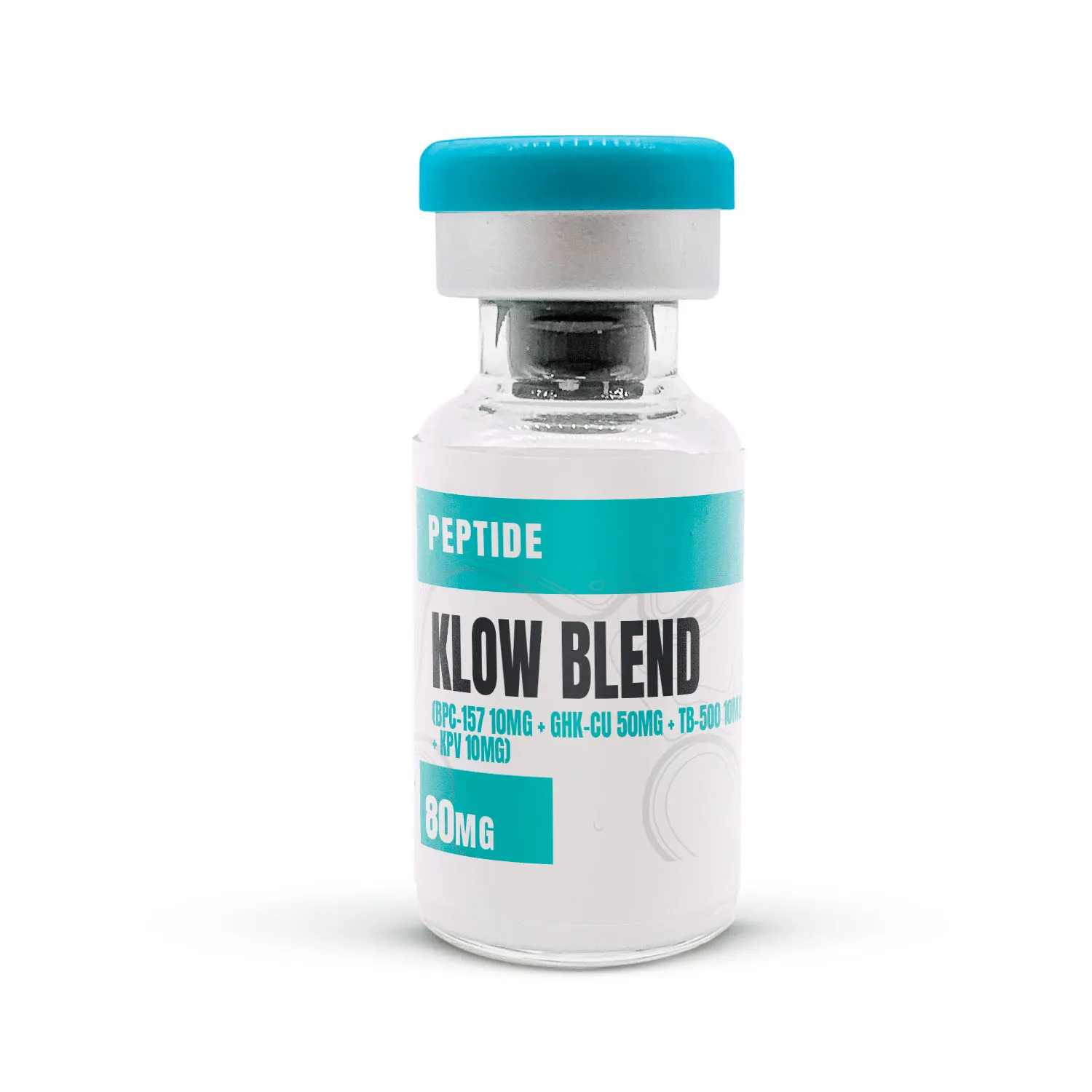
KLOW Blend (BPC-157 10mg + GHK-Cu 50mg + TB-500 10mg + KPV 10mg) Research Overview
Disclaimer: The compounds described on this page are intended for laboratory research use only and are not approved for human consumption.
Overview of KLOW Blend
Four peptides co-blended at 10mg + 50mg + 10mg + 10mg (80mg total per vial, catalog code KLOW80). This exact four-way ratio has not been independently studied. Research Use Only; not FDA-approved; not for human or veterinary use. Requires IRB approval for human-subject research and IACUC approval for animal studies.
Regulatory Note (July 2026): BPC-157 was removed from FDA 503A Category 2 in April 2026, and BPC-157, TB-500, and KPV are all scheduled for FDA Pharmacy Compounding Advisory Committee (PCAC) review on July 23, 2026. None of these peptides are currently authorized for pharmacy compounding; that status remains pending the PCAC outcome.
BPC-157
A synthetic pentadecapeptide (15 amino acids) derived from a gastric-juice fragment, studied for tissue-repair and cytoprotective activity. Not a SARM.
BPC-157 Chemical Properties
| Property | Details |
| CAS Number | 137525-51-0 |
| Compound Type | Synthetic pentadecapeptide (gastric-juice-derived fragment) |
| Classification NOT a SARM | No androgen receptor activity |
| Molecular Weight | ~1,419.53 g/mol |
| Chemical Formula | C62H98N16O22 |
| Synonyms | PL 14736, Bepecin |
| PubChem Reference | CID 9941957 |
| Physical Form | Lyophilized powder |
| Purity | Verify per Certificate of Analysis |
| Storage | Ultra-low freezer (-20°C or lower); protect from light/moisture |
| Shelf Life | Verify per Certificate of Analysis |
| Regulatory Status | Research Use Only (RUO); not FDA-approved |
GHK-Cu
A copper(II) complex of the tripeptide Gly-His-Lys, studied for copper-dependent connective-tissue and matrix-remodeling activity. Not a SARM; not a GH-releasing peptide.
GHK-Cu Chemical Properties
| Property | Details |
| CAS Number | 89030-95-5 |
| Compound Type | Copper(II)-chelated tripeptide complex |
| Classification NOT a SARM | No androgen receptor activity |
| Classification NOT a GH-releasing peptide | Depends on chelated copper, not receptor signaling |
| Molecular Weight | ~400.9 g/mol |
| Chemical Formula | C14H21CuN6O4 |
| Synonyms | Copper Tripeptide-1, Copper Peptide |
| PubChem Reference | CID 71587328 |
| Physical Form | Lyophilized powder |
| Purity | Verify per Certificate of Analysis |
| Storage | Cool, dry, dark place, or ultra-low freezer for extended storage |
| Shelf Life | Verify per Certificate of Analysis |
| Regulatory Status | Research Use Only (RUO); not FDA-approved |
TB-500
The synthetic, full-length form of Thymosin Beta-4 (43 amino acids), studied for actin-binding and cytoskeletal activity. Note: “TB-500” sometimes refers to a shorter 7-amino-acid fragment (CAS 885340-08-9); this page describes the full-length sequence commonly sold under the TB-500 name. Not a SARM.
TB-500 Chemical Properties
| Property | Details |
| CAS Number | 77591-33-4 |
| Compound Type | Synthetic 43-amino-acid actin-binding peptide (Thymosin Beta-4) |
| Classification NOT a SARM | No androgen receptor activity |
| Molecular Weight | ~4,963.44 g/mol |
| Chemical Formula | C212H350N56O78S |
| Synonyms | Thymosin Beta-4, Timbetasin |
| PubChem Reference | CID 16132341 |
| Physical Form | Lyophilized powder |
| Purity | Verify per Certificate of Analysis |
| Storage | Ultra-low freezer (-20°C or lower); protect from light/moisture |
| Shelf Life | Verify per Certificate of Analysis |
| Regulatory Status | Research Use Only (RUO); not FDA-approved |
| WADA Status | Prohibited S2.3 (Growth Factors: Thymosin-β4 and its derivatives, e.g. TB-500) |
KPV
A synthetic tripeptide (Lys-Pro-Val) corresponding to the C-terminal fragment of alpha-MSH, studied for anti-inflammatory activity via NF-κB pathway suppression. Not a SARM; does not bind melanocortin receptors and has no pigmentation-related activity.
KPV Chemical Properties
| Property | Details |
| CAS Number | 67727-97-3 |
| Compound Type | Synthetic tripeptide, alpha-MSH C-terminal fragment (11-13) |
| Classification NOT a SARM | No androgen receptor activity |
| Classification NOT a melanocortin agonist | Lacks alpha-MSH’s receptor-binding and pigmentation activity |
| Molecular Weight | ~342.43 g/mol |
| Chemical Formula | C16H30N4O4 |
| Synonyms | Lys-Pro-Val, alpha-MSH (11-13), ACTH (11-13) |
| PubChem Reference | CID 125672 |
| Physical Form | Lyophilized powder |
| Purity | Verify per Certificate of Analysis |
| Storage | Ultra-low freezer (-20°C or lower); protect from light/moisture |
| Shelf Life | Verify per Certificate of Analysis |
| Regulatory Status | Research Use Only (RUO); not FDA-approved |
How KLOW Blend Works in Research Models
BPC-157 is studied for cytoprotective, pro-angiogenic activity linked to the nitric oxide pathway. GHK-Cu is studied for stimulating collagen, elastin, and glycosaminoglycan synthesis via copper-dependent matrix remodeling. TB-500 is studied for its interaction with G-actin, linked to cell migration and tissue repair. KPV is studied as an inhibitor of NF-κB signaling, linked to reduced inflammatory cytokine activity. These four complementary tissue-repair and anti-inflammatory pathways have not been studied together in this specific blend.
Risk & Handling
- Handle with gloves, eye protection, and a fume hood or biosafety cabinet.
- Keep frozen and away from light/moisture until needed.
- Only trained lab personnel should reconstitute or dose this product.
Why Consider KLOW Blend for Research?
- Verified purity Tested per Certificate of Analysis (CoA)
- Identity verified LC-MS/HPLC analysis per lot
- Complete documentation Full CoA available on request
- Expert assistance Technical questions and compliance guidance
- Contact: help@ironmountainlabz.com
Frequently Asked Questions
Is this legal to buy in the US?
Yes, for research purposes it’s sold as a research chemical under US law, not as a supplement or drug. It’s for use by qualified researchers at licensed institutions, not for personal or human use.
How many peptides are actually in one vial?
Four: BPC-157 (10mg), GHK-Cu (50mg), TB-500 (10mg), and KPV (10mg), adding up to 80mg total. Don’t expect it to act like just one of these on its own.
Is there research backing this exact four-peptide combination?
Not as one formula, no. Each peptide has its own research on its own, some in animal studies, some in cell studies but this specific four-way blend and ratio hasn’t been tested together. Check this product’s own Certificate of Analysis for purity.
What do researchers in the US actually study these peptides for?
Different angles for each one tissue protection, collagen and connective-tissue support, cell migration for repair, and calming inflammation. This is about the science on each ingredient, not a promise about this specific product.
Do I need any kind of approval to work with this in a US lab?
Yes. Any research on people needs IRB sign-off, and animal studies need IACUC approval standard requirements at US research institutions. It’s not sold for personal use.
How should this be shipped, stored, and handled once it arrives?
Keep it in an ultra-low freezer (-20°C or colder), away from light and moisture, the same way it should arrive from a US supplier. Use gloves, a respirator, and eye protection, plus a fume hood or biosafety cabinet, when handling it. Ask help@ironmountainlabz.com for the SDS before first use.
References
- Sikiric P, Seiwerth S, Rucman R, et al. Stable gastric pentadecapeptide BPC 157-NO-system relation. Curr Pharm Des. 2014;20(7):1126-1135. PMID: 23755725. https://pubmed.ncbi.nlm.nih.gov/23755725/
- Pickart L, Margolina A. Regenerative and Protective Actions of the GHK-Cu Peptide in the Light of the New Gene Data. Int J Mol Sci. 2018;19(7):1987. PMID: 29986520. https://pubmed.ncbi.nlm.nih.gov/29986520/
- Goldstein AL, Hannappel E, Sosne G, Kleinman HK. Thymosin β4: a multi-functional regenerative peptide. Basic properties and clinical applications. Expert Opin Biol Ther. 2012;12(1):37-51. PMID: 22074294. https://pubmed.ncbi.nlm.nih.gov/22074294/
- Dalmasso G, Charrier-Hisamuddin L, Nguyen HT, Yan Y, Sitaraman S, Merlin D. PepT1-mediated tripeptide KPV uptake reduces intestinal inflammation. Gastroenterology. 2008;134(1):166-178. PMID: 18061177. https://pubmed.ncbi.nlm.nih.gov/18061177/
IML Affiliate Disclosure
Some links on IML may connect readers with third-party suppliers through affiliate arrangements. IML may receive compensation from qualifying transactions at no additional cost to the reader, but the third-party supplier remains responsible for the actual sale, fulfillment, and product documentation.