

Description
Natural Rice Bran Ceramide Research Overview
Disclaimer: The compounds described on this page are intended for laboratory research use only and are not approved for human consumption.
Overview of Natural Rice Bran Ceramide
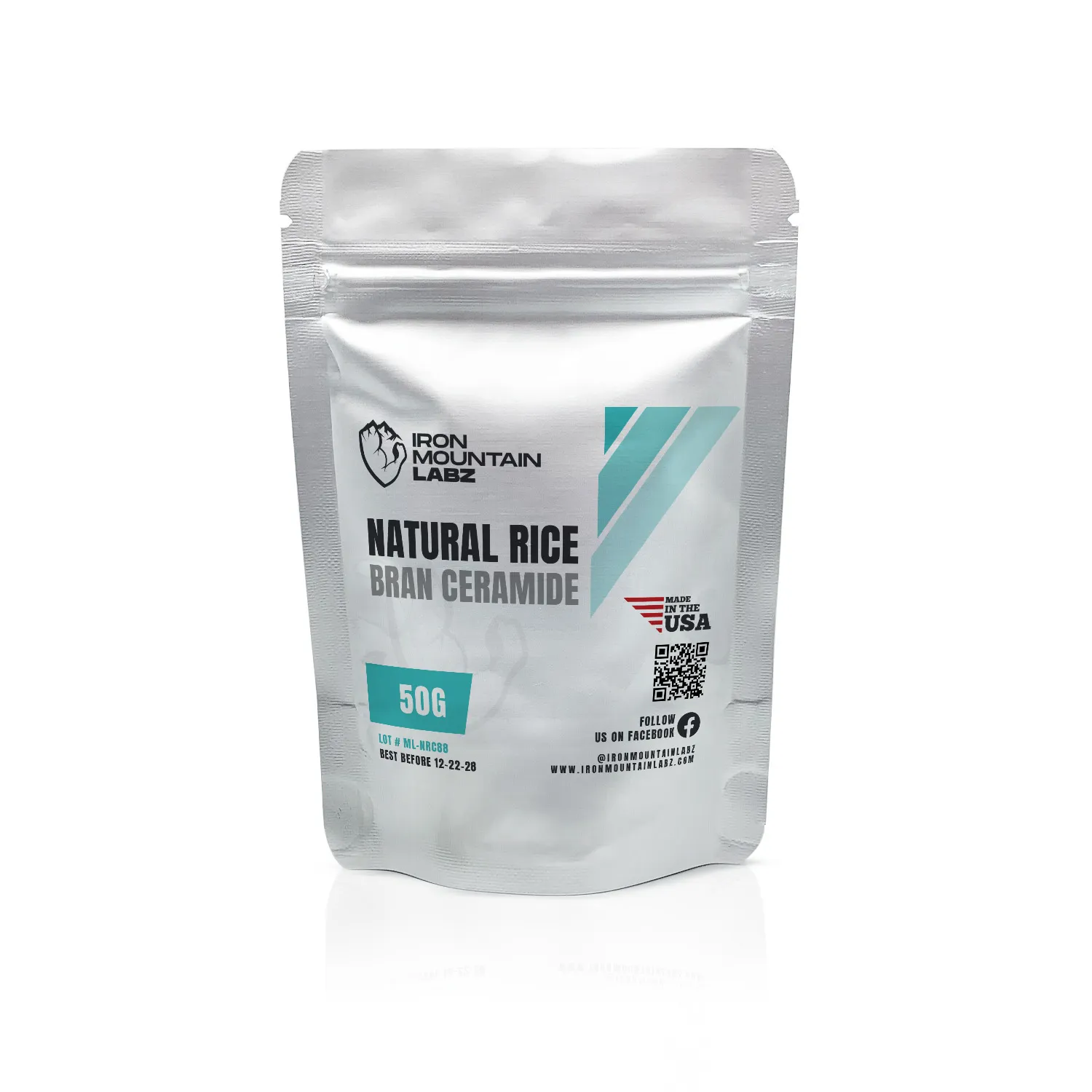
Natural Rice Bran Ceramide (CAS 100403-19-8) is a sphingolipid — a class of fat molecule (lipid). Ceramides are N-acyl sphingosines: structurally, the backbone is the long-chain amino alcohol sphingosine (trans-4-sphingenine, C18:1), linked via an amide bond to a fatty acid chain — in the dominant C18-ceramide species, this is stearic acid (C18:0). The result is Cer[d18:1/18:0] (N-stearoylsphingosine), with approximate molecular formula C42H83NO4 and MW ~536.89 g/mol (PubChem CID: 5280432). This compound is not a SARM — it has no androgen receptor binding activity. It is not a peptide — it contains zero amino acids; it is a fat molecule (ceramide = sphingosine backbone + fatty acid chain). In consumer markets, ceramide is used as a cosmetic/food ingredient for skin barrier applications; The linked vendor supplies it as a research-grade sphingolipid for in vitro laboratory investigation.
Extracted from rice bran (Oryza sativa), this preparation contains a mixture of ceramide homologs; the dominant species is C18-ceramide (Cer[d18:1/18:0]). Plant-derived ceramides may also contain phytosphingosine-based species (4-hydroxysphinganine backbone), providing a distinct hydroxyl-ceramide profile relevant to comparative lipid biochemistry research.
This product is not approved by the FDA for any therapeutic indication, including ingestion, injection, or any form of administration for human use. It is intended for laboratory and research purposes only. It is not a dietary supplement or consumer product in this research-grade formulation. Restricted to qualified researchers and licensed laboratory institutions. IRB guidance is required for clinical research; IACUC compliance is required for preclinical animal research. Store sealed under inert atmosphere at −20°C; handle organic solvent solutions in a certified fume hood.
Chemical Properties
| Section | Details |
| CAS Number | 100403-19-8 |
| Chemical Class | Sphingolipid (Lipid / Fat Molecule) |
| Classification — NOT a SARM | No androgen receptor binding activity |
| Classification — NOT a Peptide | Contains zero amino acids; it is a fat molecule (ceramide = sphingosine backbone + fatty acid) |
| Regulatory Status | Cosmetic / food ingredient in consumer context; sold here as research-grade material only |
| Molar Mass | ~669.10 g/mol (dominant phytosphingosine-based species, C42H83NO4; MW varies across homolog mixture) |
| Chemical Formula | C42H83NO4 (dominant phytosphingosine-based species, CAS 100403-19-8) |
| IUPAC Name | (2S,3R,4R)-2-(tetracosanoylamino)octadecane-1,3,4-triol (phytosphingosine backbone, no C4 double bond; note: rice bran ceramide is a mixture and IUPAC applies to dominant species only) |
| Synonyms | Rice bran ceramide; phytoceramide; N-stearoylsphingosine; Cer(d18:1/18:0); Oryza sativa ceramide extract |
| PubChem CID | Not independently confirmed for rice bran ceramide mixture; Ceramide NP/CAS 100403-19-8 reference available via supplier COA |
| Physical Form | White to cream-colored waxy powder or solid |
| Purity | ≥98% total ceramide content (HPLC-ELSD) |
| Solubility | Insoluble in water; soluble in DMSO (warm to 37°C); chloroform:methanol (2:1); ethanol (warm) |
| Storage | −20°C; sealed under N₂ or Ar inert atmosphere; protect from light and moisture; all organic solvent operations in certified fume hood |
| Shelf Life | 24 months from manufacture date under recommended conditions |
| Classification | Research Use Only (RUO) |
Natural Rice Bran Ceramide’s Mechanism of Action in Research Models
Within sphingolipid signaling research, ceramide occupies a central position in the bioactive lipid second messenger network. Mechanistically, ceramide is generated in research model systems via two primary routes: (1) the de novo biosynthetic pathway — initiated at the endoplasmic reticulum by serine palmitoyltransferase (SPT; SPTLC1/SPTLC2 heterodimer) condensing palmitoyl-CoA with L-serine to form 3-ketosphingosine, which undergoes sequential N-acylation by ceramide synthase isoforms (CerS1–CerS6, each with distinct acyl chain length specificity) and desaturation by dihydroceramide desaturase 1 (DES1); and (2) the sphingomyelinase pathway — neutral or acid sphingomyelinase (nSMase, aSMase) catalyzes hydrolysis of sphingomyelin at the cytoplasmic leaflet of the plasma membrane in response to cytokines, death receptor ligation, UV irradiation, or oxidative stress in preclinical models.
Hannun and Obeid (2008) reviewed the principles of bioactive lipid signaling in the context of sphingolipids, characterizing ceramide as a pleiotropic second messenger involved in regulation of cell growth, death, senescence, adhesion, and migration (DOI). In preclinical cancer cell line research, Park et al. (2010) investigated ceramide generation via de novo synthesis and acidic sphingomyelinase activation in the context of CD95 receptor clustering, PP2A activation, and ROS-dependent apoptotic signaling in gastrointestinal tumor cell lines (DOI). In membrane biophysics research models, ceramide-enriched gel-phase domains within bilayer membranes have been investigated as platforms that may facilitate clustering of death receptor complexes, attributed to ceramide’s high Td (~45°C for C18-ceramide) and capacity to form tightly packed lateral domains within the plasma membrane. Data remains limited, and findings are not consistent across all experimental model systems.
Risk & Handling
Risk Tier: LOW
Rice Bran Ceramide is a plant-derived sphingolipid with no known significant acute human toxicity at laboratory handling concentrations. The primary hazards arise from the organic solvents required for dissolution:
- Organic solvent operations: All dissolution in DMSO, chloroform, methanol, or ethanol must be conducted in a certified chemical fume hood; chloroform and methanol are toxic and flammable — eliminate ignition sources
- Inert atmosphere: Store and handle sealed under N₂ or Ar; oxidative degradation of the unsaturated sphingosine backbone is possible upon prolonged air exposure
- PPE: Nitrile gloves, lab coat, and safety eyewear for all handling operations
- Spill: Absorb organic solvent spills with dry sand or vermiculite; dispose per institutional chemical waste guidelines
- No human safety data established for this research-grade formulation. Contact help@ironmountainlabz.com for the Safety Data Sheet.
Why Consider Natural Rice Bran Ceramide for Research?
- Total ceramide content: ≥98% by HPLC-ELSD per lot
- Dominant species: C18-ceramide (Cer[d18:1/18:0]) confirmed by LC-MS/MS per lot
- Residual solvents: ≤300 ppm by GC headspace per lot (ICH Q3C compliant)
- Heavy metals: Pb ≤0.5 ppm; As ≤0.5 ppm; Cd ≤0.1 ppm (ICP-MS)
- Endotoxin: ≤1.0 EU/mg (LAL gel-clot method)
- Certificate of Analysis available on request per lot
- For queries, complaints, or support, please contact help@ironmountainlabz.com
FAQs
Q1: What is Rice Bran Ceramide chemically, and why is it not a SARM or peptide?
Rice Bran Ceramide is a sphingolipid — a fat molecule in which the long-chain amino alcohol sphingosine is linked via an amide bond to a fatty acid chain (stearic acid, C18:0, in the dominant species). It contains zero amino acids and has no peptide bonds, making it definitively not a peptide. It has no androgen receptor binding activity, making it definitively not a SARM. It is a bioactive lipid second messenger studied in cell biology for roles in apoptosis signaling and membrane organization.
Q2: What is the regulatory status of this material? In consumer markets, ceramides are sold as cosmetic and food ingredients for skin barrier support. The linked vendor supplies this as a research-grade sphingolipid for laboratory investigation of ceramide-mediated lipid signaling. Not approved by the FDA for any therapeutic indication. Not a dietary supplement or consumer product in this formulation. Restricted to qualified researchers and licensed laboratory institutions.
Q3: What research applications has ceramide been investigated in?
In preclinical laboratory settings: ceramide signaling in apoptosis (PP2A activation, Akt dephosphorylation, mitochondrial outer membrane permeabilization), sphingolipid metabolism assays (ceramide synthase and sphingomyelinase biochemistry), plasma membrane lipid domain organization studies, cancer cell biology in vitro models, and autophagy regulation research. All in laboratory and preclinical contexts only — not for human or veterinary therapeutic use.
Q4: How is Rice Bran Ceramide dissolved for cell biology research assays?
Prepare DMSO stock solutions (10–20 mM; warm to 37°C with sonication); ethanol stocks (warm to 50°C); or chloroform:methanol (2:1) for lipidomic preparations. For cell culture addition, dilute DMSO stocks to ≤0.1% v/v final concentration. Ceramide-BSA complexes or hydroxypropyl-β-cyclodextrin (HPβCD) can provide aqueous delivery alternatives. No human safety data has been established for this research-grade formulation.
Q5: What storage conditions are required to maintain ceramide integrity?
Store at −20°C, sealed under N₂ or Ar inert atmosphere, protected from light and moisture (shelf life: 24 months). Avoid repeated exposure to air — the sphingosine double bond is susceptible to oxidative degradation over time. Prepare working solutions fresh where possible. All organic solvent dissolution must occur in a certified chemical fume hood.
References
-
- Hannun YA, Obeid LM. Principles of bioactive lipid signalling: lessons from sphingolipids. Nat Rev Mol Cell Biol. 2008;9(2):139–150. PMID: 18216770.
https://pubmed.ncbi.nlm.nih.gov/18216770/ - Lin, M. H., Hsu, F. F., Crumrine, D., Meyer, J., Elias, P. M., & Miner, J. H. (2019). Fatty acid transport protein 4 is required for incorporation of saturated ultralong-chain fatty acids into epidermal ceramides and monoacylglycerols. Scientific Reports, 9(1), 13254. https://pubmed.ncbi.nlm.nih.gov/31519952/
- Park MA, Mitchell C, Zhang G, et al. Vorinostat and sorafenib increase CD95 activation in gastrointestinal tumor cells through a Ca²⁺-de novo ceramide-PP2A-reactive oxygen species-dependent signaling pathway. Cancer Research. 2010;70(15):6313–6324. PMID: 20631074
- https://pubmed.ncbi.nlm.nih.gov/20631074/
- Hannun YA, Obeid LM. Principles of bioactive lipid signalling: lessons from sphingolipids. Nat Rev Mol Cell Biol. 2008;9(2):139–150. PMID: 18216770.
IML Affiliate Disclosure
Some links on IML may connect readers with third-party suppliers through affiliate arrangements. IML may receive compensation from qualifying transactions at no additional cost to the reader, but the third-party supplier remains responsible for the actual sale, fulfillment, and product documentation.