

Description
Phosphatidylserine Research Overview
Disclaimer: The compounds described on this page are intended for laboratory research use only and are not approved for human consumption.
Overview of Phosphatidylserine
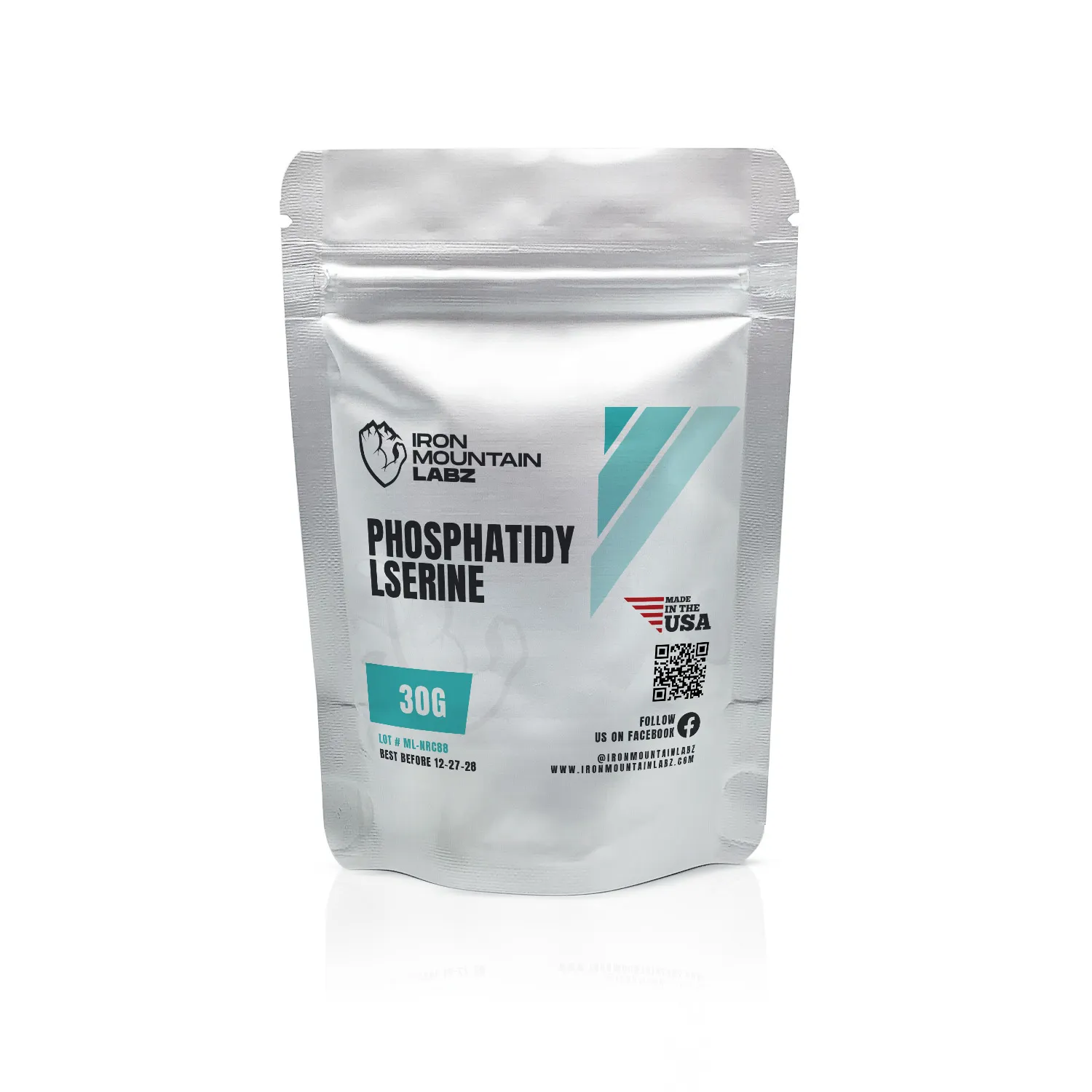
Phosphatidylserine (PS; CAS 383150-60-5 for the 1-palmitoyl-2-oleoyl-sn-glycero-3-phosphoserine / POPS reference species) is a phospholipid – a class of fat molecule containing a phosphate group. PS is an aminophospholipid characterized by a glycerophosphate backbone bearing two fatty acid ester chains at sn-1 and sn-2 positions, and a phosphoserine headgroup at sn-3. Representative species: formula C42H80NO10P; MW ~760.04 g/mol; PubChem CID: 5311051. It is not a SARM – it has no androgen receptor activity. It is not a peptide – it is a phospholipid fat molecule containing a phosphate group; while the serine headgroup is an amino acid moiety, PS as a whole is classified as a phospholipid, not an amino acid chain.
PS constitutes approximately 13–15% of total phospholipid in the brain and 2–10% of peripheral cell membranes. The FDA allows a qualified health claim for PS dietary supplements regarding cognitive function and dementia risk reduction. The linked vendor supplies PS as a research-grade phospholipid for in vitro laboratory investigation of membrane biology, apoptotic signaling, and PKC biochemistry – not as a consumer supplement.
This product is not approved by the FDA as a drug for any therapeutic indication, including ingestion, injection, or any form of administration for human use. It is intended for laboratory and research purposes only. It is not a dietary supplement or consumer product in this research-grade formulation. Restricted to qualified researchers and licensed laboratory institutions. IRB guidance is required for clinical research; IACUC compliance is required for preclinical animal research. Handle organic solvent solutions in a certified fume hood; protect from oxidation.
Chemical Properties
| Section | Details |
| CAS Number | 383150-60-5 (POPS reference species); 26537-29-1 (phosphatidyl-L-serine general class, well-established) |
| Chemical Class | Phospholipid |
| Classification – NOT a SARM | No androgen receptor activity |
| Classification – NOT a Peptide | A phospholipid (fat molecule containing phosphate group); the serine moiety is a headgroup within the lipid, not an amino acid chain |
| Regulatory Status | Dietary Supplement (DSHEA) – FDA qualified health claim for cognitive function; sold here as research-grade material only |
| Molar Mass | ~760.04 g/mol (POPS species; MW varies with acyl chain composition in mixed species preparations) |
| Chemical Formula | C42H80NO10P (POPS species) |
| IUPAC Name | (2S)-2-amino-3-[[(2R)-2-[(9Z)-hexadec-9-enoyloxy]-3-(hexadecanoyloxy)propoxy]-hydroxyphosphoryl]oxypropanoic acid |
| Synonyms | Phosphatidylserine; PS; L-α-phosphatidyl-L-serine; soy PS; bovine brain PS; 3-sn-phosphatidyl-L-serine |
| PubChem CID | 5311051 (POPS reference species) |
| Physical Form | White to off-white waxy powder or solid |
| Purity | ≥98% phosphatidylserine by HPLC-ELSD |
| Solubility | Insoluble in water; soluble in chloroform:methanol (1:1); DMSO (with warming); ethanol (with warming) |
| Storage | −20°C; sealed under N₂ or Ar inert atmosphere; protect from light, moisture, and oxygen – unsaturated acyl chains susceptible to peroxidation; all organic solvent operations in certified fume hood |
| Shelf Life | 24 months from manufacture date under recommended conditions |
| Classification | Research Use Only (RUO) |
Phosphatidylserine’s Mechanism of Action in Research Models
Within membrane biology and apoptosis research, phosphatidylserine plays dual structural and signaling roles. Under normal physiological conditions, PS is actively maintained in the cytoplasmic (inner) leaflet of the plasma membrane bilayer by ATP-dependent phospholipid flippases – specifically the type IV P-type ATPases ATP8A1 and ATP8A2 – which continuously translocate PS from the outer to the inner leaflet against its concentration gradient. Based on articles retrieved from PubMed, Segawa and Nagata (2015) reviewed the molecular mechanisms of apoptotic PS externalization, characterizing the flippase/scramblase system in detail: during apoptosis, caspase-3 cleaves and inactivates flippases while simultaneously activating the Ca²⁺-independent phospholipid scramblase TMEM16F (anoctamin 6), resulting in rapid bidirectional scrambling and net PS exposure on the outer membrane leaflet – the canonical “eat-me” signal recognized by phagocyte PS receptors including TIM-4, BAI1, Stabilin-2, and bridging proteins such as MFG-E8 and Gas6 (DOI).
In biochemical research, PS also functions as an allosteric activator of conventional protein kinase C (PKC) isoforms (PKCα, PKCβI, PKCβII, PKCγ) by engaging the C2 regulatory domain at the membrane interface – the molecular basis for Ca²⁺/DAG/PS-dependent PKC activation in cell signaling research. In the neurological context, Zhang et al. (2022) investigated a PS-containing supplement formulation in a double-blind, placebo-controlled clinical study with 109 healthy adults, reporting significant improvements across all five subcategories of a standardized clinical memory test at 30 days compared to placebo, though the study involved a combination formulation (DOI). Data remains limited, and findings are not consistent across all experimental model systems.
Risk & Handling
Risk Tier: LOW-MODERATE
Phosphatidylserine is a naturally occurring membrane phospholipid. No acute human toxicity is established at laboratory handling concentrations. The primary hazards arise from required organic solvents:
- Organic solvent operations: Chloroform, methanol, and DMSO required for dissolution – all operations must be conducted in a certified chemical fume hood; chloroform and methanol are toxic and flammable – eliminate ignition sources; use appropriate solvent-resistant gloves
- Oxidation risk: Unsaturated acyl chains susceptible to lipid peroxidation on air exposure – store under N₂/Ar atmosphere; add 0.01% (w/v) BHT antioxidant to chloroform stock solutions for extended storage; monitor peroxide value before sensitive biological assays
- Inert atmosphere storage: Seal under N₂ or Ar immediately after use; do not leave open to air
- PPE: Nitrile gloves, lab coat, and safety eyewear for all handling operations
- No human safety data established for this research-grade formulation. Contact help@ironmountainlabz.com for the Safety Data Sheet.
Why Consider Phosphatidylserine for Research?
- PS content: ≥98% by HPLC-ELSD per lot
- Species profile: LC-MS/MS lipid species composition reported on COA per lot
- Peroxide value: ≤5 meq/kg (lipid oxidation monitoring per lot)
- Residual solvents: ≤300 ppm by GC headspace per lot (ICH Q3C compliant)
- Heavy metals: Pb ≤0.5 ppm; As ≤0.5 ppm (ICP-MS)
- Certificate of Analysis available on request per lot
- For queries, complaints, or support, please contact help@ironmountainlabz.com
FAQs
Q1: What is phosphatidylserine chemically, and why is it not a SARM or peptide?
Phosphatidylserine is a phospholipid – a fat molecule with a glycerophosphate backbone esterified to two fatty acid chains and a phosphoserine headgroup. While the serine headgroup is an amino acid moiety, the compound as a whole is classified as a phospholipid, not a peptide chain. It has no androgen receptor activity, making it definitively not a SARM. In consumer markets, it is a DSHEA dietary supplement ingredient with an FDA-qualified health claim for cognitive function.
Q2: What is the FDA regulatory context for phosphatidylserine? The FDA has authorized a qualified health claim stating that PS “may reduce the risk of dementia and cognitive dysfunction in the elderly.” This pertains to consumer supplement products. The linked vendor supplies PS as research-grade material for laboratory investigation – not as a supplement product. This formulation is not a dietary supplement or consumer product; it is restricted to qualified researchers and licensed laboratory institutions.
Q3: What research applications has phosphatidylserine been investigated in?
In preclinical and in vitro laboratory settings: apoptosis detection (annexin V-FITC binding assays for PS externalization), flippase/scramblase activity studies (TMEM16F, ATP8A1/A2), PKC isoform activation assays using PS-containing liposomes, coagulation factor complex assembly research, efferocytosis and macrophage phagocytosis models, and liposomal drug delivery systems. All in laboratory and preclinical contexts only.
Q4: How is phosphatidylserine incorporated into liposomal research systems?
PS is typically dissolved in chloroform:methanol (1:1) and combined with other lipid components in defined molar ratios. Solvent is evaporated under N₂ stream to form a thin film, which is hydrated and extruded through polycarbonate membranes (typically 100 nm pore size) to form unilamellar liposomes. The resulting liposomes are used as PKC activator substrates, coagulation factor assembly platforms, or model membrane systems for biophysical experiments.
Q5: What storage and handling precautions are required?
Store at −20°C under N₂/Ar inert atmosphere, sealed, protected from light and moisture (shelf life: 24 months). Add BHT antioxidant (0.01% w/v) to chloroform stock solutions if preparing for extended storage. All organic solvent operations in a certified fume hood. Verify peroxide value before sensitive biological assays. No human safety data established for this research-grade formulation. Contact help@ironmountainlabz.com for the Safety Data Sheet.
References
- Segawa K, Nagata S. An apoptotic “eat me” signal: phosphatidylserine exposure. Trends Cell Biol. 2015;25(11):639–650. PMID: 26437594.
https://pubmed.ncbi.nlm.nih.gov/26437594/ - Vance JE, Tasseva G. Formation and function of phosphatidylserine and phosphatidylethanolamine in mammalian cells. Biochimica et Biophysica Acta. 2013;1831(3):543–554. PMID: 22960355 https://pubmed.ncbi.nlm.nih.gov/22960355/
- Leventis PA, Grinstein S. The distribution and function of phosphatidylserine in cellular membranes. Annual Review of Biophysics. 2010;39:407–427. PMID: 20192774 https://pubmed.ncbi.nlm.nih.gov/20192774/
IML Affiliate Disclosure
Some links on IML may connect readers with third-party suppliers through affiliate arrangements. IML may receive compensation from qualifying transactions at no additional cost to the reader, but the third-party supplier remains responsible for the actual sale, fulfillment, and product documentation.