

Description
GS-441524 Research Overview
Disclaimer: The compounds described on this page are intended for laboratory research use only and are not approved for human consumption.
Overview of GS-441524
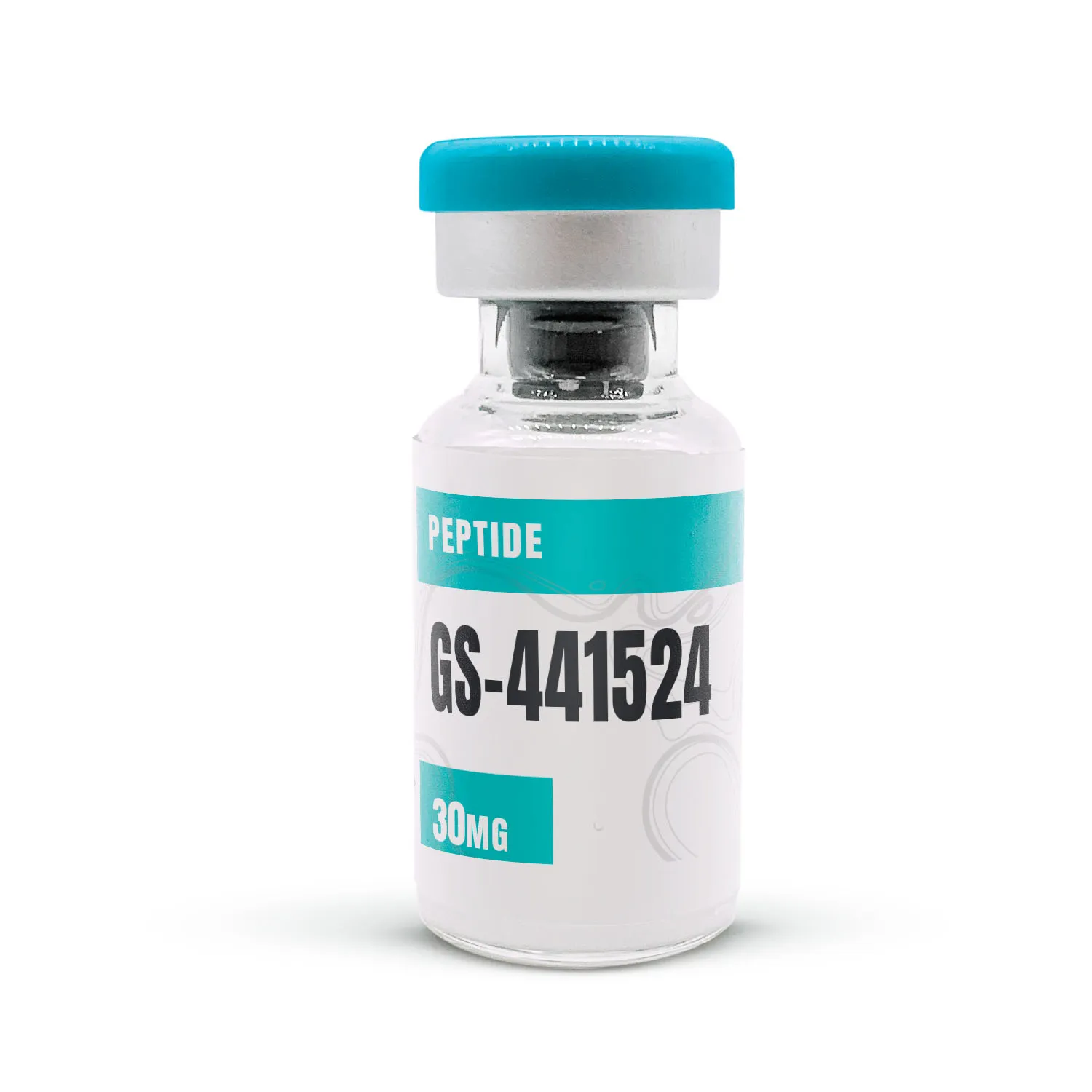
GS-441524 (CAS 1191237-69-0) is a nucleoside analog – a synthetic antiviral research compound classified under the Other Research category. Structurally, it consists of a modified ribose sugar ring bearing a 1′-cyano group at the anomeric position, coupled to a 4-aminopyrrolotriazine nucleobase moiety. Molecular formula: C12H13N5O4; MW: 291.26 g/mol; PubChem CID: 44468216. GS-441524 is the active parent nucleoside of remdesivir (GS-5734) and is the precursor to the antiviral drug’s active triphosphate metabolite. It is not a SARM – it targets viral RNA-dependent RNA polymerase (RdRp), not androgen receptors. It is not a peptide – it is constructed from a modified sugar ring plus a modified nucleobase; it contains zero amino acids.
GS-441524 differs from remdesivir in that it lacks the McGuigan phosphoramidate prodrug moiety, requiring intracellular phosphorylation by adenosine kinase (ADK) for activation to its active triphosphate form GS-443902. This mechanistic distinction makes GS-441524 a pharmacologically distinct research tool for studying ADK-dependent antiviral nucleotide activation pathways and direct antiviral nucleoside activity.
This product is not approved by the FDA for any therapeutic indication for human or veterinary use, including ingestion, injection, or any form of administration. It is intended for laboratory and research purposes only. It is not a dietary supplement or consumer product. Restricted to qualified researchers and licensed laboratory institutions. IRB guidance is required for clinical research; IACUC compliance is required for preclinical animal research. Store at −20°C in a sealed container protected from light. Handle in a ventilated environment; DMSO solutions should not contact skin directly.
Chemical Properties
| Section | Details |
| CAS Number | 1191237-69-0 |
| Chemical Class | Nucleoside Analog (Antiviral Research Compound) |
| Classification – NOT a SARM | Targets viral RNA-dependent RNA polymerase (RdRp), not androgen receptors |
| Classification – NOT a Peptide | Made from a modified ribose sugar + modified nucleobase; contains zero amino acids |
| Regulatory Status | Research Compound – Not FDA-Approved for Human Use |
| Molar Mass | 291.26 g/mol |
| Chemical Formula | C12H13N5O4 |
| IUPAC Name | (2R,3R,4S,5R)-2-(4-aminopyrrolo[2,1-f][1,2,4]triazin-7-yl)-3,4-dihydroxy-5-(hydroxymethyl)tetrahydrofuran-2-carbonitrile |
| Synonyms | GS-441524; remdesivir parent nucleoside; adenosine C-nucleoside antiviral; 1′-CN adenosine analog |
| PubChem CID | 44468216 |
| Physical Form | White to off-white crystalline solid |
| Purity | ≥99% (HPLC-UV); ≥99% ee – (2S,3S,4R,5R) configuration confirmed by chiral HPLC |
| Solubility | DMSO: ≥25 mg/mL; methanol: soluble; water: ~0.5 mg/mL |
| Storage | −20°C; sealed amber container; protect from light and moisture; DMSO solutions require skin-contact precautions |
| Shelf Life | 24 months from manufacture date under recommended conditions |
| Classification | Research Use Only (RUO) |
GS-441524’s Mechanism of Action in Research Models
Within antiviral nucleoside analog research, GS-441524 operates through an intracellular prodrug activation mechanism. Following cellular uptake via equilibrative nucleoside transporters (ENT1/ENT2; SLC29A1/SLC29A2), adenosine kinase (ADK; EC 2.7.1.20) phosphorylates the 5′-hydroxyl of GS-441524 to generate the 5′-monophosphate; nucleoside monophosphate kinase (NMPK) and nucleoside diphosphate kinase (NDPK) sequentially complete phosphorylation to the active triphosphate GS-443902. GS-443902 then competes with ATP at the nucleoside triphosphate (NTP) binding site of the viral RNA-dependent RNA polymerase (RdRp) elongation complex.
Gordon et al. (2020) demonstrated using purified SARS-CoV-2 nsp12/nsp7/nsp8 RdRp complex that the active triphosphate form (RDV-TP, equivalent to GS-443902) is efficiently incorporated at the i position, causing RNA synthesis termination at position i+3 – a “delayed chain termination” mechanism distinct from classical immediate chain terminators (DOI). The 1′-cyano group in GS-441524 provides critical steric obstruction at the i+3 position and also confers resistance to excision by the nsp14-ExoN proofreading exonuclease found in coronaviruses, distinguishing it from nucleoside analogs susceptible to proofreading-mediated resistance. In a separate research context, Izes et al. (2020) reviewed GS-441524 in feline infectious peritonitis coronavirus (FIPV) research, summarizing preclinical and clinical veterinary research data in which the nucleoside analog was investigated as a potential treatment option (DOI). Data remains limited, and findings are not consistent across all viral polymerase model systems.
Risk & Handling
Risk Tier: LOW-MODERATE
GS-441524 is a pharmacologically active nucleoside analog research compound. No established acute human toxicity data exists at laboratory handling concentrations. The primary hazard is potential systemic absorption via DMSO vehicle:
- DMSO vehicle: DMSO is a penetration enhancer – do not allow DMSO solutions of GS-441524 to contact bare skin; use chemical-resistant nitrile or butyl rubber gloves when handling DMSO preparations
- Photosensitivity: Protect from direct light during handling; store in amber-capped containers at −20°C
- PPE: Chemical-resistant nitrile gloves, lab coat, and safety eyewear for all handling operations
- Regulatory: Not DEA scheduled; verify applicable local regulations before procurement and use
- Spill: Collect crystalline material with a damp paper towel; dispose per institutional pharmaceutical research waste guidelines
- No human safety data established for this research-grade formulation. Contact help@ironmountainlabz.com for the Safety Data Sheet.
Why Consider GS-441524 for Research?
- Purity: ≥99% by HPLC-UV per lot
- Chiral purity: ≥99% ee for the (2S,3S,4R,5R) configuration by chiral HPLC per lot
- Identity: confirmed by ¹H-NMR and high-resolution ESI-MS per lot
- Residual solvents: ≤300 ppm by GC headspace per lot (ICH Q3C compliant)
- Endotoxin: ≤1.0 EU/mg (LAL gel-clot method)
- Certificate of Analysis available on request per lot
- For queries, complaints, or support, please contact help@ironmountainlabz.com
FAQs
Q1: What is GS-441524 chemically, and why is it not a SARM or peptide?
GS-441524 is a nucleoside analog – a synthetic antiviral small molecule composed of a modified 1′-cyano ribose sugar ring coupled to a 4-aminopyrrolotriazine nucleobase. It contains zero amino acids, making it definitively not a peptide. It targets viral RNA-dependent RNA polymerase (RdRp) – not androgen receptors – making it definitively not a SARM. It is classified as an antiviral research compound (nucleoside analog class) and is the parent nucleoside of remdesivir.
Q2: Is GS-441524 the same compound as remdesivir (Veklury)?
No. GS-441524 is the parent nucleoside of remdesivir but lacks remdesivir’s McGuigan phosphoramidate prodrug group. This structural difference means GS-441524 requires intracellular phosphorylation by adenosine kinase (ADK) for activation, whereas remdesivir bypasses ADK via its prodrug mechanism. In preclinical in vitro research, GS-441524 typically requires 3–30× higher concentrations than remdesivir for equivalent antiviral activity in cell culture models – a mechanistic distinction making it a useful probe for ADK-dependent antiviral activation pathways.
Q3: What viral research models has GS-441524 been investigated in?
In preclinical in vitro and ex vivo research settings: SARS-CoV-2, MERS-CoV, feline infectious peritonitis coronavirus (FIPV), Ebola virus, and related RNA viruses – in biochemical RdRp inhibition assays and cell-based antiviral activity models. All applications strictly in laboratory and preclinical contexts; not for human or veterinary therapeutic use.
Q4: What is the regulatory status of GS-441524 in the United States?
GS-441524 is not approved by the FDA for any human or veterinary therapeutic use. It is not DEA-scheduled. It is a research-grade compound intended for laboratory investigational use only. Researchers should verify applicable state and federal regulations before procurement and use.
Q5: How should GS-441524 be stored and handled safely in laboratory settings?
Store at −20°C in amber-capped, sealed containers protected from light and moisture (shelf life: 24 months). Prepare DMSO stock solutions (≥25 mg/mL); dilute into assay buffer – final DMSO concentration should not exceed 0.5% v/v in cell-based assays. Avoid skin contact with DMSO solutions – use chemical-resistant gloves. Do not repeatedly freeze-thaw. No human safety data has been established for this research-grade formulation.
References
- Gordon CJ, Tchesnokov EP, Woolner E, et al. Remdesivir is a direct-acting antiviral that inhibits RNA-dependent RNA polymerase from severe acute respiratory syndrome coronavirus 2 with high potency. J Biol Chem. 2020;295(20):6785–6797. PMID: 32284326.
https://doi.org/10.1074/jbc.RA120.013679 - Izes AM, Yu J, Norris JM, Govendir M. Current status on treatment options for feline infectious peritonitis and SARS-CoV-2 positive cats. Vet Q. 2020;40(1):322–330. PMID: 33138721.
https://doi.org/10.1080/01652176.2020.1845917 - Pedersen NC, Perron M, Bannasch M, et al. Efficacy and safety of the nucleoside analog GS-441524 for treatment of cats with naturally occurring feline infectious peritonitis. Journal of Feline Medicine and Surgery. 2019;21(4):271–281. PMID: 30786823
- https://pubmed.ncbi.nlm.nih.gov/30786823/
IML Affiliate Disclosure
Some links on IML may connect readers with third-party suppliers through affiliate arrangements. IML may receive compensation from qualifying transactions at no additional cost to the reader, but the third-party supplier remains responsible for the actual sale, fulfillment, and product documentation.