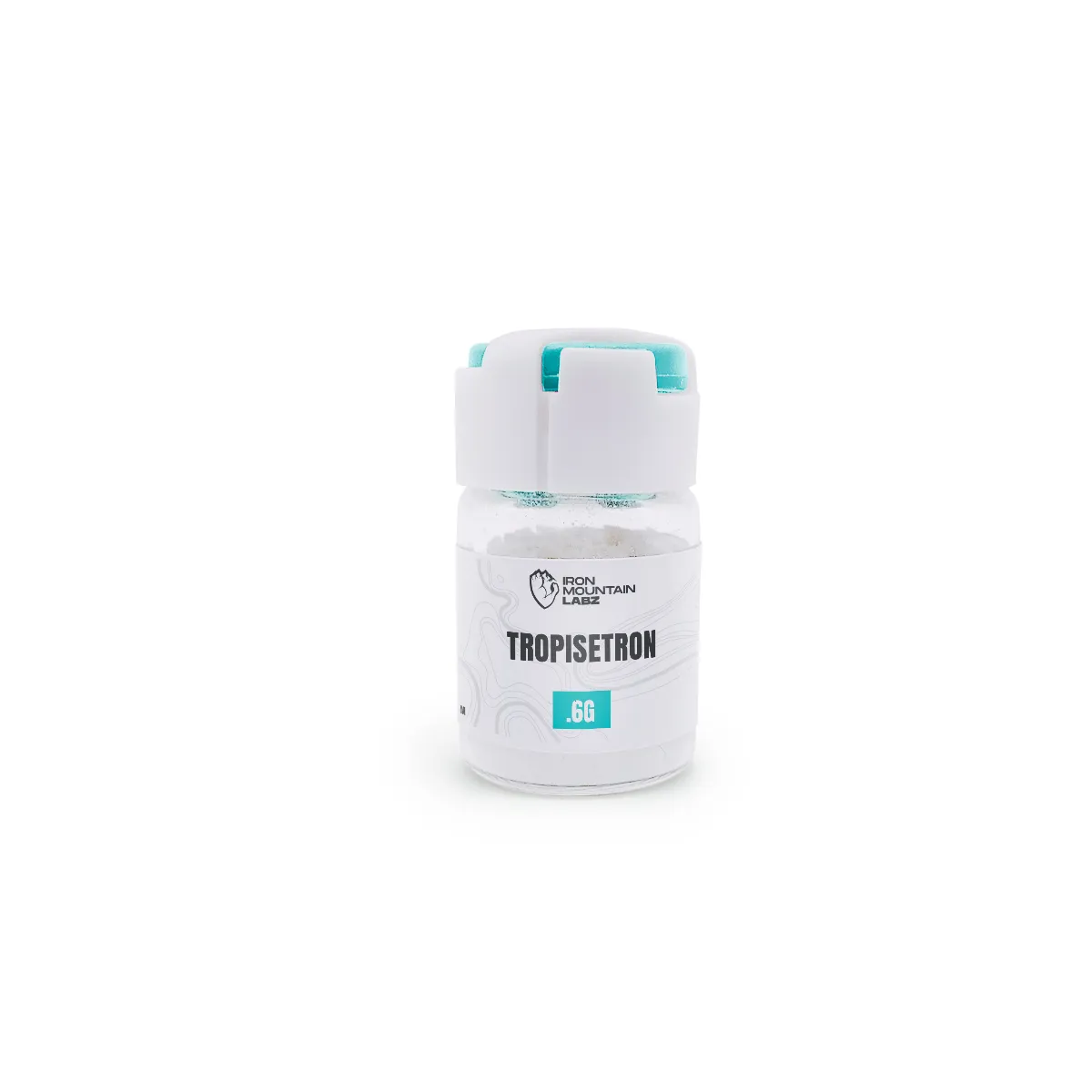


Description
Tropisetron Research Overview
Disclaimer: The compounds described on this page are intended for laboratory research use only and are not approved for human consumption.
Overview of Tropisetron
Tropisetron (CAS 89565-68-4) is an indole alkaloid small molecule – a naturally derived structural class of compound featuring the bicyclic indole ring system (benzene fused to pyrrole), classified as a nootropic research compound. Structurally, it consists of a tropane (8-azabicyclo[3.2.1]octane) core esterified to indole-3-carboxylic acid at the N-methyl bridgehead carbon. Molecular formula: C17H20N2O2; MW: 284.35 g/mol; PubChem CID: 5284616. It is not a SARM – it has no androgen receptor activity; it acts pharmacologically as a selective 5-HT3 serotonin receptor antagonist and, at distinct binding sites, a partial agonist at the alpha7 nicotinic acetylcholine receptor (α7-nAChR). It is not a peptide – it is a single alkaloid small molecule with no amino acid chain.
Tropisetron is an approved antiemetic pharmaceutical in some countries (Navoban® brand; indicated for chemotherapy-induced nausea and vomiting). Its research interest extends well beyond antiemesis: the compound’s dual pharmacology at 5-HT3 and α7-nAChR sites makes it a uniquely positioned research tool for studying serotonergic/cholinergic pathway interactions, neuroinflammation, and receptor-mediated cytoprotective signaling in preclinical models.
This product is not approved by the FDA for any human or veterinary therapeutic use in this research-grade formulation, including ingestion, injection, or any form of administration. It is intended for laboratory and research purposes only. It is not a dietary supplement or consumer product. Restricted to qualified researchers and licensed laboratory institutions. IRB guidance is required for clinical research; IACUC compliance is required for preclinical animal research. CNS-active alkaloid – treat as pharmacologically active; avoid skin contact and inhalation during handling.
Chemical Properties
| Section | Details |
| CAS Number | 89565-68-4 |
| Chemical Class | Indole Alkaloid / Small Molecule |
| Classification – NOT a SARM | Targets 5-HT3 serotonin receptor and α7-nAChR; no androgen receptor activity |
| Classification – NOT a Peptide | Single alkaloid small molecule; no amino acid chain |
| Regulatory Status | Approved antiemetic drug (Navoban®) in some countries; research-grade powder sold here for laboratory use only |
| Molar Mass | 284.35 g/mol |
| Chemical Formula | C17H20N2O2 |
| IUPAC Name | [(1R,3r,5S)-8-methyl-8-azabicyclo[3.2.1]octan-3-yl] 1H-indole-3-carboxylate |
| Synonyms | Tropisetron; ICS-205-930; Navoban® (pharmaceutical brand – not this product); 3α-tropanyl 1H-indole-3-carboxylate |
| PubChem CID | 5284616 (free base, CAS 89565-68-4); 5310068 (hydrochloride salt – different CID) |
| Physical Form | White to off-white crystalline solid |
| Purity | ≥99% (HPLC-UV) |
| Solubility | DMSO: ≥20 mg/mL; water: ~5 mg/mL (as HCl salt); ethanol: soluble |
| Storage | −20°C; sealed container; protect from light and moisture; handle as pharmacologically active compound |
| Shelf Life | 24 months from manufacture date under recommended conditions |
| Classification | Research Use Only (RUO) |
Tropisetron’s Mechanism of Action in Research Models
Within serotonergic receptor pharmacology research, tropisetron acts as a competitive antagonist at the 5-HT3 receptor (5-hydroxytryptamine type 3 receptor; a pentameric Cys-loop ligand-gated ion channel of the LGIC superfamily). Zhang et al. (2021) resolved three cryo-EM structures of the 5-HT3A homopentamer reconstituted in saposin-based lipid bilayer nanodiscs – revealing symmetric apo, asymmetric apo, and asymmetric agonist-bound conformations – and demonstrated that the lipid bilayer environment stabilizes the receptor in a tightly packed coupled state that enables a wide-open pore conformation capable of conducting sodium ions in molecular dynamics simulations (DOI). Mechanistically, tropisetron competes with serotonin for binding at the orthosteric site located at each subunit interface within the extracellular domain, stabilizing the receptor in a closed-channel conformation and preventing the gating conformational rearrangement that opens the cation-selective pore.
At the α7 nicotinic acetylcholine receptor (α7-nAChR; CHRNA7 gene product), tropisetron has been characterized as a partial agonist at the orthosteric ACh binding site – a pharmacological property distinct from its antagonism at 5-HT3. Zirak et al. (2020) investigated the cytoprotective mechanism of tropisetron in a cyclophosphamide-induced hemorrhagic cystitis model in rats, demonstrating that tropisetron significantly reduced MDA levels, suppressed STAT3 phosphorylation, and decreased histopathological bladder injury – effects that were blocked by co-administration of the selective α7-nAChR antagonist methyllycaconitine, confirming α7-nAChR-dependent signaling as the primary cytoprotective mechanism in that model (DOI). Data remains limited, and findings are not consistent across all experimental model systems.
Risk & Handling
Risk Tier: MODERATE
Tropisetron is a pharmacologically active indole alkaloid with established clinical pharmacology at 5-HT3 and α7-nAChR receptors. Handle as a pharmacologically active compound throughout all operations:
- CNS/ANS activity: Avoid skin contact and inhalation – risk of systemic absorption through mucosal surfaces or skin
- Approved drug awareness: Tropisetron (Navoban®) is a prescription pharmaceutical in several countries – this research-grade material must NOT be used for human or veterinary therapeutic purposes under any circumstances
- DMSO solutions: Chemical-resistant gloves required – DMSO is a penetration enhancer
- Ester bond: Susceptible to alkaline hydrolysis – avoid basic pH aqueous solutions; store near neutral pH
- PPE: Nitrile gloves, lab coat, and safety eyewear for all handling operations
- No human safety data established for this research-grade formulation. Contact help@ironmountainlabz.com for the Safety Data Sheet.
Why Consider Tropisetron for Research?
- Purity: ≥99% by HPLC-UV per lot
- Identity: confirmed by ¹H-NMR and LC-MS/MS per lot
- Residual solvents: ≤300 ppm by GC headspace per lot (ICH Q3C compliant)
- Endotoxin: ≤1.0 EU/mg (LAL gel-clot method)
- Certificate of Analysis available on request per lot
- For queries, complaints, or support, please contact help@ironmountainlabz.com
FAQs
Q1: What is tropisetron chemically, and why is it not a SARM or peptide?
Tropisetron is an indole alkaloid small molecule – a single bicyclic compound with a tropane core esterified to indole-3-carboxylic acid. It contains no amino acid chain, making it definitively not a peptide. It targets the 5-HT3 serotonin receptor and α7-nAChR – not androgen receptors – making it definitively not a SARM. Its nootropic classification reflects its preclinical investigation in serotonergic and cholinergic pharmacology, neuroinflammation, and receptor-mediated cytoprotective signaling.
Q2: Tropisetron is an approved pharmaceutical – what is its status? Tropisetron (Navoban®) is an approved prescription antiemetic in some countries. The linked vendor supplies this compound as a research-grade reagent for laboratory investigation of 5-HT3 and α7-nAChR pharmacology – not as a pharmaceutical preparation. This research-grade material must not be used for any human or veterinary therapeutic purpose. Not approved by the FDA in this formulation.
Q3: What research applications has tropisetron been investigated in?
In preclinical and in vitro laboratory settings: 5-HT3 receptor pharmacology and electrophysiology (patch-clamp LGIC studies), α7-nAChR partial agonist characterization, cholinergic anti-inflammatory pathway research, cyclophosphamide-induced organ injury models, neuroinflammation and neuroprotection assays, and chemotherapy-induced nausea mechanism studies. All in laboratory and preclinical contexts only.
Q4: What distinguishes tropisetron from other 5-HT3 antagonists (granisetron, ondansetron) in research?
Tropisetron’s defining research advantage is its dual pharmacology – it is the only major clinical 5-HT3 antagonist characterized as a partial α7-nAChR agonist. This makes it uniquely suitable for studies examining the intersection of serotonergic and cholinergic signaling in inflammatory and neuroprotective research models. In the study by Zirak et al. (2020), granisetron and ondansetron lacked the cytoprotective activity observed with tropisetron, consistent with α7-nAChR-dependent mechanisms absent in the comparators.
Q5: What storage and safety precautions are required?
Store at −20°C in a sealed container protected from light and moisture (shelf life: 24 months). Handle as pharmacologically active – nitrile gloves, lab coat, safety eyewear mandatory. DMSO solutions require chemical-resistant gloves. Avoid alkaline conditions (ester bond susceptibility). No human safety data established for this research-grade formulation. Contact help@ironmountainlabz.com for the Safety Data Sheet.
References
- Zirak MR, Karimi G, Rahimian R, et al. Tropisetron ameliorates cyclophosphamide-induced hemorrhagic cystitis in rats. Eur J Pharmacol. 2020;883:173310. PMID: 32619674.
https://pubmed.ncbi.nlm.nih.gov/32619674/ - Zhang Y, Dijkman PM, Zou R, et al. Asymmetric opening of the homopentameric 5-HT3 serotonin receptor in lipid bilayers. Nat Commun. 2021;12(1):1074. PMID: 33594077.
https://pubmed.ncbi.nlm.nih.gov/33594077/ - Machu TK. Therapeutics of 5-HT3 receptor antagonists: current uses and future directions. Pharmacology & Therapeutics. 2011;130(3):338–347. PMID: 21356241 https://pubmed.ncbi.nlm.nih.gov/21356241/
IML Affiliate Disclosure
Some links on IML may connect readers with third-party suppliers through affiliate arrangements. IML may receive compensation from qualifying transactions at no additional cost to the reader, but the third-party supplier remains responsible for the actual sale, fulfillment, and product documentation.