

Description
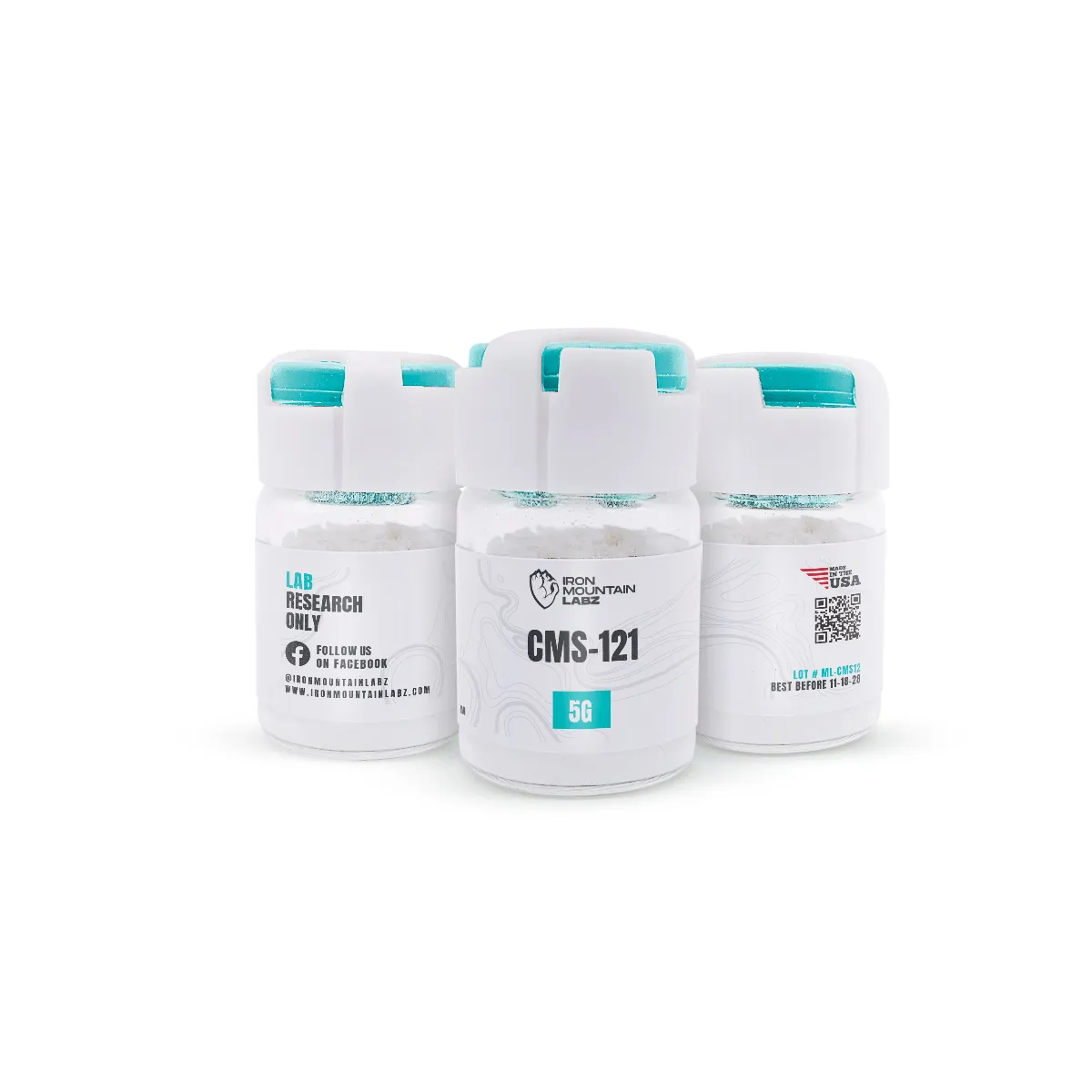
CMS-121 Powder Research Overview
Disclaimer: The compounds described on this page are intended for laboratory research use only and are not approved for human consumption.
Overview of CMS-121 Powder
CMS-121 (CAS 1353224-53-9) is a synthetic flavonoid derivative in the quinolone subclass – a compound structurally derived from fisetin (a naturally occurring plant flavonol) through medicinal chemistry optimization into a quinolone scaffold. Molecular formula: C20H19NO3; MW: 321.37 g/mol; PubChem CID: 135741221; IUPAC: 4-[4-(cyclopentyloxy)quinolin-2-yl]benzene-1,2-diol. It is classified as a nootropic research compound. It is not a SARM – it targets acetyl-CoA carboxylase 1 (ACC1) and fatty acid synthase (FASN) lipid metabolic enzymes, not androgen receptors. It is not a peptide – it is a synthetic quinolone small molecule derived from fisetin (a plant-derived flavonol); the quinolone scaffold belongs to the same heterocyclic flavonoid derivative chemical family and contains no amino acid chain.
CMS-121 has been undergoing animal toxicology studies in preparation for FDA IND (Investigational New Drug) application for Alzheimer’s disease investigation, developed alongside J147 by the Salk Institute. Phase 1 status should be verified via ClinicalTrials.gov before citing. The compound’s nootropic research significance lies in its ability to modulate lipid metabolism in neurons via ACC1 inhibition, resulting in elevated acetyl-CoA levels – which in turn drive increased histone acetylation at memory-associated chromatin sites and preservation of mitochondrial homeostasis in aging brain research models.
This product is not approved by the FDA for any therapeutic indication. It is not an IND (Investigational New Drug) formulation. It is intended for laboratory and research purposes only; not a dietary supplement or consumer product. Restricted to qualified researchers and licensed laboratory institutions. IRB guidance is required for clinical research; IACUC compliance is required for preclinical animal research. Handle as a CNS-active research compound with appropriate precautions.
Chemical Properties
| Section | Details |
| CAS Number | 1353224-53-9 |
| Chemical Class | Synthetic Flavonoid Derivative (Quinolone) |
| Classification – NOT a SARM | Targets ACC1/FASN lipid enzymes, not androgen receptors |
| Classification – NOT a Peptide | Synthetic quinolone small molecule derived from fisetin (plant-derived flavonol); no amino acid chain |
| Regulatory Status | esearch Compound – Pre-IND animal toxicology stage (Alzheimer’s); NOT FDA-approved; NOT an IND formulation |
| Molar Mass | 321.37 g/mol |
| Chemical Formula | C20H19NO3 |
| IUPAC Name | 4-[4-(cyclopentyloxy)quinolin-2-yl]benzene-1,2-diol |
| Synonyms | CMS-121; CMS121; fisetin-derived quinolone nootropic; ACC1 inhibitor; Salk neuroprotective compound |
| PubChem CID | 135741221 |
| Physical Form | White to off-white crystalline powder |
| Purity | ≥99% (HPLC-UV) |
| Solubility | DMSO: ≥10 mg/mL; ethanol: soluble; water: sparingly soluble |
| Storage | −20°C; sealed; protect from light and moisture; handle as CNS-active research compound |
| Shelf Life | 24 months from manufacture date under recommended conditions |
| Classification | Research Use Only (RUO) |
CMS-121 Powder’s Mechanism of Action in Research Models
Within lipid metabolism and brain aging research, CMS-121 inhibits acetyl-CoA carboxylase 1 (ACC1; EC 6.4.1.2) – the cytoplasmic enzyme that catalyzes the ATP-dependent, biotin-mediated carboxylation of acetyl-CoA to malonyl-CoA: the committed first and rate-limiting step of de novo fatty acid biosynthesis (DNL). ACC1 inhibition by CMS-121 prevents the conversion of acetyl-CoA to malonyl-CoA, resulting in net intracellular accumulation of acetyl-CoA in neuronal cells. Acetyl-CoA is the obligate acetyl group donor for histone acetyltransferases (HATs; e.g., p300/CBP, PCAF/GCN5), which transfer the acetyl moiety to the ε-amino group of specific lysine residues on histone tails. Elevated acetyl-CoA therefore directly increases histone acetylation at HAT-accessible sites.
Currais et al. (2019) demonstrated in the eLife landmark study that CMS-121 and the related compound J147 both reduced cognitive decline and metabolic/transcriptional markers of aging in SAMP8 rapidly aging mice – and that both compounds preserved mitochondrial homeostasis by regulating acetyl-CoA metabolism via ACC1 inhibition, resulting in increased acetylation of histone H3K9 at a site linked to memory enhancement in preclinical models (DOI). The centrality of ACC1-mediated neuronal acetyl-CoA regulation is further contextualized by Ge et al. (2025), who demonstrated in a brain injury model that AMPK-mediated phosphorylation of ACC1 directly regulates polyunsaturated fatty acid biosynthesis in neurons – confirming ACC1 as an active regulatory hub in neuronal lipid metabolism in brain tissue (DOI). Data remains limited, and findings are not consistent across all experimental model systems.
Risk & Handling
Risk Tier: MODERATE
CMS-121 is a CNS-active synthetic quinolone/flavonoid derivative. No established acute human toxicity data at laboratory handling concentrations. Handle as a pharmacologically active research compound:
- CNS activity: Avoid skin contact and inhalation of fine powder – potential for systemic absorption through skin or mucosal surfaces
- Catechol moiety: The 3,4-dihydroxyphenyl (catechol) group in CMS-121 is susceptible to oxidative degradation – protect solutions from air exposure; prepare fresh immediately before assays where possible
- DMSO solutions: Chemical-resistant gloves required – DMSO is a penetration enhancer
- Phase 1 clinical compound: This research-grade product is NOT an IND formulation and must not be used for any unauthorized human administration
- PPE: Nitrile gloves, lab coat, and safety eyewear for all handling operations
- No human safety data established for this research-grade formulation. Contact help@ironmountainlabz.com for the Safety Data Sheet.
Why Consider CMS-121 Powder for Research?
- Purity: ≥99% by HPLC-UV per lot
- Identity: confirmed by ¹H-NMR and LC-MS/MS per lot
- Residual solvents: ≤300 ppm by GC headspace per lot (ICH Q3C compliant)
- Endotoxin: ≤1.0 EU/mg (LAL gel-clot method)
- Certificate of Analysis available on request per lot
- For queries, complaints, or support, please contact help@ironmountainlabz.com
FAQs
Q1: What is CMS-121 chemically, and why is it not a SARM or peptide?
CMS-121 is a synthetic flavonoid derivative in the quinolone subclass – a small molecule derived from the plant flavonol fisetin through medicinal chemistry modification. It contains no amino acid chain, making it definitively not a peptide. It targets ACC1/FASN lipid metabolic enzymes – not androgen receptors – making it definitively not a SARM. Its mechanism involves elevating neuronal acetyl-CoA levels to drive histone acetylation associated with memory-related gene expression in aging brain research models.
Q2: What is the clinical development status of CMS-121? CMS-121 is in Phase 1 clinical investigation for Alzheimer’s disease, developed alongside J147 by the Salk Institute. The linked vendor supplies research-grade material for preclinical laboratory investigation only – this is NOT an IND formulation and must not be used in human subjects outside approved clinical trial protocols. Not approved by the FDA for any indication.
Q3: How does CMS-121 relate to J147 as a research compound?
CMS-121 and J147 are structurally related synthetic derivatives of fisetin developed by the same Salk Institute research group. Both inhibit ACC1, elevate acetyl-CoA, and preserve mitochondrial homeostasis in SAMP8 aging brain models (Currais et al. 2019). CMS-121 and J147 are used together in comparative pharmacology studies to examine the shared metabolic mechanism and to identify compound-specific effects via structure-activity relationship (SAR) research.
Q4: What research applications has CMS-121 been investigated in?
In preclinical and in vitro laboratory settings: ACC1 enzyme inhibition assays, acetyl-CoA metabolomics in neuronal cell lines, histone H3K9 acetylation studies (western blot, ChIP-qPCR), mitochondrial homeostasis assays (Seahorse XFe), cognitive decline assessment in SAMP8 mice, and transcriptomic/metabolomic profiling of aging brain tissue. All in laboratory and preclinical contexts only.
Q5: What handling precautions are required for CMS-121 in the laboratory?
CNS-active synthetic flavonoid/quinolone – avoid skin contact and inhalation. Chemical-resistant gloves for DMSO solution preparation. Protect catechol-containing solutions from air oxidation by preparing fresh and working in reduced-oxygen conditions where possible. No human safety data established for this research-grade formulation. This product must not be used as IND material or for any unauthorized human administration. Contact help@ironmountainlabz.com for the Safety Data Sheet.
References
- Currais A, Huang L, Goldberg J, et al. Elevating acetyl-CoA levels reduces aspects of brain aging. eLife. 2019;8:e47866. PMID: 31742554.
https://pubmed.ncbi.nlm.nih.gov/31742554/ - Ge Y, Wang T, Hu Q, et al. Adiponectin ameliorates traumatic brain injury-induced ferroptosis through AMPK-ACC1 signaling pathway. Brain Behav Immun. 2025;126:160–175. PMID: 39947491.
https://pubmed.ncbi.nlm.nih.gov/39947491/ - Chiruta C, Schubert D, Bhattacharya S, Bhattacharya SK. Chemical modification of the multitarget neuroprotective compound fisetin. Journal of Medicinal Chemistry. 2012;55(1):378–389. PMID: 22148278 https://pubmed.ncbi.nlm.nih.gov/22148278/
IML Affiliate Disclosure
Some links on IML may connect readers with third-party suppliers through affiliate arrangements. IML may receive compensation from qualifying transactions at no additional cost to the reader, but the third-party supplier remains responsible for the actual sale, fulfillment, and product documentation.