

Description
GLOW Blend (BPC-157 10mg + GHK-Cu 50mg + TB-500 10mg) Research Overview
Disclaimer: The compounds described on this page are intended for laboratory research use only and are not approved for human consumption.
Overview of GLOW Blend
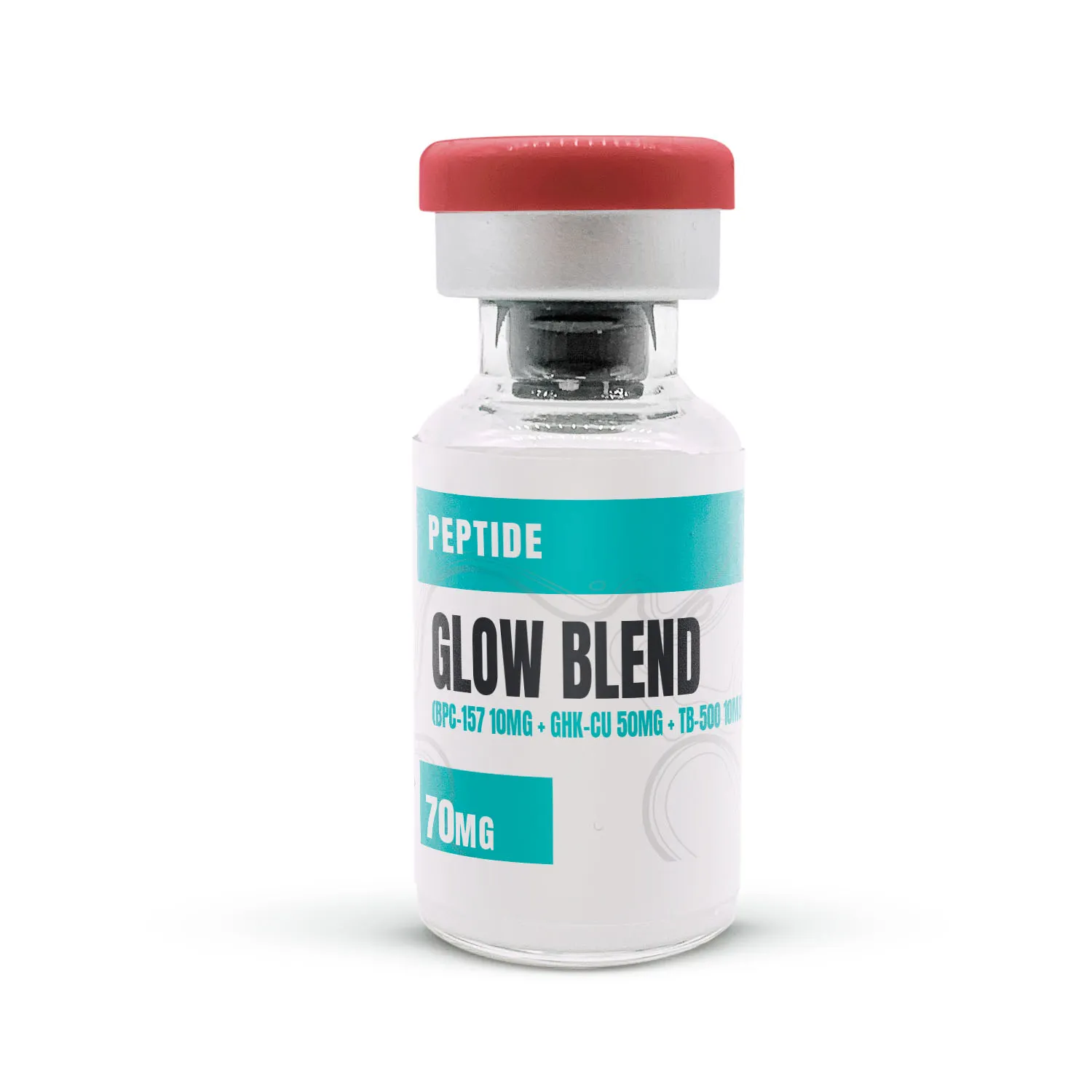
Three peptides co-blended at 10mg + 50mg + 10mg (70mg total per vial, catalog code GLOW70). This exact ratio has not been independently studied. Research Use Only; not FDA-approved; not for human or veterinary use. Requires IRB approval for human-subject research and IACUC approval for animal studies.
[Regulatory Note, July 2026]: BPC-157 was removed from FDA 503A Category 2 in April 2026. This does not mean it is approved for compounding; the FDA’s Pharmacy Compounding Advisory Committee (PCAC) is scheduled to evaluate BPC-157 for inclusion on the 503A Bulks List at its July 23–24, 2026 meeting. Compounding status remains unresolved pending that outcome.
BPC-157
A synthetic pentadecapeptide (15 amino acids) derived from a gastric-juice fragment, studied for tissue-repair and cytoprotective activity. Not a SARM.
BPC-157 Chemical Properties
| Property | Details |
| CAS Number | 137525-51-0 |
| Compound Type | Synthetic pentadecapeptide (gastric-juice-derived fragment) |
| Classification NOT a SARM | No androgen receptor activity |
| Molecular Weight | ~1,419.53 g/mol |
| Chemical Formula | C62H98N16O22 |
| Synonyms | PL 14736, Bepecin |
| PubChem Reference | CID 9941957 |
| Physical Form | Lyophilized powder |
| Purity | Verify per Certificate of Analysis |
| Storage | Ultra-low freezer (-20°C or lower); protect from light/moisture |
| Shelf Life | Verify per Certificate of Analysis |
| Regulatory Status | Research Use Only (RUO); not FDA-approved |
GHK-Cu
A copper(II) complex of the tripeptide Gly-His-Lys, studied for copper-dependent connective-tissue and matrix-remodeling activity. Not a SARM; not a GH-releasing peptide.
GHK-Cu Chemical Properties
| Property | Details |
| CAS Number | 89030-95-5 |
| Compound Type | Copper(II)-chelated tripeptide complex |
| Classification NOT a SARM | No androgen receptor activity |
| Classification NOT a GH-releasing peptide | Depends on chelated copper, not receptor signaling |
| Molecular Weight | ~400.9 g/mol |
| Chemical Formula | C14H21CuN6O4 |
| Synonyms | Copper Tripeptide-1, Copper Peptide |
| PubChem Reference | CID 71587328 |
| Physical Form | Lyophilized powder |
| Purity | Verify per Certificate of Analysis |
| Storage | Cool, dry, dark place, or ultra-low freezer for extended storage |
| Shelf Life | Verify per Certificate of Analysis |
| Regulatory Status | Research Use Only (RUO); not FDA-approved |
TB-500
The synthetic, full-length form of Thymosin Beta-4 (43 amino acids), studied for actin-binding and cytoskeletal activity. Note: “TB-500” sometimes refers to a shorter 7-amino-acid fragment (CAS 885340-08-9); this page describes the full-length sequence commonly sold under the TB-500 name. Not a SARM.
TB-500 Chemical Properties
| Property | Details |
| CAS Number | 77591-33-4 |
| Compound Type | Synthetic 43-amino-acid actin-binding peptide (Thymosin Beta-4) |
| Classification NOT a SARM | No androgen receptor activity |
| Molecular Weight | ~4,963.44 g/mol |
| Chemical Formula | C212H350N56O78S |
| Synonyms | Thymosin Beta-4, Timbetasin |
| PubChem Reference | CID 16132341 |
| Physical Form | Lyophilized powder |
| Purity | Verify per Certificate of Analysis |
| Storage | Ultra-low freezer (-20°C or lower); protect from light/moisture |
| Shelf Life | Verify per Certificate of Analysis |
| Regulatory Status | Research Use Only (RUO); not FDA-approved |
| WADA Status | Prohibited S2.3 (Growth Factors: Thymosin-β4 and its derivatives, e.g. TB-500) |
How the GLOW Blend Works in Research Models
BPC-157 is studied for cytoprotective, pro-angiogenic activity linked to the nitric oxide pathway. GHK-Cu is studied for stimulating collagen, elastin, and glycosaminoglycan synthesis via copper-dependent matrix remodeling. TB-500 is studied for its interaction with G-actin, linked to cell migration and tissue repair. These three complementary repair pathways have not been studied together in this specific blend.
Risk & Handling
- Handle with gloves, eye protection, and a fume hood or biosafety cabinet.
- Keep frozen and away from light/moisture until needed.
- Only trained lab personnel should reconstitute or dose this product.
Why Consider GLOW Blend for Research?
- Verified purity Tested per Certificate of Analysis (CoA)
- Identity verified LC-MS/HPLC analysis per lot
- Complete documentation Full CoA available on request
- Expert assistance Technical questions and compliance guidance
- Contact: help@ironmountainlabz.com
Frequently Asked Questions
Q1: What’s in this vial, one peptide or several?
Three peptides: BPC-157 (10mg), GHK-Cu (50mg), and TB-500 (10mg), totaling 70mg. Don’t assume it acts like any single peptide alone.
Q2: Why isn’t there a study on this exact blend?
Each peptide is well studied individually but not together in this ratio. Verify purity/stability from this product’s own CoA.
Q3: What is this blend generally studied for?
Tissue repair and regeneration, through three different routes: tissue protection, collagen/connective-tissue rebuilding, and cell-migration signaling. This describes the science, not a claim about this specific product.
Q4: Do I need permission to work with this?
Yes. Sold only to qualified researchers at licensed institutions. IRB approval required for human-subject work; IACUC approval for animal studies. Not for personal use.
Q5: How should this be stored and handled?
Ultra-low freezer (-20°C or colder), away from light/moisture. Use PPE (gloves, respirator, eye protection) and a fume hood/biosafety cabinet. Request the SDS from help@ironmountainlabz.com before first use.
References
- Sikiric P, Seiwerth S, Rucman R, et al. Stable gastric pentadecapeptide BPC 157-NO-system relation. Curr Pharm Des. 2014;20(7):1126-1135. PMID: 23755725. https://pubmed.ncbi.nlm.nih.gov/23755725/
- Pickart L, Margolina A. Regenerative and Protective Actions of the GHK-Cu Peptide in the Light of the New Gene Data. Int J Mol Sci. 2018;19(7):1987. PMID: 29986520. https://pubmed.ncbi.nlm.nih.gov/29986520/
- Maquart FX, Bellon G, Chaqour B, et al. In vivo stimulation of connective tissue accumulation by the tripeptide-copper complex glycyl-L-histidyl-L-lysine-Cu2+ in rat experimental wounds. J Clin Invest. 1993;92(5):2368-2376. PMID: 8227353. https://pubmed.ncbi.nlm.nih.gov/8227353/
- Goldstein AL, Hannappel E, Sosne G, Kleinman HK. Thymosin β4: a multi-functional regenerative peptide. Basic properties and clinical applications. Expert Opin Biol Ther. 2012;12(1):37-51. PMID: 22074294. https://pubmed.ncbi.nlm.nih.gov/22074294/
IML Affiliate Disclosure
Some links on IML may connect readers with third-party suppliers through affiliate arrangements. IML may receive compensation from qualifying transactions at no additional cost to the reader, but the third-party supplier remains responsible for the actual sale, fulfillment, and product documentation.