

Description
Mitoquinone Mesylate (MitoQ) Research Overview
Disclaimer: The compounds described on this page are intended for laboratory research use only and are not approved for human consumption.
Overview of Mitoquinone Mesylate (MitoQ)
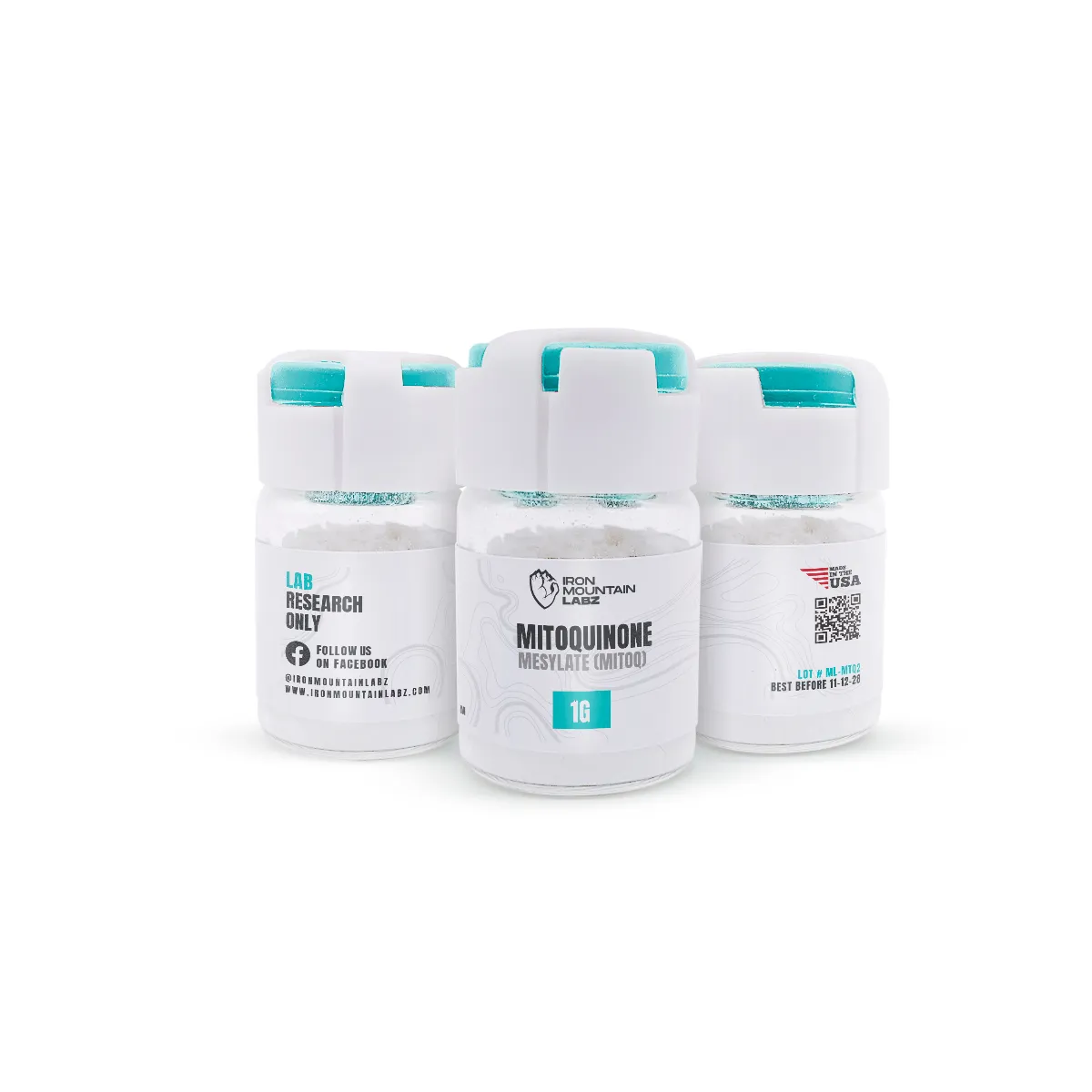
Mitoquinone mesylate (MitoQ; CAS 845959-50-4) is a ubiquinone-TPP conjugate small molecule – CoQ10’s ubiquinone (2,3-dimethoxy-5-methyl-1,4-benzoquinone) redox moiety covalently linked to a lipophilic triphenylphosphonium (TPP⁺) cation via a 10-carbon aliphatic linker, supplied as the methanesulfonate salt. Molecular formula (mesylate): C37H44O4P⁺·CH3O3S⁻; MW: 678.82 g/mol; PubChem CID: 66870706. It is classified as a supplement and nootropic research compound. MitoQ is not a SARM – it has no androgen receptor activity. It is not a peptide – it is CoQ10 (a fat-soluble vitamin-like quinone molecule) linked to a triphenylphosphonium cation; it contains no amino acid chain. Market price: $100–$250 / 1g research grade; $45 / 60 capsules (MitoQ.com consumer supplement) (USA, July 2026).
CAS disambiguation: CAS 845959-50-4 = Mitoquinone mesylate (quinone/oxidized form – this product). CAS 845959-55-9 = Mitoquinol mesylate (hydroquinone/reduced form) – a different compound. Confirm the correct CAS before procurement and use.
MitoQ is sold as a consumer supplement by the MitoQ brand and has been investigated in human clinical trials for vascular aging and liver disease. The linked vendor supplies research-grade mitoquinone mesylate for laboratory investigation of mitochondria-targeted antioxidant mechanisms – not as the consumer supplement product.
This product is not approved by the FDA as a drug. Intended for laboratory and research purposes only; not a dietary supplement or consumer product in this research-grade formulation. Restricted to qualified researchers and licensed laboratory institutions.
Chemical Properties
| Section | Details |
| CAS Number | 845959-50-4 (Mitoquinone mesylate; quinone/oxidized form – this product) |
| CAS Note | ≠ CAS 845959-55-9 (Mitoquinol mesylate; quinol/reduced form – different compound) |
| Chemical Class | Ubiquinone-TPP Conjugate / Small Molecule |
| Classification – NOT a SARM | No androgen receptor activity |
| Classification – NOT a Peptide | CoQ10 ubiquinone moiety linked to triphenylphosphonium cation; no amino acid chain |
| Regulatory Status | Dietary Supplement + Research-Grade; sold as consumer supplement by MitoQ brand; sold here as research-grade material only |
| Molar Mass | 678.82 g/mol (mesylate salt) |
| Chemical Formula | C37H44O4P⁺·CH3O3S⁻ |
| IUPAC Name | 10-(4,5-dimethoxy-2-methyl-3,6-dioxocyclohexa-1,4-dien-1-yl)decyl-triphenylphosphanium methanesulfonate |
| Synonyms | MitoQ; mitoquinone mesylate; TPP-ubiquinone conjugate; mitochondria-targeted CoQ10 |
| PubChem CID | 66870706 |
| Physical Form | Yellow to orange-yellow amorphous or crystalline solid |
| Purity | ≥99% (HPLC-UV); TPP⁺ identity confirmed by ³¹P-NMR |
| Solubility | Ethanol: ≥20 mg/mL; DMSO: soluble; water: sparingly soluble (<0.5 mg/mL) |
| Storage | −20°C; amber vials; sealed under N₂/Ar; protect from light – benzoquinone photosensitive |
| Shelf Life | 24 months from manufacture date |
| Classification | Research Use Only (RUO) |
Mitoquinone Mesylate’s Mechanism of Action in Research Models
Within mitochondria-targeted antioxidant research, MitoQ exploits the large, negative mitochondrial membrane potential (ΔΨm; −160 to −180 mV) to concentrate the TPP⁺ cation selectively within the mitochondrial matrix – accumulating ~500–1,000-fold relative to the cytoplasm, driven by the electrophoretic force on the lipophilic cation crossing the inner mitochondrial membrane. Once within the mitochondrial lipid bilayer, MitoQ’s benzoquinone moiety is continuously cycled between the oxidized (quinone) and reduced (quinol/MitoQH₂) forms by Complex II (succinate dehydrogenase), generating the active antioxidant species. MitoQH₂ then scavenges superoxide (O₂•⁻), hydroxyl radical (•OH), and peroxynitrite (ONOO⁻) via radical chain-breaking antioxidant chemistry within the mitochondrial inner membrane, where free radical damage is most concentrated.
Adlam et al. (2005) demonstrated the founding preclinical proof-of-concept for MitoQ: rats fed MitoQ showed significantly reduced heart dysfunction, cell death, and mitochondrial damage after cardiac ischemia-reperfusion injury – and critically, protection was abolished by an untargeted analog (decyl-ubiquinone) and by the TPP⁺ cation alone, confirming that both mitochondrial targeting AND antioxidant activity are required for in vivo protection (DOI). Rossman et al. (2018) translated these findings to humans in a randomized, placebo-controlled, double-blind crossover trial in 20 healthy older adults, demonstrating that 6 weeks of oral MitoQ (20 mg/day) improved brachial artery flow-mediated dilation by 42% versus placebo and reduced aortic stiffness (carotid-femoral pulse wave velocity) – effects associated with amelioration of mitochondrial ROS-mediated suppression of endothelial function (DOI). Data remains limited, and findings are not consistent across all experimental model systems.
Risk & Handling
Risk Tier: LOW-MODERATE
MitoQ is a lipophilic quinone-TPP conjugate supplement compound. No significant acute human toxicity at laboratory handling concentrations:
- Photosensitivity: Benzoquinone chromophore is light-sensitive – amber vials mandatory; foil-wrap all solution storage; work under reduced-light conditions
- Inert atmosphere: Store sealed under N₂/Ar to prevent aerial oxidation of the benzoquinone ring
- Reducing agent incompatibility: Avoid DTT, ascorbate, or other strong reducing agents in the same solution – uncontrolled redox cycling will consume MitoQ
- CAS verification: Confirm 845959-50-4 (quinone) vs. 845959-55-9 (quinol) on the COA before use in redox experiments
- PPE: Nitrile gloves, lab coat, and safety eyewear for all handling operations
- No human safety data established for this research-grade formulation. Contact help@ironmountainlabz.com for the Safety Data Sheet.
Why Consider MitoQ Mesylate for Research?
- Purity: ≥99% by HPLC-UV per lot; TPP⁺ identity confirmed by ³¹P-NMR per lot
- CAS verified: 845959-50-4 (quinone/oxidized sold form; distinct from reduced quinol 845959-55-9)
- Identity: confirmed by ¹H-NMR and LC-MS per lot
- Residual solvents: ≤300 ppm by GC headspace per lot (ICH Q3C compliant)
- Endotoxin: ≤1.0 EU/mg (LAL gel-clot method)
- Certificate of Analysis available on request per lot
- For queries, complaints, or support, please contact help@ironmountainlabz.com
FAQs
Q1: What is MitoQ chemically, and why is it not a SARM or peptide? MitoQ is a ubiquinone-TPP conjugate – CoQ10’s ubiquinone redox moiety covalently linked to a triphenylphosphonium cation via a 10-carbon linker, as the mesylate salt. It contains no amino acid chain, making it definitively not a peptide. It has no androgen receptor activity, making it definitively not a SARM. In consumer markets it is sold as a supplement by the MitoQ brand; The linked vendor supplies research-grade material for laboratory use only.
Q2: What is the critical CAS distinction for MitoQ?
CAS 845959-50-4 = Mitoquinone mesylate (quinone/oxidized form – the stable sold form, this product). CAS 845959-55-9 = Mitoquinol mesylate (hydroquinone/reduced form). In biological systems, the quinone form is intracellularly reduced to the antioxidant quinol form by Complex II. Always verify the CAS on the COA before use in redox mechanism experiments.
Q3: What research applications has MitoQ been investigated in?
In preclinical and clinical laboratory settings: mitochondrial ROS scavenging assays, cardiac ischemia-reperfusion injury models, vascular endothelial function research (flow-mediated dilation assays), mitochondrial membrane potential (JC-1 assay) studies, neurodegenerative disease oxidative stress models, and human clinical trials for vascular aging and liver disease. All applications as per applicable institutional and regulatory frameworks.
Q4: Why is the TPP⁺ mechanism important for understanding MitoQ’s research utility?
The lipophilic TPP⁺ cation accumulates ~500–1,000-fold within mitochondria driven by ΔΨm, achieving pharmacologically relevant antioxidant concentrations at the inner mitochondrial membrane without requiring active transport. This makes MitoQ a powerful research tool for studying mitochondrial oxidative stress in intact cells and in vivo. Critically, decyl-TPP⁺ (TPP⁺ without the antioxidant moiety) serves as the key mitochondrial-targeting specificity control in research experiments.
Q5: What storage and photosensitivity precautions are needed?
Amber vials; inert atmosphere storage at −20°C; foil-wrap solutions. Strong reducing agents in the same solution will reduce the quinone ring – separate deliberately or account for this in experimental design. Verify CAS 845959-50-4 on COA. No human safety data established for this research-grade formulation.
References
- Adlam VJ, Harrison JC, Porteous CM, et al. Targeting an antioxidant to mitochondria decreases cardiac ischemia-reperfusion injury. FASEB J. 2005;19(9):1088–1095. PMID: 15985532.
https://pubmed.ncbi.nlm.nih.gov/15985532/ - Rossman MJ, Santos-Parker JR, Steward CAC, et al. Chronic supplementation with a mitochondrial antioxidant (MitoQ) improves vascular function in healthy older adults. Hypertension. 2018;71(6):1056–1063. PMID: 29661838.
https://pubmed.ncbi.nlm.nih.gov/29661838/ - Murphy MP, Smith RAJ. Targeting antioxidants to mitochondria by conjugation to lipophilic cations. Annual Review of Pharmacology and Toxicology. 2007;47:629–656. PMID: 16918266 https://pubmed.ncbi.nlm.nih.gov/16918266/
IML Affiliate Disclosure
Some links on IML may connect readers with third-party suppliers through affiliate arrangements. IML may receive compensation from qualifying transactions at no additional cost to the reader, but the third-party supplier remains responsible for the actual sale, fulfillment, and product documentation.