

Description
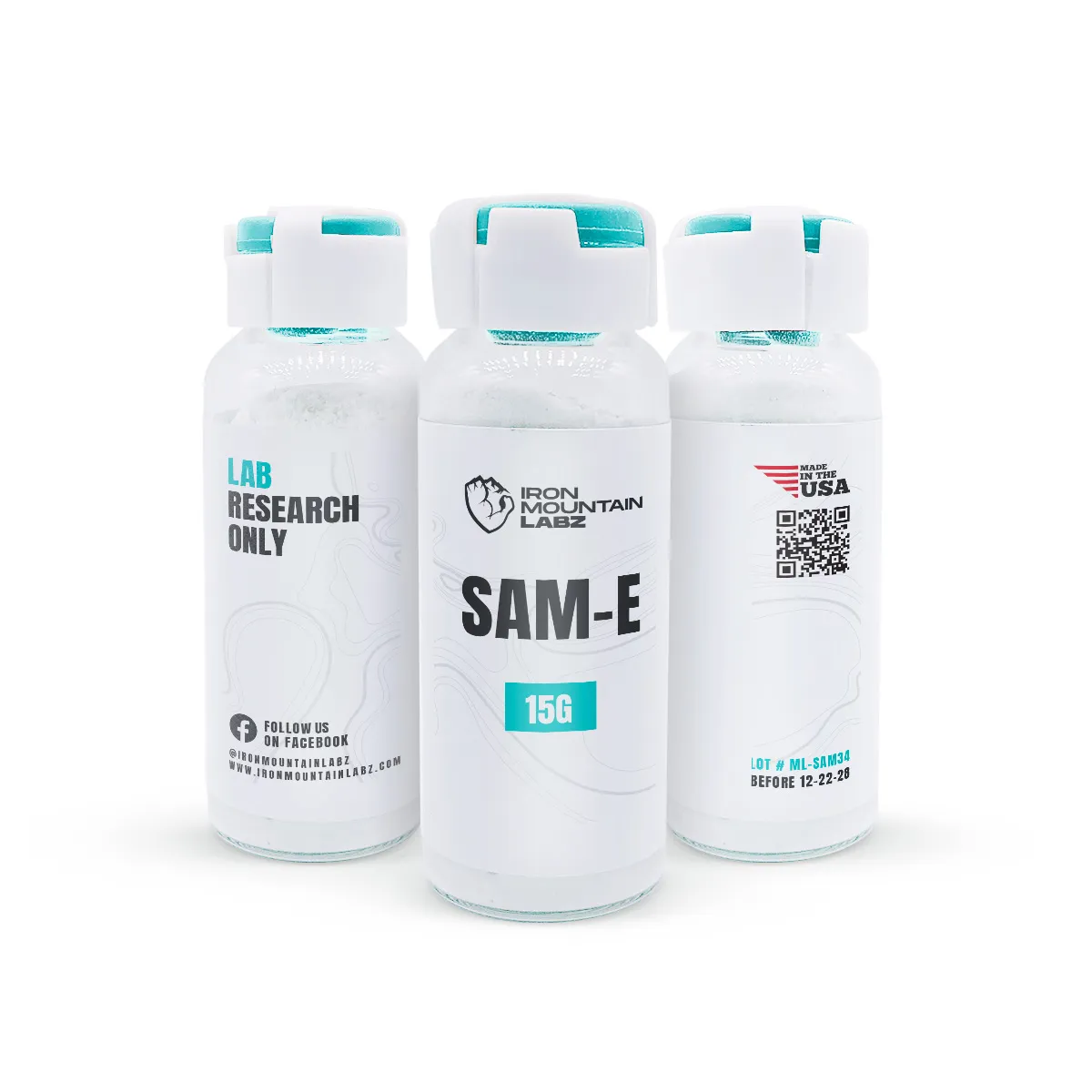
SAM-e Powder Research Overview
Disclaimer: The compounds described on this page are intended for laboratory research use only and are not approved for human consumption.
Overview of SAM-e Powder
S-Adenosyl-L-methionine (SAM-e; CAS 29908-03-0) is a coenzyme / methyl donor – the universal biological methyl group donor for over 40 SAM-dependent methyltransferase (SAMT) reactions in mammalian cells. It is classified as a supplement research compound. SAM-e is not a SARM – it has no androgen receptor activity. SAM-e is not a peptide – while it is biosynthesized from the amino acid methionine (via methionine adenosyltransferase, MAT, condensing methionine with ATP), the product is itself a single coenzyme molecule (S-adenosyl-L-methionine), not an amino acid chain or peptide. The adenosyl group replaces the amino acid’s methyl group in a distinct chemical modification. Molecular formula: C15H23N6O5S⁺ (sulfonium cation); MW: 398.43 g/mol (as sulfonium cation); PubChem CID: 34756.
SAM-e occupies a central position in one-carbon metabolism as the principal methyl group donor for methylation of DNA (by DNMT1, DNMT3a, DNMT3b), RNA (m6A, m5C modifications), histones (H3K4, H3K9, H3K27 by HKMTs), proteins, phospholipids, and small molecules. Each methyl transfer generates S-adenosylhomocysteine (SAH) – a potent product inhibitor of virtually all SAMTs. In the US, SAM-e is a DSHEA dietary supplement ingredient; in several EU countries (Italy, Germany, Spain), it is a prescription pharmaceutical (Ademethionine/Samyr®) for intrahepatic cholestasis and depressive disorders. The linked vendor supplies research-grade SAM-e for laboratory investigation of one-carbon metabolism, epigenetic methylation research, and methyltransferase biochemistry – not as any pharmaceutical preparation.
This product is not approved by the FDA as a drug for any therapeutic indication beyond DSHEA supplement context. Intended for laboratory and research purposes only; not a dietary supplement or consumer product in this research-grade formulation. Restricted to qualified researchers and licensed laboratory institutions. IRB guidance is required for clinical research; IACUC compliance is required for preclinical animal research. Critical handling note: SAM-e is highly chemically labile – it spontaneously racemizes at the sulfonium center and undergoes adenosine deamination in aqueous solution. Store at −80°C in single-use aliquots under inert atmosphere; never freeze-thaw repeatedly.
Chemical Properties
| Section | Details |
| CAS Number | 29908-03-0 (sulfonium salt form) |
| Chemical Class | Coenzyme / Methyl Donor |
| Classification – NOT a SARM | No androgen receptor activity |
| Classification – NOT a Peptide | Derived from amino acid methionine but is itself a single coenzyme molecule; not an amino acid chain |
| Regulatory Status | Dietary Supplement (DSHEA) in USA; Rx pharmaceutical (Ademethionine/Samyr®) in some EU countries; sold here as research-grade material only |
| Molar Mass | 398.43 g/mol (sulfonium cation); varies by counterion/salt form |
| Chemical Formula | C15H23N6O5S⁺ (sulfonium cation, PubChem CID 34756); C15H22N6O5S (neutral free base, PubChem CID 34755) |
| IUPAC Name | (2S)-2-amino-4-[[(2S,3S,4R,5R)-5-(6-aminopurin-9-yl)-3,4-dihydroxyoxolan-2-yl]methyl-methylsulfaniumyl]butanoic acid |
| Synonyms | SAM-e; S-adenosylmethionine; AdoMet; SAM; SAM·HCl; Ademethionine; Samyr® (EU pharmaceutical – not this product) |
| PubChem CID | 34756 |
| Physical Form | White to off-white hygroscopic powder (tosylate or HCl salt form) |
| Purity | ≥99% (HPLC-UV); (S,S)-diastereomer ratio reported on COA per lot |
| Active Diastereomer | Only (S,S)-SAM-e is biologically active – verify ratio on COA before quantitative assay use |
| Solubility | Water: soluble at pH 4–5 (acidic stability zone); DMSO: sparingly soluble; avoid neutral/basic aqueous pH – rapid decomposition |
| Storage | −80°C (preferred) or −20°C under N₂/Ar; pre-aliquot into single-use tubes immediately upon receipt; minimize freeze-thaw cycles to zero |
| Shelf Life | 12–18 months from manufacture at −80°C; shorter at −20°C |
| Classification | Research Use Only (RUO) |
SAM-e Powder’s Mechanism of Action in Research Models
Within one-carbon metabolism research, SAM-e functions as the universal methyl donor by donating its activated methyl group to nucleophilic nitrogen (N), oxygen (O), or carbon (C) acceptors via SN2-type reactions catalyzed by SAM-dependent methyltransferases (SAMTs). The sulfonium center of SAM-e is electrophilically activated: the positively charged sulfur polarizes the methyl-S bond, rendering the methyl group susceptible to nucleophilic attack. After each methyl transfer, S-adenosylhomocysteine (SAH) is generated; SAH is then hydrolyzed by SAH hydrolase (AHCY; EC 3.3.1.1) to homocysteine + adenosine, and homocysteine is re-methylated to methionine via methionine synthase (MS; MTR) using 5-methyltetrahydrofolate (5-mTHF) as the methyl source – completing the methionine cycle.
Jeandel et al. (2026) provided experimental evidence of methionine synthase (MS) localization and activity in the cell nucleus, where it interacts with MATα2 (the catalytic subunit of MATII responsible for nuclear SAM production) and the methyltransferase DNMT3b – demonstrating the spatial compartmentalization of one-carbon metabolism in the nucleus and its direct relevance to epigenome regulation via localized SAM availability (DOI). Tillmann et al. (2018) characterized liver SAM levels in a genetic rat depression model (FSL rats), demonstrating that SAM levels in liver were significantly reduced in the depression model vs. controls and were modulated by dietary interventions – establishing SAM as a measurable biomarker of one-carbon metabolic capacity in preclinical depression research models (DOI). Data remains limited, and findings are not consistent across all experimental model systems.
Risk & Handling
Risk Tier: LOW-MODERATE
SAM-e is an endogenous coenzyme. The primary laboratory hazard is its exceptional chemical lability rather than acute toxicity:
- Chemical lability – CRITICAL: SAM-e racemizes spontaneously at the sulfonium center at neutral/basic pH and deaminates at elevated temperature; aqueous solutions at pH 7 / 37°C decompose within hours – only the (S,S)-diastereomer is biologically active
- Storage protocol: Pre-aliquot into single-use volumes upon receipt; store at −80°C under N₂/Ar; never freeze-thaw; zero freeze-thaw cycles
- Prepare aqueous solutions at pH 4–5 (dilute HCl) immediately before use; do not prepare ahead
- Hygroscopic: Reseal immediately after use; include desiccant
- PPE: Nitrile gloves, lab coat, and safety eyewear for all handling operations
- No human safety data established for this research-grade formulation. Contact help@ironmountainlabz.com for the Safety Data Sheet.
Why Consider SAM-e Powder for Research?
- Purity: ≥99% by HPLC-UV per lot; (S,S)-diastereomer ratio specified on COA
- Identity: confirmed by ¹H-NMR and LC-MS/MS per lot
- Heavy metals: Pb ≤0.5 ppm; As ≤0.5 ppm (ICP-MS)
- Stability check: UV absorbance at 254 nm (adenosine chromophore integrity) assessed per lot
- Certificate of Analysis with (S,S)-diastereomer ratio data available on request per lot
- For queries, complaints, or support, please contact help@ironmountainlabz.com
FAQs
Q1: What is SAM-e chemically, and why is it not a SARM or peptide?
SAM-e is a coenzyme / methyl donor – S-adenosyl-L-methionine, a sulfonium coenzyme produced by methionine adenosyltransferase (MAT) condensing methionine with ATP. While derived from the amino acid methionine, SAM-e itself is a single coenzyme molecule with a modified adenosyl group – not a peptide chain. It has no androgen receptor activity, making it definitively not a SARM. In the US it is a DSHEA dietary supplement; in some EU countries a prescription drug.
Q2: Why is the (S,S)-diastereomer distinction critical for SAM-e research? SAM-e has two stereocenters – the α-amino acid carbon and the sulfonium center. Only the naturally occurring (S,S)-diastereomer is biologically active and recognized by SAMTs. The (R,S)-diastereomer forms during synthesis and degrades further on storage. Certificates of analysis, where available, are provided by the vendor. Readers should review the vendor’s documentation for the specific batch. Verify this ratio before use in quantitative methyltransferase assays.
Q3: What research applications has SAM-e been investigated in?
In preclinical and in vitro laboratory settings: methyltransferase enzyme kinetics (DNMT activity assays, PKMT/PRMT histone methyltransferase assays), one-carbon metabolism flux analysis, epigenetic methylation research, liver metabolism and hepatosteatosis models, neurological methylation research, and gut-brain axis metabolic studies. All in laboratory and preclinical contexts only.
Q4: How must SAM-e be stored to maintain biological activity?
Pre-aliquot single-use volumes upon receipt; store at −80°C under N₂/Ar inert atmosphere (shelf life: 12–18 months; shorter at −20°C). Never freeze-thaw. Prepare working solutions at pH 4–5 in ice-cold buffer immediately before use. Monitor (S,S)-diastereomer ratio by chiral HPLC if using stored material in critical quantitative experiments. No human safety data established for this research-grade formulation.
Q5: What is the EU regulatory status of SAM-e and how does it affect research use? Ademethionine (SAM-e) is a prescription pharmaceutical for intrahepatic cholestasis and depressive disorders in some EU countries (Samyr® in Italy/Germany). The linked vendor supplies research-grade material for laboratory investigation only – not as the Ademethionine pharmaceutical. This product must not be used for unauthorized human therapeutic purposes. Not FDA-approved as a drug in the US.
References
-
- Jeandel M, Alberto JM, Baspinar O, et al. Methionine synthase interacts with the methionine adenosyl-transferase MATα2 and the DNA methyltransferase DNMT3b in the nucleus. J Inherit Metab Dis. 2026;49(4):e70211. PMID: 42309558.
https://pubmed.ncbi.nlm.nih.gov/42309558/ - Tillmann S, Awwad HM, Eskelund AR, et al. Probiotics affect one-carbon metabolites and catecholamines in a genetic rat model of depression. Mol Nutr Food Res. 2018;62(7):e1701070. PMID: 29453804.
https://pubmed.ncbi.nlm.nih.gov/29453804/ - Lu SC, Mato JM. S-Adenosylmethionine in liver health, injury, and cancer. Physiological Reviews. 2012;92(4):1515–1542. PMID: 23073631 https://pubmed.ncbi.nlm.nih.gov/23073631/
- Jeandel M, Alberto JM, Baspinar O, et al. Methionine synthase interacts with the methionine adenosyl-transferase MATα2 and the DNA methyltransferase DNMT3b in the nucleus. J Inherit Metab Dis. 2026;49(4):e70211. PMID: 42309558.
IML Affiliate Disclosure
Some links on IML may connect readers with third-party suppliers through affiliate arrangements. IML may receive compensation from qualifying transactions at no additional cost to the reader, but the third-party supplier remains responsible for the actual sale, fulfillment, and product documentation.