

Description
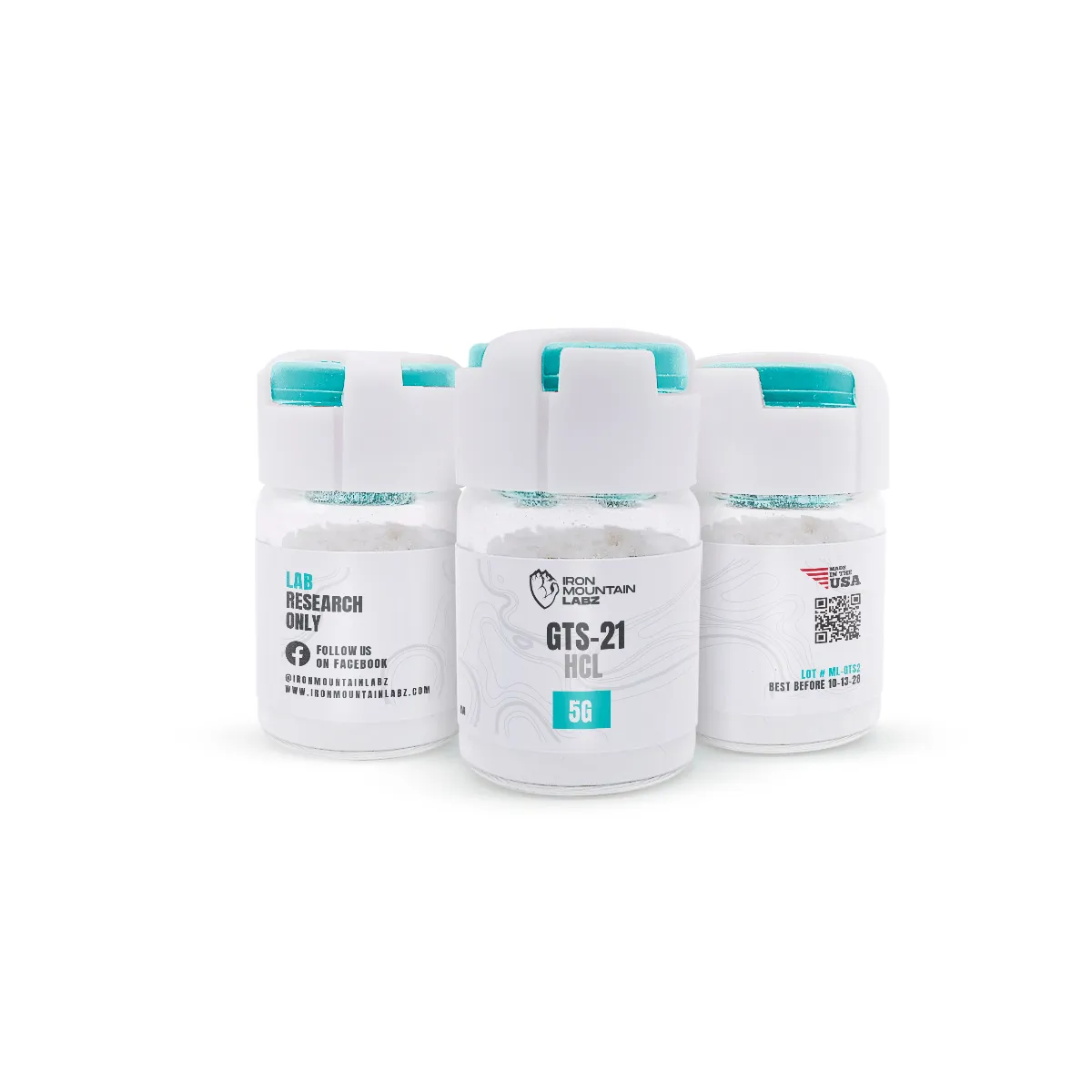
GTS-21 HCl Research Overview
Disclaimer: The compounds described on this page are intended for laboratory research use only and are not approved for human consumption.
Overview of GTS-21 HCl
GTS-21 dihydrochloride (DMXB-A; CAS 156223-05-1) is an anabaseine derivative small molecule – a synthetic compound built on the pyridine-tetrahydropyridine bicyclic scaffold of anabaseine, the marine worm toxin from Paranemertes peregrina, with a 2,4-dimethoxybenzylidene substituent at the 3-position of the tetrahydropyridine ring. Molecular formula: C19H20N2O2·2HCl; MW: 369.29 g/mol (dihydrochloride); CAS (free base): 112939-12-5. It is classified as a nootropic research compound. GTS-21 is not a SARM – it targets the α7 nicotinic acetylcholine receptor (α7-nAChR; CHRNA7 gene), not androgen receptors. It is not a peptide – it is a single synthetic small molecule alkaloid derived from the anabaseine scaffold; it contains no amino acid chain.
GTS-21 is the most widely characterized selective α7-nAChR partial agonist in research, with clinical trial history in schizophrenia (Phase 1/2) and extensive preclinical data in cognitive, inflammatory, and neuroprotective research models. Its nootropic classification reflects its primary investigation in α7-nAChR-mediated cognitive enhancement and cholinergic anti-inflammatory pathway (CAP) research.
This product is not approved by the FDA for any therapeutic indication. Intended for laboratory and research purposes only; not a dietary supplement or consumer product. Restricted to qualified researchers and licensed laboratory institutions. IRB guidance required for clinical research; IACUC compliance required for preclinical animal research. Pharmacologically active alkaloid – handle with appropriate precautions.
Chemical Properties
| Section | Details |
| CAS Number | 156223-05-1 (dihydrochloride salt) |
| Chemical Class | Anabaseine Derivative / Small Molecule |
| Classification – NOT a SARM | Targets α7-nAChR (CHRNA7), not androgen receptors |
| Classification – NOT a Peptide | Derived from marine toxin anabaseine; single small alkaloid molecule; no amino acid chain |
| Regulatory Status | Research Compound – Not FDA-Approved |
| Molar Mass | 369.29 g/mol (dihydrochloride salt, verified); free base MW to be confirmed via PubChem – verify from batch COA |
| Chemical Formula | C19H20N2O2·2HCl |
| IUPAC Name | (E)-3-(2,4-dimethoxybenzylidene)-3,4,5,6-tetrahydro-2,3′-bipyridine dihydrochloride |
| Synonyms | GTS-21; DMXB-A; DMXBA; 3-(2,4-dimethoxybenzylidene)anabaseine 2HCl; α7-nAChR partial agonist |
| PubChem CID | 5310985 (free base reference) |
| Physical Form | White to off-white crystalline solid |
| Purity | ≥99% (HPLC-UV) |
| Solubility | Water: ≥10 mg/mL (as 2HCl salt); DMSO: soluble; ethanol: soluble |
| Storage | −20°C; sealed; protect from light and moisture |
| Shelf Life | 24 months from manufacture date |
| Classification | Research Use Only (RUO) |
GTS-21 HCl’s Mechanism of Action in Research Models
Within nicotinic receptor pharmacology research, GTS-21 acts as a selective partial agonist of the α7-nAChR homopentamer (five CHRNA7 subunits arranged around a central cation-selective pore). At the orthosteric ACh binding site located at each of the five subunit interfaces within the extracellular domain – formed by the aromatic cage residues Trp147, Tyr93, Tyr188, Tyr195, and the Cys190-Cys191 vicinal disulfide loop – GTS-21 produces submaximal channel activation (~30–40% of maximal ACh response) with slower desensitization kinetics compared to full agonists.
α7-nAChR is a Ca²⁺-permeable channel with a high relative calcium permeability (PCa/PNa ~20), and its activation in macrophages and vagal neurons drives the cholinergic anti-inflammatory pathway (CAP) via JAK2-STAT3 signaling, suppressing NF-κB-mediated TNF-α, IL-1β, IL-6, and HMGB1 production. Kem et al. (2018) conducted a randomized, placebo-controlled, double-blind Phase 1/2 crossover trial of DMXB-A (GTS-21) in schizophrenia patients, characterizing the compound’s pharmacokinetics, cognitive effects on the MATRICS Consensus Cognitive Battery, and P50 sensory gating – establishing the clinical pharmacology profile and pharmacokinetic limitations of this α7-nAChR agonist in human subjects (DOI). Jones et al. (2014) demonstrated in a preclinical rat attentional set-shifting model that GTS-21, alongside other α7-nAChR agonists, significantly reversed MK-801-induced executive function deficits in a maze-based assay – validating the preclinical framework for α7-nAChR agonist cognitive research (DOI). Data remains limited, and findings are not consistent across all model systems.
Risk & Handling
Risk Tier: MODERATE
GTS-21 is a pharmacologically active α7-nAChR partial agonist alkaloid – active at micromolar concentrations:
- CNS/immune activity: Avoid skin contact and inhalation – systemic absorption risk through mucosa or skin
- DMSO solutions: Chemical-resistant gloves required – DMSO is a penetration enhancer
- HCl salt: Mildly acidic in aqueous solution – avoid eye contact; flush immediately with water if contact occurs
- PPE: Nitrile gloves, lab coat, and safety eyewear for all handling operations
- No DEA scheduling; not a controlled substance – verify applicable local regulations
- No human safety data established for this research-grade formulation. Contact help@ironmountainlabz.com for the Safety Data Sheet.
Why Consider GTS-21 HCl for Research?
- Purity: ≥99% by HPLC-UV per lot
- Identity: confirmed by ¹H-NMR and LC-MS/MS per lot
- Residual solvents: ≤300 ppm by GC headspace per lot (ICH Q3C compliant)
- Endotoxin: ≤1.0 EU/mg (LAL gel-clot method)
- Certificate of Analysis available on request per lot
- For queries, complaints, or support, please contact help@ironmountainlabz.com
FAQs
Q1: What is GTS-21 chemically, and why is it not a SARM or peptide?
GTS-21 is an anabaseine derivative small molecule – a single synthetic alkaloid built on the pyridine-tetrahydropyridine scaffold of the marine toxin anabaseine with a 2,4-dimethoxybenzylidene substituent. It contains no amino acid chain, making it definitively not a peptide. It targets α7-nAChR – not androgen receptors – making it definitively not a SARM. Its nootropic classification reflects its investigation in α7-nAChR-mediated cognitive, neuroprotective, and anti-inflammatory research.
Q2: What is GTS-21’s clinical research history? GTS-21 (DMXB-A) has been investigated in Phase 1/2 clinical trials for cognitive deficits in schizophrenia, examining effects on the MATRICS Consensus Cognitive Battery and P50 auditory gating. The linked vendor supplies research-grade material for laboratory investigation only – not as a clinical formulation. Not FDA-approved for any indication.
Q3: What research applications has GTS-21 been investigated in?
In preclinical and in vitro laboratory settings: α7-nAChR binding and functional assays (electrophysiology, Ca²⁺ imaging), cholinergic anti-inflammatory pathway research (macrophage NF-κB/STAT3 signaling, TNF-α/HMGB1 assays), attentional set-shifting and cognitive flexibility assays in rodent models, P50 sensory gating models, and comparative α7-nAChR pharmacology (partial vs. full agonist studies). All in laboratory and preclinical contexts only.
Q4: How does GTS-21 differ from full α7-nAChR agonists in research?
GTS-21 produces ~30–40% of maximal ACh response (partial agonist) and desensitizes more slowly than full agonists – enabling sustained α7-nAChR signaling in research assays. This partial agonism reduces the risk of receptor tachyphylaxis that limits the research utility of full agonists. GTS-21 shows greater α7 selectivity over α4β2 receptors than nicotine, making it a useful tool for α7-specific mechanistic research.
Q5: What safety precautions apply to GTS-21 research handling?
Pharmacologically active alkaloid – avoid skin contact and inhalation. Nitrile gloves, lab coat, eyewear. Chemical-resistant gloves for DMSO solutions. HCl salt is mildly acidic – flush eyes immediately with water if contact occurs. No human safety data established for this research-grade formulation. Contact help@ironmountainlabz.com for the Safety Data Sheet.
References
-
- Kem WR, Olincy A, Johnson L, et al. Pharmacokinetic limitations on effects of an alpha7-nicotinic receptor agonist in schizophrenia: randomized trial with an extended-release formulation. Neuropsychopharmacology. 2018;43(3):583–589. PMID: 28825423.
https://pubmed.ncbi.nlm.nih.gov/28825423/ - Jones KM, McDonald IM, Bourin C, et al. Effect of alpha7 nicotinic acetylcholine receptor agonists on attentional set-shifting impairment in rats. Psychopharmacology (Berl). 2014;231(4):673–683. PMID: 24057763.
https://pubmed.ncbi.nlm.nih.gov/24057763/ - Pavlov VA, Ochani M, Yang LH, et al. Selective alpha7-nicotinic acetylcholine receptor agonist GTS-21 improves survival in murine endotoxemia and severe sepsis. Critical Care Medicine. 2007;35(4):1139–1144. PMID: 17334244 https://pubmed.ncbi.nlm.nih.gov/17334244/
- Kem WR, Olincy A, Johnson L, et al. Pharmacokinetic limitations on effects of an alpha7-nicotinic receptor agonist in schizophrenia: randomized trial with an extended-release formulation. Neuropsychopharmacology. 2018;43(3):583–589. PMID: 28825423.
IML Affiliate Disclosure
Some links on IML may connect readers with third-party suppliers through affiliate arrangements. IML may receive compensation from qualifying transactions at no additional cost to the reader, but the third-party supplier remains responsible for the actual sale, fulfillment, and product documentation.