

Description
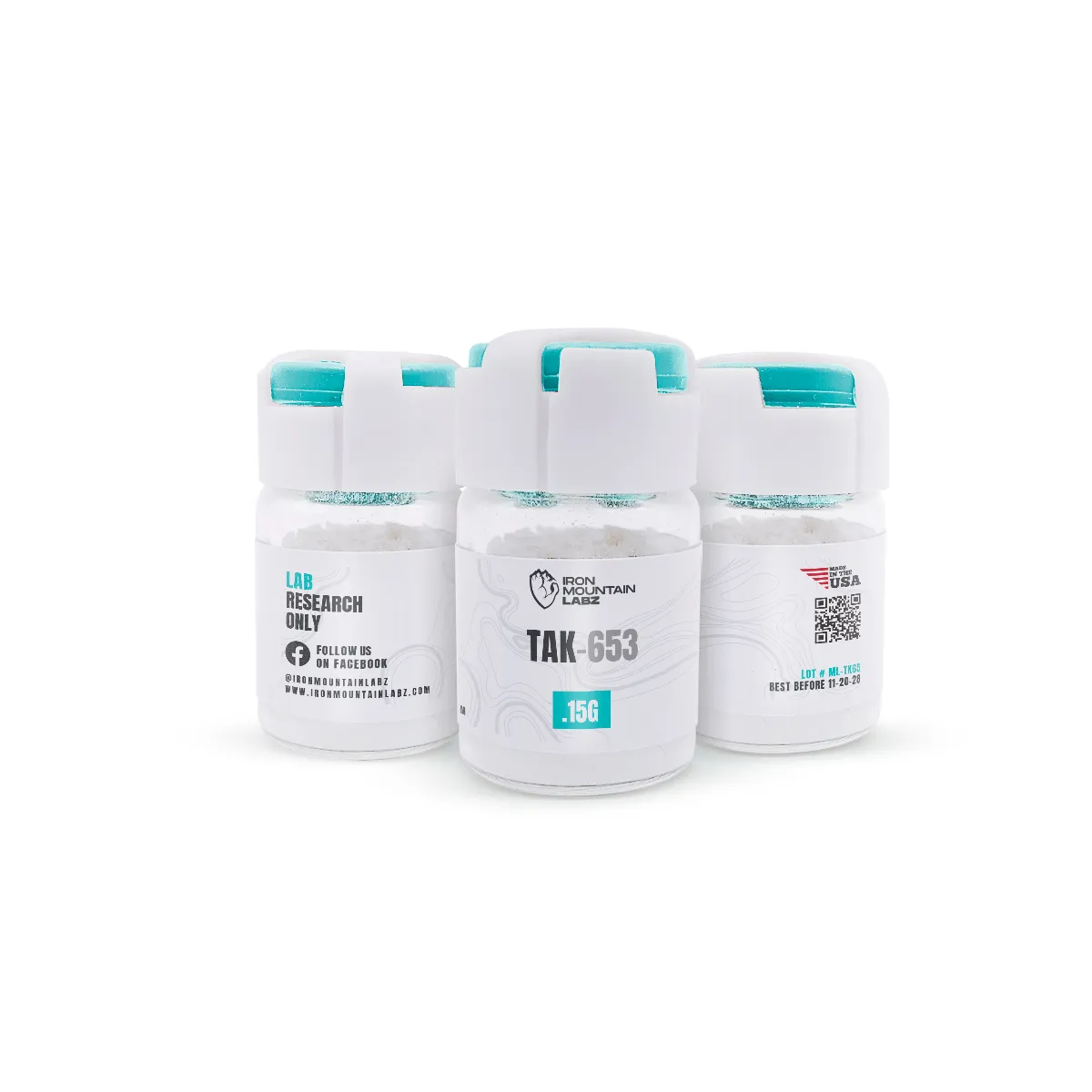
TAK-653 Powder Research Overview
Disclaimer: The compounds described on this page are intended for laboratory research use only and are not approved for human consumption.
Overview of TAK-653 Powder
TAK-653 (CAS 1358751-06-0; osavampator) is a heterocyclic small molecule – specifically a dihydropyrazino[2,1-c][1,2,4]thiadiazine 2,2-dioxide – classified as a nootropic research compound and AMPA receptor positive allosteric modulator (PAM). Molecular formula: C19H23N3O3S; MW: 375.46 g/mol; PubChem CID: 56655833; IUPAC: 9-[4-(cyclohexyloxy)phenyl]-7-methyl-3,4-dihydropyrazino[2,1-c][1,2,4]thiadiazine 2,2-dioxide. TAK-653 is not a SARM – it targets AMPA-type glutamate receptors (GluA1–GluA4), not androgen receptors. It is not a peptide – it is a synthetic thiadiazine heterocycle (Takeda compound) containing no amino acid chain.
TAK-653 is in Phase 1/2 clinical trials for treatment-resistant depression (TRD), developed by Takeda Pharmaceutical. Its research significance lies in its mechanism as a “silent” AMPA PAM – it potentiates AMPA receptor responses to glutamate without direct agonist activity in the absence of glutamate, distinguishing it from AMPA receptor full agonists and enabling a different pharmacological approach to rapid-acting antidepressant research compared to the NMDA receptor antagonist ketamine.
CAS note: The correct CAS for TAK-653/osavampator is 1358751-06-0. Some databases have erroneously listed CAS 1628839-90-6 for this compound – use only 1358751-06-0 and verify identity by NMR/MS before use.
This product is not approved by the FDA. Not an IND formulation. Intended for laboratory and research purposes only; not a dietary supplement. Restricted to qualified researchers and licensed laboratory institutions. IRB guidance required for clinical research; IACUC compliance required for preclinical animal research.
Chemical Properties
| Section | Details |
| CAS Number | 1358751-06-0 (osavampator – CORRECTED; CAS 1628839-90-6 is erroneous in some databases) |
| Chemical Class | Heterocyclic Small Molecule (AMPA Receptor Positive Allosteric Modulator) |
| Classification – NOT a SARM | Targets AMPA glutamate receptors (GluA1–GluA4), not androgen receptors |
| Classification – NOT a Peptide | Synthetic thiadiazine heterocycle (Takeda compound); no amino acid chain |
| Regulatory Status | Research Compound – Phase 1/2 Clinical Trial (treatment-resistant depression); NOT FDA-approved; NOT an IND formulation |
| Molar Mass | 375.46 g/mol |
| Chemical Formula | C19H23N3O3S |
| IUPAC Name | 9-[4-(cyclohexyloxy)phenyl]-7-methyl-3,4-dihydropyrazino[2,1-c][1,2,4]thiadiazine 2,2-dioxide |
| Synonyms | TAK-653; osavampator; AMPA receptor PAM; thiadiazine antidepressant research compound |
| PubChem CID | 56655833 |
| Physical Form | White to off-white crystalline powder |
| Purity | ≥99% (HPLC-UV) |
| Solubility | DMSO: ≥10 mg/mL; water: sparingly soluble; ethanol: soluble with warming |
| Storage | −20°C; sealed; protect from light and moisture |
| Shelf Life | 24 months from manufacture date |
| Classification | Research Use Only (RUO) |
TAK-653 Powder’s Mechanism of Action in Research Models
Within AMPA receptor pharmacology research, TAK-653 operates as a positive allosteric modulator (PAM) – binding at an allosteric site on the AMPA receptor (AMPAR) tetrameric complex distinct from the orthosteric glutamate binding site within the ligand-binding domain (LBD). PAMs stabilize the receptor in a more open-channel conformation by slowing receptor desensitization (the rapid transition from open to desensitized state following agonist binding) and/or increasing channel opening probability, thereby amplifying glutamate-evoked excitatory postsynaptic currents without direct activation in the absence of endogenous glutamate.
Vega-Gutiérrez et al. (2025) resolved cryo-EM structures of the GluA4:TARP-γ2 AMPA receptor complex in active, resting, and desensitized states at a full gating cycle level – characterizing TARP-γ2 regulatory sites in the LBD that modulate gating kinetics and identifying structural bases for allosteric modulation relevant to PAM binding (DOI). Hara et al. (2021) demonstrated that TAK-653 in rat primary cortical neurons significantly increased phosphorylated mTOR, p70S6K, Akt, and ERK – consistent with AMPAR-driven activation of the PI3K-Akt-mTOR signaling cascade downstream of synaptic activity – and elevated BDNF protein levels; sub-chronic TAK-653 (6 days) produced significant antidepressant-like effects in the rat RSBM (Reduction of Submissive Behavior Model) without inducing the hyperlocomotor response observed with ketamine (30 mg/kg i.p.), providing a mechanistic and pharmacological differentiation from NMDA antagonist-based antidepressant approaches (DOI). Data remains limited, and findings are not consistent across all experimental model systems.
Risk & Handling
Risk Tier: MODERATE
TAK-653 is a CNS-active AMPA receptor modulator. Handle as a pharmacologically active research compound:
- CNS activity: Avoid skin contact and inhalation
- DMSO solutions: Chemical-resistant gloves required – DMSO is a penetration enhancer
- CAS verification critical: Verify compound identity by ¹H-NMR and LC-MS against Hara et al. (2021, PMID 34655652) – some databases list erroneous CAS 1628839-90-6; use CAS 1358751-06-0 only
- Phase 1/2 clinical compound: NOT an IND formulation – must not be used for any unauthorized human administration
- PPE: Nitrile gloves, lab coat, and safety eyewear for all handling operations
- No human safety data established for this research-grade formulation. Contact help@ironmountainlabz.com for the Safety Data Sheet.
Why Consider TAK-653 Powder for Research?
- Purity: ≥99% by HPLC-UV per lot
- CAS verified: 1358751-06-0 (corrected from erroneous 1628839-90-6 in some databases)
- Identity: confirmed by ¹H-NMR and LC-MS/MS per lot
- Residual solvents: ≤300 ppm by GC headspace per lot (ICH Q3C compliant)
- Endotoxin: ≤1.0 EU/mg (LAL gel-clot method)
- Certificate of Analysis available on request per lot
- For queries, complaints, or support, please contact help@ironmountainlabz.com
FAQs
Q1: What is TAK-653 chemically, and why is it not a SARM or peptide?
TAK-653 is a dihydropyrazino[2,1-c][1,2,4]thiadiazine 2,2-dioxide heterocyclic small molecule. It contains no amino acid chain, making it definitively not a peptide. It targets AMPA-type glutamate receptors – not androgen receptors – making it definitively not a SARM. Its nootropic classification reflects its investigation as an AMPA receptor PAM in mTOR/BDNF-mediated antidepressant signaling research.
Q2: How does TAK-653 mechanistically differ from ketamine in antidepressant research?
Both TAK-653 and ketamine activate the mTOR-BDNF signaling cascade in preclinical cortical neuron models, producing rapid antidepressant-like effects. Ketamine achieves this via NMDA receptor antagonism; TAK-653 acts via AMPA receptor potentiation (PAM mechanism). In preclinical studies, TAK-653 did not induce hyperlocomotion (a behavioral surrogate for psychotomimetic effects) at active antidepressant doses, unlike ketamine – making it a mechanistically distinct research tool for the glutamatergic rapid antidepressant field.
Q3: What is the clinical development status of TAK-653? TAK-653 (osavampator) is in Phase 1/2 clinical investigation for treatment-resistant depression by Takeda Pharmaceutical. The linked vendor supplies research-grade material for preclinical laboratory investigation only. This is NOT an IND formulation and must not be used in human subjects. Not FDA-approved for any indication.
Q4: Why is the CAS correction important for TAK-653?
CAS 1628839-90-6 has been erroneously associated with TAK-653/osavampator in some commercial databases. The correct CAS is 1358751-06-0, confirmed by Hara et al. (2021, PMID 34655652). Researchers should verify compound identity by ¹H-NMR and HRMS before use in critical experiments.
Q5: What safety precautions apply to TAK-653 research handling?
CNS-active AMPA modulator – avoid skin contact and inhalation. Nitrile gloves, lab coat, eyewear. Chemical-resistant gloves for DMSO solutions. Verify CAS identity on the COA before use. No human safety data established. Contact help@ironmountainlabz.com for the Safety Data Sheet.
References
- Hara H, Suzuki A, Kunugi A, et al. TAK-653, an AMPA receptor potentiator with minimal agonistic activity, produces an antidepressant-like effect with a favorable safety profile in rats. Pharmacol Biochem Behav. 2021;211:173289. PMID: 34655652.
https://pubmed.ncbi.nlm.nih.gov/34655652/ - Vega-Gutiérrez C, Picañol-Párraga J, Sánchez-Valls I, et al. GluA4 AMPA receptor gating mechanisms and modulation by auxiliary proteins. Nat Struct Mol Biol. 2025;32(12):2416–2428. PMID: 40954371.
https://pubmed.ncbi.nlm.nih.gov/40954371/ - Suzuki A, Kimura H, Hara H, et al. Strictly regulated agonist-dependent activation of AMPA-R is the key characteristic of TAK-653 for robust synaptic responses and cognitive improvement. Scientific Reports. 2021;11(1):14532. PMID: 34267258 https://pubmed.ncbi.nlm.nih.gov/34267258/
IML Affiliate Disclosure
Some links on IML may connect readers with third-party suppliers through affiliate arrangements. IML may receive compensation from qualifying transactions at no additional cost to the reader, but the third-party supplier remains responsible for the actual sale, fulfillment, and product documentation.