

Description
Deazaflavin Research Overview
Disclaimer: The compounds described on this page are intended for laboratory research use only and are not approved for human consumption.
Overview of Deazaflavin
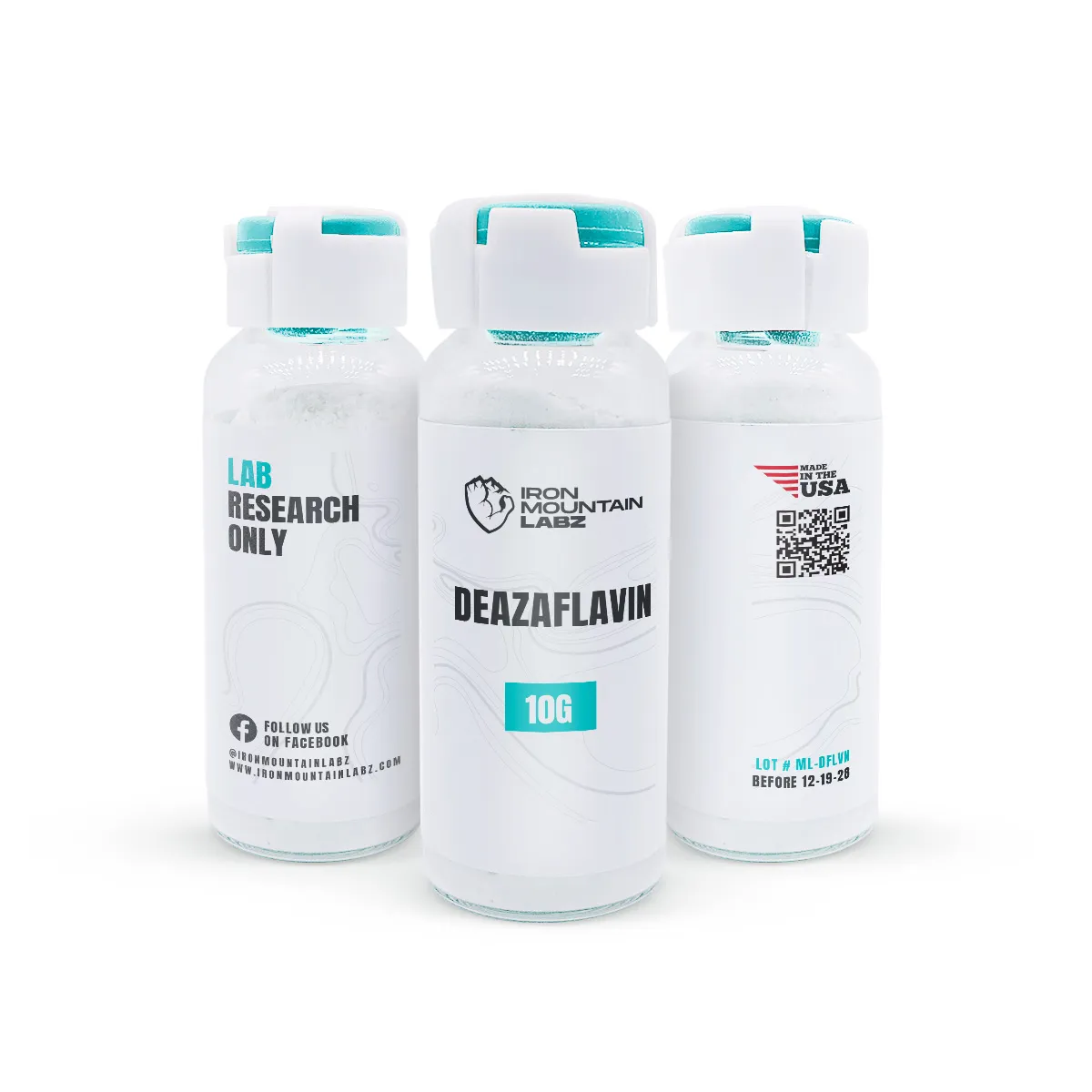
Deazaflavin (5-deazariboflavin; CAS 3326-21-4) is a flavin analog / heterocyclic coenzyme – a synthetic analog of riboflavin (vitamin B2) in which the nitrogen atom at position 5 (N-5) of the isoalloxazine tricyclic ring system is replaced by a carbon atom (C-5), generating the 5-deazaisoalloxazine ring. Molecular formula: C12H9N3O2 (deazariboflavin aglycone – verify vs. COA for specific ribityl form); MW: 227.22 g/mol (aglycone); PubChem CID: 67753. It is classified as a nootropic and a supplement ingredient research compound. Deazaflavin is not a SARM – it has no androgen receptor activity. It is not a peptide – it is a synthetic flavin heterocycle in which the N-5 nitrogen of the isoalloxazine ring is replaced by carbon; it contains no amino acid chain.
Per the product catalogue, Deazaflavin is classified as a NAD+ pathway coenzyme research compound – reflecting its structural role as the core chromophore of coenzyme F420, the low-potential hydride carrier (E°’ = −340 mV) that underpins F420-dependent oxidoreductase biochemistry in methanogenic archaea and actinomycetes.
Research transparency note: As of July 2026, no peer-reviewed publications specifically characterizing Deazaflavin (CAS 3326-21-4) in mammalian biological systems are available in indexed biomedical databases. The following overview and references relate to the 5-deazaflavin compound class and the NAD+ biosynthesis pathway context. Supplied for researchers in F420-dependent enzymology, deazaflavin redox chemistry, and NAD+ pathway pharmacology.
This product is not approved by the FDA for any therapeutic indication. Intended for laboratory and research purposes only; not a dietary supplement or consumer product in this research-grade formulation. Restricted to qualified researchers and licensed laboratory institutions.
Chemical Properties
| Section | Details |
| CAS Number | 3326-21-4 (5-deazariboflavin / deazaflavin aglycone – verify specific form vs. COA) |
| Chemical Class | Flavin Analog / Heterocyclic Coenzyme (5-Deazaflavin class) |
| Classification – NOT a SARM | No androgen receptor activity |
| Classification – NOT a Peptide | Synthetic flavin (vitamin B2 analog) where nitrogen-5 is replaced by carbon; no amino acid chain |
| Regulatory Status | Research Compound / Supplement Ingredient (deazaflavin class) |
| Molar Mass | 227.22 g/mol (aglycone); verify ribityl/glycosylated form vs. COA |
| Chemical Formula | C12H9N3O2 (aglycone) |
| IUPAC Name | benzo[g]pteridine-2,4(3H,10H)-dione (deazaisoalloxazine core ring system; IUPAC naming varies by database – verify vs. COA for the specific ribityl/glycosylated form supplied) |
| Synonyms | 5-deazariboflavin; deazaflavin; 5-deazaflavin; flavin B2 analog; NAD+ pathway coenzyme analog |
| PubChem CID | 67753 |
| Physical Form | Yellow to orange crystalline solid |
| Purity | ≥99% (HPLC-UV at ~420 nm) |
| Solubility | DMSO: soluble; ethanol: soluble with warming; water: sparingly soluble |
| Storage | −20°C; amber vials; sealed; protect from light – extended π-chromophore absorbs at ~420 nm |
| Shelf Life | 24 months from the manufacture date |
| Classification | Research Use Only (RUO) |
Deazaflavin’s Mechanism of Action in Research Models
Within deazaflavin biochemistry research, the defining mechanistic property of 5-deazaflavin is its constraint to obligate two-electron (hydride, H⁻) transfer chemistry, arising from the C-5 substitution eliminating the N-5 lone pair responsible for stabilizing the one-electron flavin semiquinone radical (FMNH•) in natural riboflavin/FMN/FAD. This mechanistic constraint makes deazaflavin the foundational structural class for the coenzyme F420 hydride carrier – a low-potential electron carrier (E°’ = −340 mV, lower than NADH at −320 mV) that operates specifically as a two-electron hydride donor/acceptor in F420-dependent oxidoreductases (FDOs) across archaea and actinomycetes.
Nguyen et al. (2017) characterized the crystal structure (1.5 Å resolution) and biochemical properties of F420-dependent glucose-6-phosphate dehydrogenase (FGD) from Rhodococcus jostii RHA1, demonstrating conservation of the deazaflavin cofactor-binding pocket architecture relative to the Mycobacterium tuberculosis FGD1 (Mtb-FGD1) and establishing the FGD catalytic mechanism for F420H₂ generation needed by F420-dependent reductases involved in antitubercular prodrug (pretomanid, delamanid) bioreductive activation (DOI). In the broader NAD+ coenzyme biology context, Khaidizar et al. (2021) reviewed the centrality of NAMPT and the NAD+ salvage pathway in aging, characterizing NAD+ decline with age and the research landscape for coenzyme precursors and coenzyme analogs as potential interventions in age-related metabolic decline (DOI). Data remain limited, and findings are not consistent across all experimental model systems.
Risk & Handling
Risk Tier: LOW
Deazaflavin is a synthetic flavin analog heterocycle with no established mammalian toxicological profile. Handle with standard organic compound precautions:
- Photosensitivity: Extended deazaflavin π-chromophore absorbs at ~420 nm – amber vials mandatory for all storage; work under reduced-light conditions; foil-wrap all solution storage containers
- Inhalation risk: Fine powder – use a ventilated workspace or N95 during weighing
- PPE: Nitrile gloves, lab coat, and safety eyewear for all handling operations
- No established acute human toxicity for this flavin analog compound class at laboratory handling concentrations
- No human safety data has been established for this research-grade formulation. Contact help@ironmountainlabz.com for the Safety Data Sheet.
Why Consider Deazaflavin for Research?
- Purity: ≥99% by HPLC-UV per lot
- Identity: confirmed by ¹H-NMR and LC-MS/MS per lot
- Light-sensitive packaging: amber vials; store at −20°C protected from light
- Residual solvents: ≤300 ppm by GC headspace per lot (ICH Q3C compliant)
- Certificate of Analysis available on request per lot
- For queries, complaints, or support, please contact help@ironmountainlabz.com
FAQs
Q1: What is Deazaflavin chemically, and why is it not a SARM or peptide?
Deazaflavin (5-deazariboflavin) is a flavin analog heterocycle – a synthetic riboflavin (vitamin B2) structural analog in which the isoalloxazine ring N-5 position is replaced by carbon, constraining its redox chemistry to obligate two-electron hydride transfer. It contains no amino acid chain, making it definitively not a peptide. It has no androgen receptor activity, making it definitively not a SARM. It belongs to the 5-deazaflavin class that underpins coenzyme F420 – a NAD-pathway-related hydride carrier in microbial and potential mammalian systems.
Q2: Why does the N-5/C-5 substitution matter mechanistically?
In natural flavins (riboflavin, FMN, FAD), the N-5 nitrogen lone pair stabilizes the one-electron semiquinone radical (FMNH•), enabling both one-electron and two-electron flavin chemistry. In 5-deazaflavins, the C-5 substitution raises the radical state energy to prohibitive levels – eliminating semiquinone formation. This makes deazaflavin compounds exclusive two-electron (hydride) carriers and valuable probes for discriminating one-electron vs. two-electron mechanisms in flavoenzyme research.
Q3: What research applications is Deazaflavin relevant to?
In laboratory research: F420-dependent oxidoreductase (FDO) enzyme biochemistry; antitubercular prodrug activation research (pretomanid/delamanid bioreductive activation by F420H₂-dependent reductases); mechanistic probe studies discriminating one-electron vs. two-electron flavoenzyme pathways; NAD+ coenzyme analog and pathway research; and methanoarchaea methanogenesis biochemistry. All in laboratory and preclinical contexts.
Q4: Is there mammalian biological data available for Deazaflavin?
No peer-reviewed publications specifically characterizing Deazaflavin (CAS 3326-21-4) in mammalian biological systems are available as of July 2026. Researchers should treat this as a chemical tool compound requiring in-house characterization in any mammalian system, with appropriate controls. Contact help@ironmountainlabz.com for available application-specific guidance.
Q5: What storage conditions are required?
Store at −20°C in amber-capped sealed vials protected from light (shelf life: 24 months). Work under reduced-light conditions. Foil-wrap all solution storage. N95 during powder weighing. No human safety data has been established for this research-grade formulation.
References
Research transparency note: As of July 2026, no peer-reviewed publications specific to Deazaflavin (CAS 3326-21-4) in mammalian biological systems are available. The following references address the deazaflavin/F420 compound class biochemistry and NAD+ pathway context.
-
- Nguyen QT, Trinco G, Binda C, Mattevi A, Fraaije MW. Discovery and characterization of an F420-dependent glucose-6-phosphate dehydrogenase (Rh-FGD1) from Rhodococcus jostii RHA1. Appl Microbiol Biotechnol. 2017;101(7):2831–2842. PMID: 27966048.
https://pubmed.ncbi.nlm.nih.gov/27966048/ - Khaidizar FD, Bessho Y, Nakahata Y. Nicotinamide phosphoribosyltransferase as a key molecule of the aging/senescence process. Int J Mol Sci. 2021;22(7):3709. PMID: 33918226.
https://pubmed.ncbi.nlm.nih.gov/33918226/ - Joosten V, van Berkel WJH. Flavoenzymes. Current Opinion in Chemical Biology. 2007;11(2):195–202. PMID: 17275397 https://pubmed.ncbi.nlm.nih.gov/17275397/
- Nguyen QT, Trinco G, Binda C, Mattevi A, Fraaije MW. Discovery and characterization of an F420-dependent glucose-6-phosphate dehydrogenase (Rh-FGD1) from Rhodococcus jostii RHA1. Appl Microbiol Biotechnol. 2017;101(7):2831–2842. PMID: 27966048.
IML Affiliate Disclosure
Some links on IML may connect readers with third-party suppliers through affiliate arrangements. IML may receive compensation from qualifying transactions at no additional cost to the reader, but the third-party supplier remains responsible for the actual sale, fulfillment, and product documentation.