

Description
Botox Research Overview
Disclaimer: The compounds described on this page are intended for laboratory research use only and are not approved for human consumption.
Overview of Botox
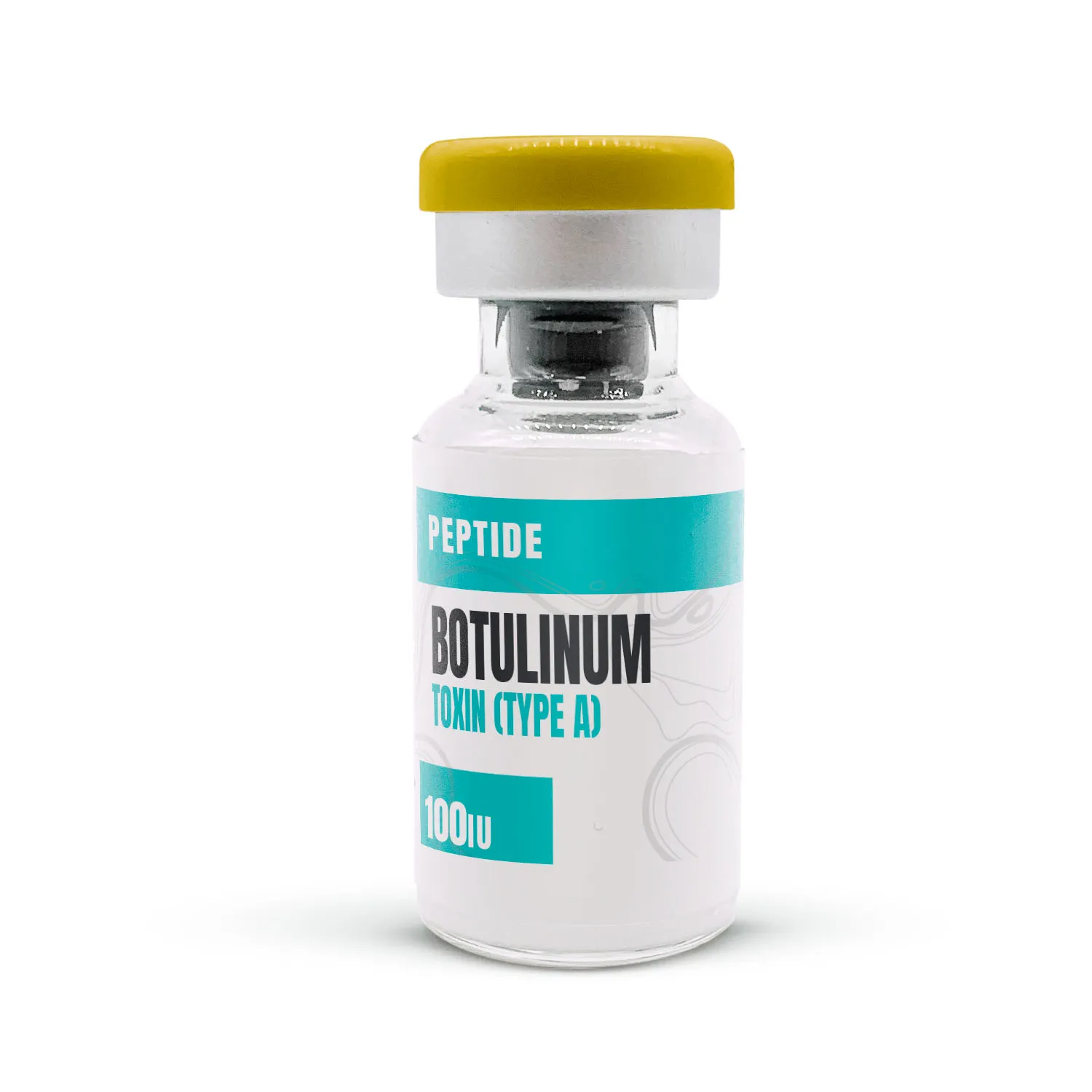
Botox is a neurotoxic protein produced by Clostridium botulinum bacteria. It’s a large protein (~150 kDa) widely studied in neuroscience research for its mechanism of action on synaptic neurotransmission. This is research-grade material supplied at 100 international units (IU) per vial in a 10-vial pack. It is not a small-molecule drug, not for human administration, and not FDA-approved for clinical use.
What it’s used for in research: BoNT/A is investigated for its specific blocking of acetylcholine release at the neuromuscular junction, making it valuable for studying synaptic mechanisms and presynaptic neurobiology.
Specifications
| Property | Details |
| CAS Number | 93384-43-1 |
| Compound Type | Proteinaceous neurotoxin (metalloprotease); Tier 1 Select Agent |
| Molecular Weight | Heavy chain (~96–101 kDa) + light chain (~50–52 kDa) for total ~150 kDa |
| Chemical Formula (Light Chain) | C2286H3500N578O666S9 |
| Chemical Formula (Heavy Chain) | C4422H6863N1151O1329S23 |
| EC Number | 297-253-4 |
| Physical Form | Lyophilized powder or solution (verify per lot) |
| Potency | 100 IU per vial; verify per Certificate of Analysis |
| Purity | Verify per Certificate of Analysis |
| Pack Size | 10 vials |
| Storage | Ultra-low freezer (–70°C or lower); protect from light |
| Regulatory Status | Tier 1 Select Toxin (CDC/USDA, effective Jan 2025); not FDA-approved; research use only |
| PubChem Reference | SID 483927762 |
How Botox Works in Research Models
BoNT/A blocks acetylcholine release by targeting the SNARE protein complex at the neuromuscular junction. The toxin binds to nerve endings, enters the neuron, and cleaves SNAP-25, a critical protein required for synaptic vesicle fusion. Once SNAP-25 is cleaved, acetylcholine cannot be released, resulting in neuromuscular paralysis. This mechanism is investigated in in vitro cell models and animal models (with IACUC approval) to understand synaptic transmission and neuronal signaling.
Key mechanism: BoNT/A light chain cleaves SNAP-25 near the C-terminus, disrupting the pre-assembled SNARE complex and preventing further recycling of SNARE proteins.
Risk & Handling
- Handle with gloves and eye protection; avoid inhaling powder during weighing or reconstitution.
- Keep frozen (-20°C) and protected from light and moisture until needed.
- Given the unverified identity of this compound, independent identity/purity testing is strongly advised before any experimental use.
Why Consider Botox for Research?
- Verified Purity — Tested per Certificate of Analysis (CoA)
- Potency Confirmed — International Units assayed per lot
- Identity Verified — LC-MS/MS or HPLC analysis per lot
- Complete Documentation — Full CoA available on request
- Regulatory Support — Help with institutional compliance documentation
- Expert Assistance — Technical questions and compliance guidance
For queries, complaints, or support, please contact help@ironmountainlabz.com
Frequently Asked Questions
What is Botox, and why is it different from peptides?
BoNT/A is a large (~150 kDa) two-chain protein toxin, not a peptide (<10 kDa) or small molecule. This size and complexity (requiring multi-step receptor binding, endocytosis, membrane translocation) distinguish its pharmacology from typical small-molecule drugs. It’s a naturally derived neurotoxin with a heavy chain (binding) and light chain (catalytic). It’s much larger and more complex than typical research peptides and classified as a Tier 1 Select Agent due to its extreme potency.
What research is it used for?
Scientists use BoNT/A to study synaptic mechanisms—specifically how acetylcholine is released at nerve endings and how blocking that release affects neurons. It’s also studied for understanding SNARE protein function and neuromuscular signaling in both cell culture and animal models.
Do I need special approvals to use this?
Yes. Before ordering, verify that your institution is registered with the Federal Select Agent Program (CDC/USDA) under 42 CFR Part 73 or 7 CFR Part 331. Your facility must have:
- Select Agent Registration — Institutional registration with CDC/USDA; contact your Institutional Biosafety Committee
- Responsible Official (RO) Designation — Appointment of an RO and Alternate RO for Select Agent oversight
- Tier 1 Access Verification — Confirmation that your institution has approval for Tier 1 select toxins (highest regulatory tier)
- IRB/IACUC Approvals — Institutional Review Board (IRB) approval for any human-related research; Institutional Animal Care and Use Committee (IACUC) approval for animal studies
- Biosafety Facility Certification — All work must occur in a certified biosafety facility (BSL-2 or higher) with trained personnel
Iron Mountain Labz will require proof of institutional registration (CDC/USDA Form 4 or current registration letter) before shipment. Contact help@ironmountainlabz.com with your institutional registration documentation.
How is it stored?
Store at –70°C or colder in an ultra-low freezer. Keep protected from light and avoid freeze-thaw cycles. Stability depends on the specific formulation—verify exact storage conditions on your Certificate of Analysis.
What happens if I’m exposed to it?
Seek immediate medical attention. Call poison control (USA: 1-800-222-1222). The compound is extremely potent, so even tiny exposures require professional evaluation. This is why proper biosafety protocols and personal protective equipment (PPE) are non-negotiable. All handling must follow institutional biosafety guidelines and federal Select Agent protocols.
References
-
- Schiavo G, Matteoli M, Montecucco C. Neurotoxins affecting neuroexocytosis. Physiol Rev. 2000;80(2):717-766. PMID: 10747206. https://pubmed.ncbi.nlm.nih.gov/10747206/
- Blasi J, Chapman ER, Link E, et al. Botulinum neurotoxin A selectively cleaves the synaptic protein SNAP-25. Nature. 1993;365(6442):160-163. PMID: 8103915. https://pubmed.ncbi.nlm.nih.gov/8103915/
- Arnon SS, Schechter R, Inglesby TV, et al. Botulinum toxin as a biological weapon: medical and public health management. JAMA. 2001;285(8):1059-1070. PMID: 11209178. https://pubmed.ncbi.nlm.nih.gov/11209178/
- Simpson LL. The origin, structure, and pharmacological activity of botulinum toxin. Pharmacol Rev. 1981;33(3):155-188. PMID: 6119708. https://pubmed.ncbi.nlm.nih.gov/6119708/
- Botulinum Neurotoxins: History, Mechanism, and Applications. J Neurochem. 2024. PMID: 40762356. https://pubmed.ncbi.nlm.nih.gov/40762356/
IML Affiliate Disclosure
Some links on IML may connect readers with third-party suppliers through affiliate arrangements. IML may receive compensation from qualifying transactions at no additional cost to the reader, but the third-party supplier remains responsible for the actual sale, fulfillment, and product documentation.