

Description
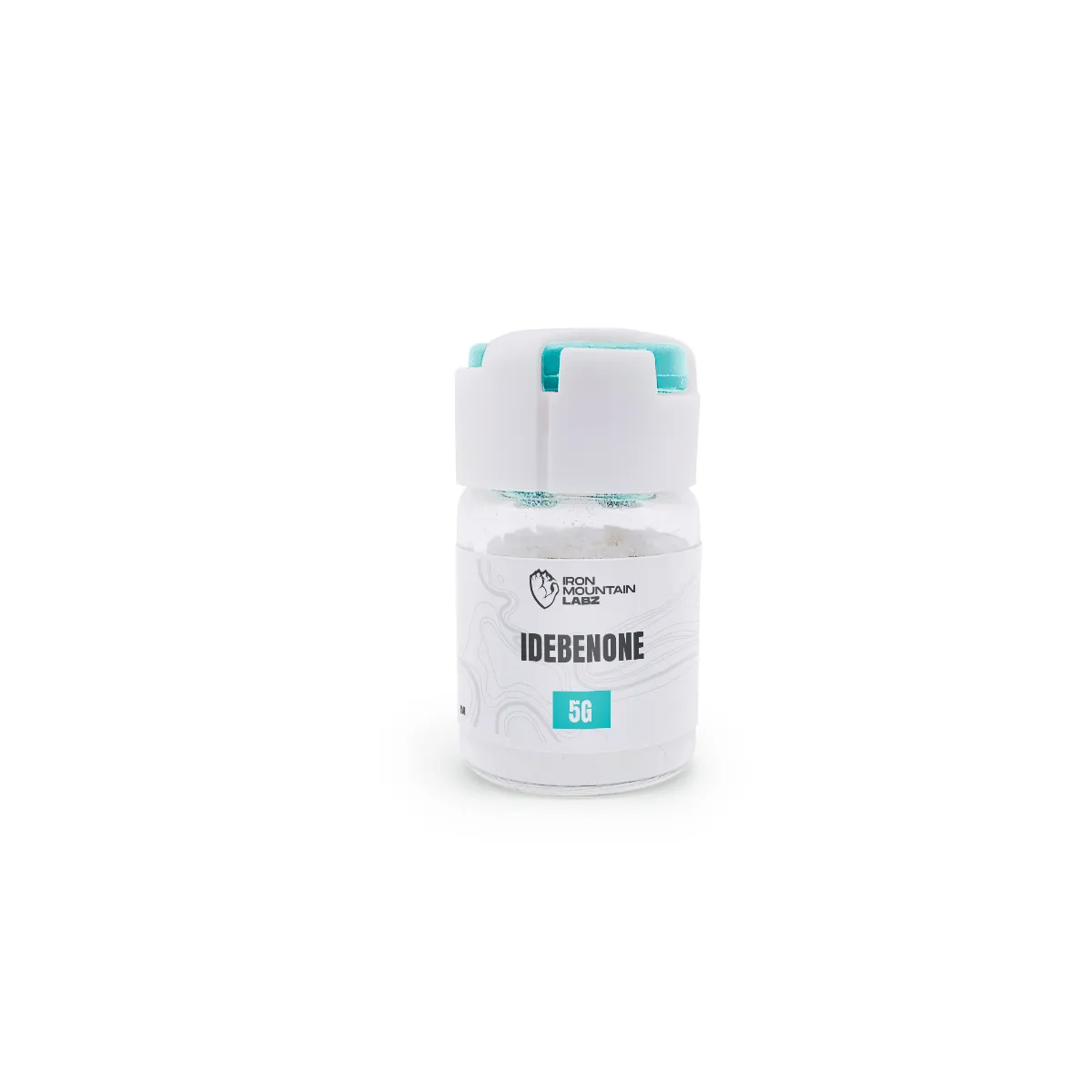
Idebenone Powder Research Overview
Disclaimer: The compounds described on this page are intended for laboratory research use only and are not approved for human consumption.
Overview of Idebenone Powder
Idebenone (CAS 58186-27-9) is a synthetic CoQ10 analog small molecule – a synthetic benzoquinone compound designed as a short-chain structural analog of Coenzyme Q10 (ubiquinone). It is classified as both a supplement ingredient and a nootropic research compound. IUPAC name: 6-(10-hydroxydecyl)-2,3-dimethoxy-5-methyl-1,4-benzoquinone; molecular formula: C19H30O5; MW: 338.44 g/mol; PubChem CID: 3686. It is not a SARM – it has no androgen receptor activity. It is not a peptide – it is a synthetic benzoquinone small molecule functioning as a CoQ10 analog; it contains no amino acid chain. Market price reference: $100–$250 / 100g (USA, July 2026).
The defining structural difference from native CoQ10 is idebenone’s short, terminally hydroxylated 10-carbon side chain (replacing CoQ10’s long polyisoprenoid chain of 6–10 isoprene units). This modification substantially increases cellular uptake, improves mitochondrial membrane penetration, and – critically – enables idebenone to accept electrons directly from Complex II (succinate dehydrogenase) under conditions of Complex I dysfunction, partially restoring mitochondrial electron transport in disease-state research models where native CoQ10 cannot compensate.
Idebenone is approved as a prescription pharmaceutical in the European Union under the brand name Raxone® (EMA-approved for Leber’s Hereditary Optic Neuropathy, LHON). The linked vendor supplies idebenone as a research-grade reagent for laboratory investigation – not as the Raxone® pharmaceutical preparation. This product is not approved by the FDA for any therapeutic indication. Intended for laboratory and research purposes only; not a dietary supplement or consumer product in this research-grade formulation. Restricted to qualified researchers and licensed laboratory institutions. IRB guidance is required for clinical research; IACUC compliance is required for preclinical animal research. Photosensitive benzoquinone – store under inert atmosphere in amber vials at −20°C.
Chemical Properties
| Section | Details |
| CAS Number | 58186-27-9 |
| Chemical Class | Synthetic CoQ10 Analog / Small Molecule |
| Classification – NOT a SARM | No androgen receptor activity |
| Classification – NOT a Peptide | Synthetic benzoquinone small molecule (CoQ10 analog); no amino acid chain |
| Regulatory Status | Supplement ingredient + EU-Approved Drug (Raxone®, EMA) for LHON; sold here as research-grade material only; NOT FDA-approved |
| Molar Mass | 338.44 g/mol |
| Chemical Formula | C19H30O5 |
| IUPAC Name | 6-(10-hydroxydecyl)-2,3-dimethoxy-5-methyl-1,4-benzoquinone |
| Synonyms | Idebenone; CV-2619; Raxone® (EU pharmaceutical – not this product); hydroxydecyl ubiquinone; synthetic CoQ10 |
| PubChem CID | 3686 |
| Physical Form | Yellow to orange-yellow crystalline powder |
| Purity | ≥99% (HPLC-UV) |
| Solubility | DMSO: ≥20 mg/mL; ethanol: soluble; water: sparingly soluble (<0.1 mg/mL) |
| Storage | −20°C; amber-capped vials; sealed under N₂ or Ar atmosphere; protect from light – benzoquinone chromophore is photosensitive |
| Shelf Life | 24 months from manufacture date under recommended conditions |
| Classification | Research Use Only (RUO) |
Idebenone Powder’s Mechanism of Action in Research Models
Within mitochondrial electron transport research, idebenone functions as a short-chain electron carrier that can bypass Complex I (NADH:ubiquinone oxidoreductase) dysfunction. In preclinical models of Complex I deficiency – the primary respiratory chain defect underlying LHON – idebenone can accept electrons from Complex II (succinate:ubiquinone oxidoreductase; SDH) and transfer them directly to Complex III (ubiquinol:cytochrome c oxidoreductase), partially restoring electron flow and sustaining mitochondrial membrane potential (ΔΨm) in research cell systems where native CoQ10 cannot compensate due to restricted access in the absence of Complex I activity.
Baglivo et al. (2023) evaluated idebenone responsiveness in fibroblast lines from 8 LHON subjects (carrying the m.11778G>A, m.3460G>A, or m.14484T>C mtDNA pathogenic variants) by measuring maximal respiration rate (MRR) and other Seahorse XFe analyzer parameters before and after idebenone supplementation in cell culture – establishing a fibroblast-based approach to characterize mitochondrial dysfunction and evaluate potential drug responsiveness in LHON research models (DOI). Carelli et al. (2023) reviewed the field of mitochondrial optic neuropathies in Handbook of Clinical Neurology, characterizing the selective neurodegeneration of retinal ganglion cells (RGCs) triggered by Complex I impairment in LHON, and noting that idebenone (Raxone®) is currently the only approved drug for a mitochondrial disorder (DOI). Data remains limited, and findings are not consistent across all experimental model systems.
Risk & Handling
Risk Tier: LOW-MODERATE
Idebenone is a synthetic benzoquinone CoQ10 analog. No significant acute human toxicity is established at laboratory handling concentrations. Primary hazards are photosensitivity and redox reactivity:
- Photosensitivity: Benzoquinone chromophore is light-sensitive – amber-capped vials are mandatory; work under reduced-light conditions; foil-wrap all solution storage containers immediately after preparation
- Inert atmosphere: Store sealed under N₂ or Ar; aerial oxidation can degrade the benzoquinone redox couple over time
- Redox reactivity: Strong reducing agents (e.g., ascorbic acid, DTT, TCEP) can prematurely reduce idebenone’s benzoquinone to the hydroquinone form, affecting experimental outcomes – keep separated from strong reductants unless reduction is intentional
- EU pharmaceutical note: Idebenone is marketed as Raxone® (prescription drug, EU) – this research-grade material must NOT be used for human therapeutic purposes
- PPE: Nitrile gloves, lab coat, and safety eyewear for all handling operations
- No human safety data established for this research-grade formulation. Contact help@ironmountainlabz.com for the Safety Data Sheet.
Why Consider Idebenone Powder for Research?
- Purity: ≥99% by HPLC-UV per lot
- Identity: confirmed by ¹H-NMR and LC-MS/MS per lot
- Light-sensitive packaging: amber-capped vials; stored under inert atmosphere
- Residual solvents: ≤300 ppm by GC headspace per lot (ICH Q3C compliant)
- Endotoxin: ≤1.0 EU/mg (LAL gel-clot method)
- Certificate of Analysis available on request per lot
- For queries, complaints, or support, please contact help@ironmountainlabz.com
FAQs
Q1: What is idebenone chemically, and why is it not a SARM or peptide?
Idebenone is a synthetic CoQ10 analog – a benzoquinone small molecule with a 10-hydroxydecyl side chain replacing CoQ10’s polyisoprenoid chain. It contains no amino acid chain, making it definitively not a peptide. It has no androgen receptor activity, making it definitively not a SARM. It functions as an electron carrier in the mitochondrial respiratory chain and is studied in research models of mitochondrial dysfunction.
Q2: How does idebenone differ from native CoQ10 in preclinical research models?
The key functional difference is that idebenone’s short, hydroxylated side chain gives it the ability to accept electrons directly from Complex II (SDH) under Complex I-deficient conditions – a capacity that native CoQ10 largely lacks in that context because CoQ10’s accessibility to Complex II is reduced when Complex I is non-functional. In LHON research cell models, idebenone has been investigated as a partial compensatory electron carrier that sustains some degree of mitochondrial electron flow and maintains ΔΨm despite Complex I impairment.
Q3: What is the EU regulatory status of idebenone and how does this affect its use as research material? Idebenone (Raxone®) is EMA-approved for Leber’s Hereditary Optic Neuropathy (LHON) in the EU. It is not FDA-approved in the US. The linked vendor supplies research-grade idebenone for laboratory investigation – not as the Raxone® pharmaceutical preparation. This research-grade material must not be used for any human therapeutic purpose. Restricted to qualified researchers and licensed laboratory institutions.
Q4: What research applications has idebenone been investigated in?
In preclinical and in vitro laboratory settings: mitochondrial respiratory chain function assays (Seahorse XFe analyzer; Complex II bypass), LHON pathogenesis research using patient-derived fibroblasts and induced pluripotent stem cell-derived retinal ganglion cells, ROS scavenging assays, neuroprotection in PC12 and SH-SY5Y neuronal cell culture models, and Friedreich’s ataxia cardiac and neuronal function research models. All in laboratory and preclinical contexts only.
Q5: What storage and photosensitivity precautions apply to idebenone?
Store at −20°C in amber-capped sealed vials under N₂/Ar atmosphere (shelf life: 24 months). Always work under reduced-light conditions when handling idebenone powder or solutions. Foil-wrap storage tubes after preparation. Avoid strong reducing agents in the same solution unless reduction of the quinone is the experimental intent. No human safety data established. Contact help@ironmountainlabz.com for the Safety Data Sheet.
References
- Baglivo M, Nasca A, Lamantea E, et al. Evaluation of mitochondrial dysfunction and idebenone responsiveness in fibroblasts from Leber’s Hereditary Optic Neuropathy (LHON) subjects. Int J Mol Sci. 2023;24(16):12580. PMID: 37628761.
https://pubmed.ncbi.nlm.nih.gov/37628761/ - Carelli V, La Morgia C, Yu-Wai-Man P. Mitochondrial optic neuropathies. Handb Clin Neurol. 2023;194:23–42. PMID: 36813316.
https://pubmed.ncbi.nlm.nih.gov/36813316/ - Heitz FD, Erb M, Anklin C, Robay D, Pernet V, Gueven N. Idebenone protects against retinal damage and loss of vision in a mouse model of Leber’s hereditary optic neuropathy. PLoS ONE. 2012;7(9):e45182. PMID: 23024808 https://pubmed.ncbi.nlm.nih.gov/23024808/
IML Affiliate Disclosure
Some links on IML may connect readers with third-party suppliers through affiliate arrangements. IML may receive compensation from qualifying transactions at no additional cost to the reader, but the third-party supplier remains responsible for the actual sale, fulfillment, and product documentation.