

Description
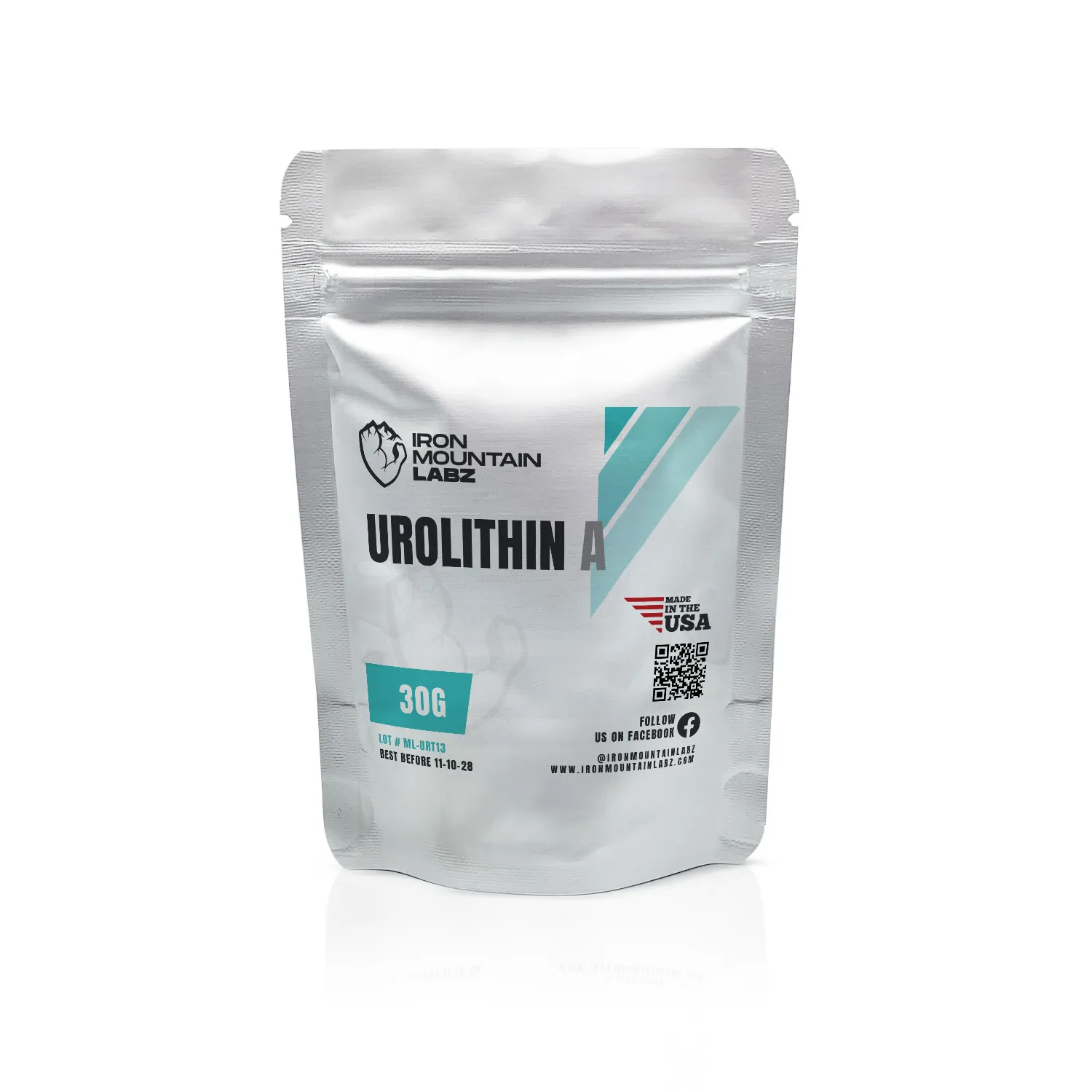
Urolithin A Powder Research Overview
Disclaimer: The compounds described on this page are intended for laboratory research use only and are not approved for human consumption.
Overview of Urolithin A Powder
Urolithin A (UA; CAS 1143-70-0) is a polyphenol metabolite (postbiotic) – a naturally occurring benzo[c]chromenone compound produced by the gut microbial transformation of ellagitannins, the polyphenolic compounds found in pomegranate, walnuts, berries, and teas. Molecular formula: C13H8O4; MW: 228.20 g/mol; PubChem CID: 5488186; IUPAC: 3,8-dihydroxy-6H-benzo[c]chromen-6-one. It is classified as a supplement research compound. It is not a SARM – it has no androgen receptor activity. It is not a peptide – it is a polyphenol postbiotic; a gut microbial metabolite produced from ellagitannin precursors, containing zero amino acids.
Urolithin A holds the distinction of being the first-in-class natural compound identified as a direct mitophagy inducer – both in vitro and in vivo following oral consumption – as established in the landmark 2016 Nature Medicine paper. The FDA has granted GRAS (Generally Recognized As Safe) status for urolithin A as a food ingredient, and it is sold commercially as Timeline Mitopure® at approximately $60/month in consumer supplement markets. The linked vendor supplies research-grade UA for laboratory investigation of mitophagy biology, PINK1/Parkin pathway research, and mitochondrial quality control research – not as a consumer supplement product.
This product is not approved by the FDA as a drug for any therapeutic indication, including ingestion, injection, or any form of administration for human use. It is intended for laboratory and research purposes only. Not a dietary supplement or consumer product in this research-grade formulation. Restricted to qualified researchers and licensed laboratory institutions. IRB guidance is required for clinical research; IACUC compliance is required for preclinical animal research.
Chemical Properties
| Section | Details |
| CAS Number | 1143-70-0 |
| Chemical Class | Polyphenol Metabolite (Postbiotic) |
| Classification – NOT a SARM | No androgen receptor activity |
| Classification – NOT a Peptide | Polyphenol postbiotic produced by gut bacteria from ellagitannins; contains zero amino acids |
| Regulatory Status | Dietary Supplement (DSHEA) + Research-Grade; FDA GRAS status as food ingredient; Timeline Mitopure® consumer product; sold here as research-grade material only |
| Market Price Reference | $200–$500 / 100g research grade; Timeline Mitopure® ~$60/month consumer |
| Molar Mass | 228.20 g/mol |
| Chemical Formula | C13H8O4 |
| IUPAC Name | 3,8-dihydroxy-6H-benzo[c]chromen-6-one |
| Synonyms | Urolithin A; UA; 3,8-dihydroxydibenzo[b,d]pyran-6-one; ellagitannin metabolite; pomegranate postbiotic; Mitopure® active ingredient |
| PubChem CID | 5488186 |
| Physical Form | Yellow to pale yellow crystalline powder |
| Purity | ≥99% (HPLC-UV) |
| Solubility | DMSO: ≥10 mg/mL; ethanol: soluble; water: sparingly soluble (<0.1 mg/mL) |
| Storage | −20°C; sealed; protect from light and moisture |
| Shelf Life | 24 months from manufacture date under recommended conditions |
| Classification | Research Use Only (RUO) |
Urolithin A Powder’s Mechanism of Action in Research Models
Within mitochondrial quality control research, Urolithin A is the first-in-class natural compound that induces mitophagy – the selective autophagic clearance of dysfunctional mitochondria. Mechanistically, UA induces mitophagy through both PINK1/Parkin-dependent and PINK1/Parkin-independent pathways in preclinical models. In C. elegans, the primary mechanistic pathway involved DCT-1 (the ortholog of mammalian BNIP3/BNIP3L/NIX), a mitophagy receptor-mediated pathway distinct from the canonical PINK1/Parkin cascade. In mammalian cell culture models, UA additionally activates PINK1 stabilization on the outer mitochondrial membrane (OMM) of depolarized mitochondria, with Parkin (PRKN; E3 ubiquitin ligase) subsequently recruited to the OMM substrates are recognized by autophagy receptor proteins – primarily p62/SQSTM1, which bridges ubiquitinated cargo to LC3B-II on the growing autophagosomal membrane – completing autophagic sequestration and subsequent lysosomal degradation of the damaged mitochondrion.
Ryu et al. (2016) identified UA in Nature Medicine as the first known natural compound that induces mitophagy both in vitro and in vivo after oral consumption – demonstrating PINK1/Parkin-dependent mitophagy induction in C. elegans (via the ortholog DCT-1), preventing accumulation of dysfunctional mitochondria during aging, extending lifespan, and improving exercise capacity in two mouse models of age-related muscle function decline as well as young rats (DOI). Hasheminezhad et al. (2021) comprehensively reviewed the molecular mechanisms of urolithins as gut microbial metabolites of ellagitannins, characterizing NF-κB pathway inhibition, MAPK modulation, MDM2-p53 interaction disruption, and mitophagy/mitochondrial biogenesis as core mechanisms across cell culture and preclinical animal model systems – and noting the first clinical safety data demonstrating UA is safe up to 2,500 mg/day with improvement in mitochondrial biomarkers in elderly participants (DOI). Data remains limited, and findings are not consistent across all experimental model systems.
Risk & Handling
Risk Tier: LOW
Urolithin A is a naturally occurring polyphenol postbiotic with well-characterized safety data in consumer contexts (FDA GRAS). No significant laboratory handling hazards are identified at standard research concentrations:
- PPE: Nitrile gloves, lab coat, and safety eyewear for all handling operations – standard organic compound precautions
- Photosensitivity: Protect from direct light during handling – the benzo[c]chromenone chromophore may undergo slow photodegradation on prolonged light exposure
- DMSO solutions: Standard DMSO skin contact precautions – nitrile gloves required for all DMSO solution handling
- Aqueous solubility: Very low in water – use DMSO stocks and dilute to ≤0.1% v/v final DMSO in cell culture medium for in vitro assays
- No human safety data established for this specific research-grade formulation. Contact help@ironmountainlabz.com for the Safety Data Sheet.
Why Consider Urolithin A Powder for Research?
- Purity: ≥99% by HPLC-UV per lot
- Identity: confirmed by ¹H-NMR and LC-MS/MS per lot
- Residual solvents: ≤300 ppm by GC headspace per lot (ICH Q3C compliant)
- Endotoxin: ≤1.0 EU/mg (LAL gel-clot method)
- Certificate of Analysis available on request per lot
- For queries, complaints, or support, please contact help@ironmountainlabz.com
FAQs
Q1: What is Urolithin A chemically, and why is it not a SARM or peptide?
Urolithin A is a polyphenol metabolite (postbiotic) – a benzo[c]chromenone dibenzopyranone compound produced by gut microbial fermentation of ellagitannins from pomegranate and related foods. It contains no amino acids and has no peptide bonds, making it definitively not a peptide. It has no androgen receptor activity, making it definitively not a SARM. In consumer markets, it is sold as a DSHEA dietary supplement ingredient with FDA GRAS status (Timeline Mitopure®).
Q2: What distinguishes research-grade Urolithin A from the consumer supplement (Timeline Mitopure®)? Consumer-grade UA products (Timeline Mitopure®, ~$60/month) are food-grade formulations intended for dietary supplementation. The linked vendor supplies research-grade UA at ≥99% HPLC-verified purity with per-lot identity confirmation by NMR and MS – meeting the analytical standards required for in vitro cell biology assays, mitophagy flux experiments, and mechanistic pathway studies. This research-grade product is not a dietary supplement or consumer product in this formulation.
Q3: What research applications has Urolithin A been investigated in?
In preclinical laboratory settings: mitophagy flux assays (LC3-II/I ratio, p62/SQSTM1 degradation, mt-Keima or MitoTracker/LysoTracker co-localization), PINK1/Parkin pathway characterization, mitochondrial quality control research, C. elegans longevity assays, skeletal muscle function research in aging rodent models, and NF-κB anti-inflammatory signaling studies in cell culture. All in laboratory and preclinical contexts only.
Q4: How is Urolithin A used in cell culture mitophagy research?
Prepare DMSO stock solutions (10–50 mM); dilute into cell culture medium to 10–100 µM final concentration (final DMSO ≤0.1% v/v). Standard positive controls: CCCP (mitochondrial uncoupler; PINK1/Parkin activation control) or oligomycin + antimycin A. Standard negative controls: vehicle DMSO. Mitophagy readouts: LC3-II western blot, p62 degradation, TOMM20 reduction by immunofluorescence, mt-Keima ratio imaging.
Q5: What is the difference between Urolithin A and Urolithin B as research tools?
Urolithin A (3,8-dihydroxy-6H-benzo[c]chromen-6-one) has hydroxyl groups at both the 3- and 8-positions. Urolithin B (3-hydroxy-6H-benzo[c]chromen-6-one) has a hydroxyl only at the 3-position. UA shows more potent mitophagy-inducing activity in preclinical models than UB, likely attributed to the additional 8-OH group. For UB, mild androgen receptor interaction is under active investigation but is not yet sufficient for SARM classification. Both are gut microbial metabolites of the same ellagitannin precursor pathway.
References
- Ryu D, Mouchiroud L, Andreux PA, et al. Urolithin A induces mitophagy and prolongs lifespan in C. elegans and increases muscle function in rodents. Nat Med. 2016;22(8):879–888. PMID: 27400265.
https://pubmed.ncbi.nlm.nih.gov/27400265/ - Hasheminezhad SH, Boozari M, Iranshahi M, et al. A mechanistic insight into the biological activities of urolithins as gut microbial metabolites of ellagitannins. Phytother Res. 2022;36(1):112–146. PMID: 34542202.
https://pubmed.ncbi.nlm.nih.gov/34542202/ - Andreux PA, Blanco-Bose W, Ryu D, et al. The mitophagy activator urolithin A is safe and induces a molecular signature of improved mitochondrial and cellular health in humans. Nature Metabolism. 2019;1(6):595–603. PMID: 32694720
https://pubmed.ncbi.nlm.nih.gov/32694720/
IML Affiliate Disclosure
Some links on IML may connect readers with third-party suppliers through affiliate arrangements. IML may receive compensation from qualifying transactions at no additional cost to the reader, but the third-party supplier remains responsible for the actual sale, fulfillment, and product documentation.