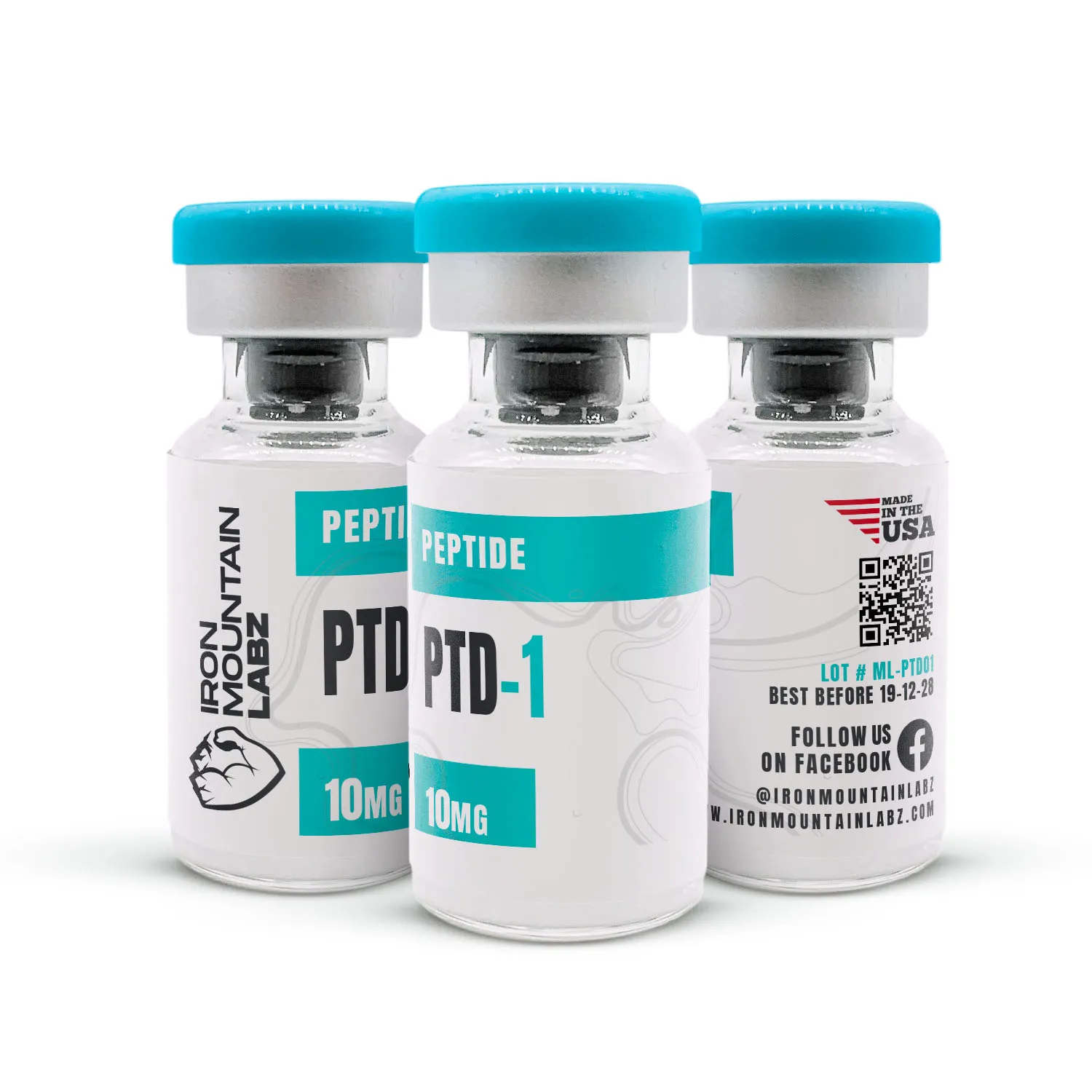


Description
Disclaimer: The compounds described on this page are intended for laboratory research use only and are not approved for human consumption.
Overview of PTD-1
PTD-1 (Protein Transduction Domain–Dishevelled Binding Motif peptide; also referred to as PTD-DBM) is a synthetic cell-penetrating peptide designed to disrupt the protein–protein interaction (PPI) between CXXC-type zinc finger protein 5 (CXXC5) and Dishevelled (Dvl), a key upstream scaffolding protein in the canonical Wnt/β-catenin signaling pathway. PTD-1 is structurally composed of two functional domains fused in tandem. One is a protein transduction domain (PTD), which confers membrane permeability and facilitates intracellular delivery. The other is a Dishevelled-binding motif (DBM), which competes with endogenous CXXC5 for the Dvl binding interface. This architecture has been investigated in preclinical models for its capacity to modulate Wnt/β-catenin pathway activity at the level of the CXXC5–Dvl interaction.
PTD-1 is classified as a research-grade synthetic peptide. It is not approved by the FDA for any therapeutic indication, including dermatological, regenerative, or wound-healing applications, and is not approved for ingestion, injection, or any form of topical or systemic administration to humans. It is not a dietary supplement, cosmetic product, or consumer compound of any kind. All research involving PTD-1 must be conducted strictly within licensed laboratory or institutional settings by qualified researchers. Studies involving animal subjects require IACUC compliance; any clinical investigations require IRB oversight and applicable regulatory authorization.
Handling of PTD-1 in laboratory environments should follow standard precautions applicable to bioactive synthetic peptides. Personnel should use appropriate protective equipment and adhere to institutional biosafety protocols. No human safety profile has been established for research-grade PTD-1 formulations.
Chemical Properties
| Section | Details |
| CAS Number | 1609454-11-6 |
| Molar Mass | 3,082.62 Da (C₁₂₄H₂₂₅N₆₁O₂₈S₂; per PubChem CID 176453931) |
| Chemical Formula | C₁₂₄H₂₂₅N₆₁O₂₈S₂ |
| IUPAC Name | L-Arginyl-L-arginyl-L-arginyl-L-arginyl-L-arginyl-L-arginyl-L-arginyl-L-arginylglycylglycylglycylglycyl-L-arginyl-L-lysyl-L-threonylglycyl-L-histidyl-L-glutaminyl-L-isoleucyl-L-cysteinyl-L-lysyl-L-phenylalanyl-L-arginyl-L-lysyl-L-cysteine |
| Synonyms | PTD-DBM; Protein Transduction Domain–Dishevelled Binding Motif peptide; CXXC5-Dvl Competing Peptide; PTD-1 |
| Peptide Class | Synthetic cell-penetrating peptide (CPP); Wnt/β-catenin pathway modulator |
| Peptide Sequence | H-Arg-Arg-Arg-Arg-Arg-Arg-Arg-Arg-Gly- Gly-Gly-Gly-Arg-Lys-Thr-Gly-His-Gln- Ile-Cys-Lys-Phe-Arg-Lys-Cys-OH(Single-letter:RRRRRRRRGGGGRKTGHQICKFRKC) |
| Physical Form | Lyophilized powder |
| Appearance | White to off-white powder |
| Purity | ≥98% (HPLC) |
| Storage | −20°C, protected from light and moisture; avoid repeated freeze-thaw cycles |
| Shelf Life | 24 months when stored under recommended conditions |
| Solubility | Soluble in sterile water or aqueous buffer systems at room temperature (laboratory use) |
| Classification | Research Use Only (RUO) |
| PubChem CID | 176453931 |
| WADA Status | Not listed on WADA 2026 Prohibited List. | Verify via GlobalDRO.com prior to sport | science research use. |
PTD-1’s Mechanism of Action in Research Models
PTD-1 has been investigated in preclinical models in the context of Wnt/β-catenin signal transduction and its regulatory controls. Mechanistically, the Wnt/β-catenin pathway governs the transcription of target genes involved in cell proliferation, differentiation, and tissue homeostasis. CXXC5, a zinc finger domain protein, has been characterized in experimental systems as a negative-feedback regulator of this pathway. It binds directly to the PDZ domain of Dishevelled (Dvl) (an upstream Wnt signal transducer) and thereby suppresses downstream β-catenin stabilization and nuclear translocation. This CXXC5-mediated brake on Wnt signaling has been observed in rodent tissue models to correlate with pathway downregulation in hair follicle and cutaneous wound healing contexts [Kim et al., 2015].
PTD-1 introduces a competing DBM sequence that interacts with the same Dvl PDZ binding interface occupied by endogenous CXXC5. In preclinical cell and tissue preparations, this competitive displacement has been observed to attenuate the inhibitory effect of CXXC5 on Dvl, resulting in restored downstream β-catenin signaling activity in experimental models [Lee et al., 2017]. The PTD component of the fusion peptide confers cellular membrane permeability, enabling intracellular delivery of the DBM domain without a requirement for transfection or carrier systems in experimental settings, as observed in in vitro cell models.
At the molecular level, preclinical investigations have examined the consequences of restored Wnt/β-catenin signaling downstream of Dvl, including changes in the phosphorylation status of glycogen synthase kinase-3β (GSK-3β), β-catenin cytoplasmic accumulation, and the transcriptional activation of Wnt target genes in dermal papilla cell and epidermal keratinocyte models. Quantitative binding affinity data (IC50 or KD) for PTD-1’s disruption of the CXXC5–Dvl interaction have not been independently published in the peer-reviewed literature as of the time of writing. Findings are not consistent across all experimental systems, and the full receptor-level binding kinetics and selectivity profile of PTD-1 have not been comprehensively characterized. Data remains limited, and no translational conclusions regarding human applicability can be drawn from available preclinical findings.
PTD-1 Research Findings in Preclinical Models
Preclinical investigations have examined PTD-1 and its parent mechanistic class in relation to the following areas of laboratory inquiry:
CXXC5–Dvl Interaction Disruption and Wnt Pathway Reactivation:
In rodent tissue preparations and in vitro dermal papilla cell models, PTD-1 has been investigated for its capacity to displace CXXC5 from the Dvl PDZ domain binding interface. In these experimental systems, displacement of CXXC5 has been observed to correlate with restoration of downstream β-catenin signaling, as evidenced by increased cytoplasmic β-catenin levels and activation of Wnt-responsive reporter constructs [Lee et al., 2017]. These findings were observed in preclinical laboratory systems and do not establish functional equivalence in human tissue models.
Hair Follicle Cycling Modulation in Rodent Models:
In C57BL/6 mouse dorsal skin models, topical application of PTD-1 at a 2 mM concentration has been investigated for its association with accelerated transition from the telogen (resting) phase to the anagen (growth) phase of the hair follicle cycle [Lee et al., 2017]. In wound-induced hair follicle neogenesis (WIHN) assay systems in the same animal model, PTD-1 application was associated with de novo follicle formation at wound sites compared to vehicle-treated controls. These associations were identified in murine experimental models; the extent to which analogous signaling dynamics occur in other species or tissue contexts has not been established in published research.
Combinatorial Signaling Context in Experimental Models:
In preclinical models, concurrent application of PTD-1 with valproic acid (VPA), a small-molecule activator of the Wnt/β-catenin pathway via GSK-3β inhibition, has been investigated for additive or synergistic modulation of downstream pathway activity in hair follicle tissue preparations. Observed effects in these combined treatment models included greater hair follicle density and follicle size metrics compared to either agent applied individually [Lee et al., 2017]. Findings across combined treatment models are limited to animal and ex vivo systems and do not establish applicability to other experimental contexts.
Note: All findings described above are derived exclusively from preclinical animal and in vitro laboratory studies. No peer-reviewed clinical efficacy or safety data specific to PTD-1 as a research-grade compound is currently available. These findings do not establish safety, efficacy, or suitability for any human or veterinary application.
Risk & Handling
Risk Tier: LOW-MODERATE (Bioactive Synthetic Cell-Penetrating Peptide)
Risk Basis: PTD-1 is a synthetic cell-penetrating peptide (CPP) with confirmed biological activity in preclinical models at millimolar topical concentrations (2 mM in murine models). Its CPP architecture (built around a polyarginine protein transduction domain) is specifically designed to penetrate cell membranes, which elevates handling caution relative to non-penetrating peptides. While not a controlled substance and not acutely toxic based on available animal data, the lack of any established human safety profile and its membrane-permeating mechanism warrant careful laboratory handling protocols. No dermal absorption, inhalation toxicity, or systemic exposure data is available for this research-grade formulation.
Handling Precautions:
- Handle under standard laboratory conditions using nitrile gloves, eye protection, and a lab coat; given the CPP architecture, skin contact should be avoided with particular care (the PTD domain is designed to traverse biological membranes and uncontrolled dermal exposure) is not advisable
- Weighing and reconstitution of lyophilized powder should be performed in a low-airflow environment or with a face mask to avoid inhalation of aerosolized particulate
- No biosafety cabinet requirement for routine handling of the lyophilized form; institutional biosafety protocols take precedence and should be consulted prior to any experimental use
- In the event of skin contact, wash thoroughly with soap and water immediately. In the event of eye contact, flush with water for a minimum of 15 minutes and seek medical evaluation per institutional first-response protocol
Storage:
- Store lyophilized powder at −20°C, protected from light and moisture
- Avoid repeated freeze-thaw cycles; pre-aliquot before initial freezing where multiple uses are anticipated
- For long-term storage of reconstituted solution: −80°C (sealed, away from moisture) for up to 6 months. For short-term storage: −20°C for up to 1 month.
Disposal:
- Dispose of unused compound, reconstituted solutions, and all contact materials (vials, syringes, pipette tips) in accordance with institutional chemical and biological waste protocols and applicable local regulations; do not dispose of down drain
No human safety profile has been established for this research-grade formulation. This compound is not approved for administration by any route.
Why Consider PTD-1 for Research?
Available product information and specifications for PTD-1 may include the following:
- Purity: ≥98% (HPLC)
- Assay Result: Confirmed to specification via reverse-phase HPLC analysis
- Appearance: White to off-white lyophilized powder; visually inspected per QC protocol
- Microbial Testing: Meets standard RUO microbial limits
- Endotoxin Levels: Tested; results available on request
- Certificate of Analysis (COA): Available upon request for each batch
For queries, complaints, or support, please contact help@ironmountainlabz.com
FAQs
Q1: What is the regulatory status of PTD-1 in the United States?
PTD-1 is not a scheduled controlled substance under the DEA Controlled Substances Act as of the time of writing. It is not approved by the FDA for any human or veterinary therapeutic indication. It is classified as a synthetic research-grade peptide, available exclusively for in vitro and preclinical laboratory research conducted by qualified researchers at licensed institutions. It may not be administered to humans or animals outside of properly authorized research frameworks with applicable institutional and regulatory oversight.
Q2: What research applications has PTD-1 been investigated for in preclinical settings?
In preclinical laboratory models, PTD-1 has been investigated in relation to Wnt/β-catenin pathway modulation, CXXC5–Dvl protein–protein interaction disruption, and hair follicle cycling dynamics in rodent tissue systems. Observed associations in animal models have included changes in follicle phase transition timing and de novo follicle formation in wound-induced neogenesis assays. These findings are derived from preclinical studies and do not establish safety or efficacy for any human application.
Q3: How should PTD-1 be stored in a laboratory setting?
For optimal stability, PTD-1 should be stored at −20°C in a moisture-free, light-protected environment. The lyophilized form is stable for up to 24 months under these conditions. Repeated freeze-thaw cycles should be avoided, as they may compromise peptide integrity. Aliquoting prior to initial freezing is recommended where multiple uses are anticipated. Any reconstitution protocols must conform to institutional laboratory safety standards.
Q4: Has PTD-1 been evaluated for safety in experimental conditions?
No human safety data has been established for this research-grade formulation. In the preclinical rodent studies from which PTD-1’s mechanism has been characterized, topical application in mouse models did not report overt toxicity in the experimental animals studied; however, these findings are limited to the specific models and exposure parameters described in those studies. Institutional risk assessments should be conducted prior to any experimental use, and all handling must comply with applicable occupational health and safety regulations.
Q5: How does PTD-1 differ structurally from other Wnt pathway modulators investigated in preclinical models?
PTD-1 is a peptide-based competitive inhibitor of a specific protein–protein interaction (CXXC5–Dvl), distinguishing it mechanistically from small-molecule GSK-3β inhibitors such as lithium chloride or valproic acid, which modulate the Wnt pathway at a different node. PTD-1 acts upstream of β-catenin degradation by targeting the negative regulatory interaction at the Dvl interface, rather than by directly inhibiting the destruction complex. In preclinical models, these distinct mechanisms have been investigated in combination to examine potential additive signaling effects in hair follicle tissue preparations.
Q6: Is PTD-1 available in other formats or related compounds?
The linked vendor offers PTD-1 in a 10mg lyophilized powder format. Researchers requiring information on batch availability, purity documentation, or related peptide compounds available from third-party vendors may contact help@ironmountainlabz.com for current inventory and specification details.
References
Lee SH, Seo SH, Lee DH, Pi LQ, Lee WS, Choi KY. Targeting of CXXC5 by a competing peptide stimulates hair regrowth and wound-induced hair neogenesis. Journal of Investigative Dermatology. 2017;137(11):2260–2269. PMID: 28595998. https://pubmed.ncbi.nlm.nih.gov/28595998/
Kim HY, Yoon JY, Yun JH, Cho KW, Lee SH, Rhee YM, Jung HS, Lim HJ, Lee H, Choi J, Heo JN, Lee W, No KT, Min D, Choi KY. CXXC5 is a negative-feedback regulator of the Wnt/β-catenin pathway involved in osteoblast differentiation. Cell Death & Differentiation. 2015;22(6):912–920. PMID: 25633194. https://pubmed.ncbi.nlm.nih.gov/25633194/
Lee SH, et al. The Dishevelled-binding protein CXXC5 negatively regulates cutaneous wound healing. J Exp Med. 2015;212(7):1061–80. PMID: 26056233. https://pubmed.ncbi.nlm.nih.gov/26056233/
IML Affiliate Disclosure
Some links on IML may connect readers with third-party suppliers through affiliate arrangements. IML may receive compensation from qualifying transactions at no additional cost to the reader, but the third-party supplier remains responsible for the actual sale, fulfillment, and product documentation.